Described as a Columbus “institution” when he died in 1969, Emerson C. Burkhart was born on a farm in Union Township, Putnam County in 1905. The son of Albert and Nora Burkhart, Emerson graduated from Kalida High School in 1924 and from Ohio Wesleyan University in 1927. After studying art in Provincetown, Massachusetts and in New York City, he settled in Columbus and, in 1937, married Mary Ann Martin, an artists’ model who devoted herself to his career. Burkhart was a prolific painter and completed an estimated 3,000 pictures during his 40-year career, including street scenes, rural landscapes, and more than 250 self-portraits, once noting his face was “cheaper than a model’s and always there.”
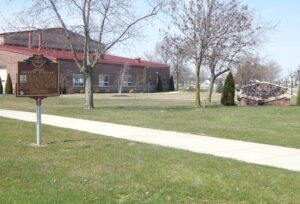
George Washington Crile was born in 1864 at Chili, in Crawford Township, Coshocton County. Before embarking on his notable medical career, he graduated from Northwestern Ohio Normal School (now Ohio Northern University) at Ada, teaching for two years before becoming principal at Plainfield School. Crile first studied medicine under village physician Dr. A.E. Walker, who loaned him medical books and took him on calls to visit rural patients. Later in life Crile credited his early experience in education in Plainfield as one of the most influential points in his career. (continued on other side)
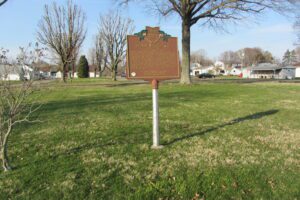
A. B. Graham, superintendent of Springfield Township Rural schools in Clark County, established the Boys and Girls Agricultural Experiment Club, which revolutionized agricultural education and non-formal youth development methods. The first meeting of the club, said to be the nation’s first farm club for young people, was held at this site on January 15, 1902 in the basement of the Clark County Courthouse. This was the start of what would be called a 4-H Club a few years later. Through the years, the overall objective of A.B. Graham and 4-H has remained the same: the development of youth as individuals and as responsible and productive citizens.
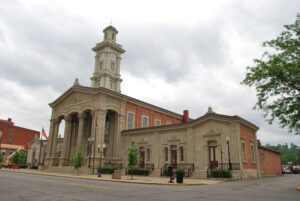
Ross County’s first courthouse was Ohio’s first statehouse. The courthouse was erected on the Public Square in 1801. Thomas Worthington, one of the building’s superintendents, laid out the foundation. Chillicothe was the last capital of the Northwest Territory, and the final session of the territorial legislature met in the courthouse in 1801. Ohio’s first constitution was written here in 1802. On March 1, 1803, Ohio’s first General Assembly convened in the building, making it the statehouse. During a time of strained relations between Native Americans and settlers in Ohio, the great Shawnee leader Tecumseh delivered a speech here in 1807 to reassure citizens that the Indians would remain peaceful. The courthouse served as the statehouse from 1803 to 1810 and from 1812 to 1816. The building was razed in 1852 to make way for the present courthouse.
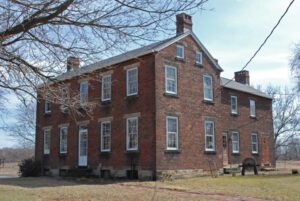
Maple-Dell was the home of John Butler, a Quaker who expressed his religious faith by working for humanitarian causes. An early Goshen Township teacher, Butler opened his home to orphans, the homeless, and runaway slaves, and devoted 20 years of his life to support the Freedman’s Camps for former slaves. One of the many individuals he sheltered was Edwin Coppock who was hung along with abolitionist, John Brown, after the raid on Harper’s Ferry in 1859. Butler met with President Lincoln and Secretary of War, Edwin Stanton in 1862 to request exemption from military service for Quakers during the Civil War. In 1868, President Grant petitioned the churches to assist in organizing a peace policy for the Indians. Butler prepared and presented to Congress a proposal for treating the Indians humanely including providing them with scientific and industrial education.
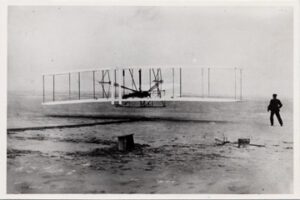
In 1899, Wilbur and Orville Wright of Dayton built a kite to test a revolutionary flight control system, and in 1900, built their first airplane (glider). With promising results, the Wrights built man-carrying gliders and airplanes to refine their ideas. Wind tunnel experiments led to accurate calculations of lift and drag. In 1903 in Kitty Hawk, North Carolina, they made the first sustained, controlled, powered flight in history, lasting 12 seconds. By 1905, the Wright brothers had developed the first practical airplane and the skills to pilot it. The U.S. Army Signal Corps purchased a Wright flyer, the first practical military aircraft, in 1909. Through public demonstrations beginning in 1908, the Wright brothers showed the world the future of aviation.
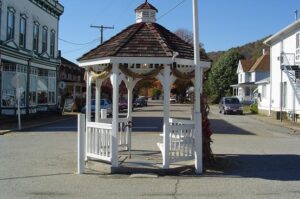
Monroe County’s ground-water resources are valuable assets for its people and economy. Especially notable are the substantial quantities of water that can be obtained in the medium sand and gravel underground aquifers located on the eastern side of the county. The Sardis Town Pump, which taps into one of these aquifers, has been in continuous operation since the nineteenth century and has played an important role in the daily life of Sardis residents. At approximately 78 feet deep, it was originally operated with a hand pump and converted to electricity in 1951. It is the drinking choice for many in the community and throughout Monroe County. It is the last of four known public wells that have served the village of Sardis.
Frances Rappaport Horwich was born in Ottawa on July 16, 1907, the daughter of Sam Rappaport, an Austrian immigrant who operated a general store, and Rosa Gratz Rappaport, a Russian immigrant. The youngest of six children, she attended the Ottawa elementary school and graduated from Ottawa High School in 1924. After high school, she attended the University of Chicago where she earned a bachelor’s degree in philosophy and taught first grade for three years. “Miss Frances,” as she was called, then earned a master’s degree from Columbia University in 1933 and a Ph.D. in 1942 from Northwestern University. From 1942 to 1952, she was involved in teaching and education development. The basic education she received in the Ottawa schools enabled her to achieve great skills and abilities. [continued on other side]