

, OH
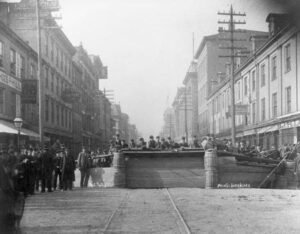
In March 1884, public confidence of Cincinnati law enforcement was extremely low. The public believed that murderers and other serious offenders were not brought to justice promptly or received little punishment. Civil unrest was brought to a boil when a seventeen-year-old was sentenced to only twenty years for manslaughter after brutally murdering his employer. On March 28, thousands of citizens stormed the county jail and courthouse. The riots lasted three days requiring forces from the Sheriff’s Office, city police, and local and state militia to restore order. Fifty-four people were killed and more than 200 wounded. The courthouse and jail suffered enormous damage, and valuable records were destroyed from the assault and fire. The riot gained international notoriety and helped pave the way for removal of political favoritism and a larger police force.
, OH
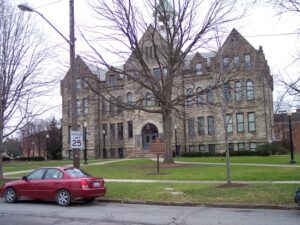
On this site the Lyceum Village and the Berea Seminary were established in 1837 by John Baldwin, James Gilruth, Henry O. Sheldon, and Josiah Holbrook. Their vision was to create the first in a connected series of Lyceum Villages. The Villages were designed especially to assist in the education of teachers, promote “scientific” exchanges over the world and thus encourage the study of the works and word of God, and cultivate the spirit of “peace on earth and good will to men.” The community, however, declined and in 1842, John Baldwin assumed the indebtedness of $15,000. James Wallace acquired the area. It was owned by the Methodist Children’s Home in the 1860s and then sold to German Wallace College in 1866, becoming the original German Wallace College campus.
, OH
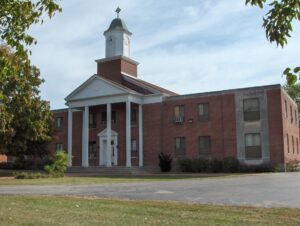
Payne Theological Seminary was originally established as Union Seminary in West Jefferson, Ohio, by the Ohio Conference of the African Methodist Church (AME) on October 18, 1844. The Cincinnati Conference of the Methodist Episcopal Church North met to establish a school for people of African descent, and in 1856, purchased Tawawa Springs, a defunct health resort, to open Wilberforce University, named for the early nineteenth century British abolitionist, William Wilberforce. In 1862 the institution closed due to low enrollment and dwindling funds. AME Bishop Daniel Alexander Payne purchased the school for $10,000, and the school was reopened in 1863 by closing the Union Seminary and merging the assets. In 1895, the department of theology separated from Wilberforce University and became Payne Theological Seminary, named in honor of Bishop Payne. Payne is the oldest, free standing African American Seminary in the United States.
, OH
The Peoples Bank Theatre, built in 1919 and called the Hippodrome, marks an age when movies transitioned from silent films and nickelodeons into a major national industry and pastime. Designed by Columbus architect Fred Elliott for the C&M (Cambridge and Marietta) Amusement Company, the theatre featured a granite archway, 1,200 seats, a 35-by-55-foot stage, an orchestra pit, and the first air conditioning of its kind in Marietta. The Hippodrome opened May 9, 1919 with the silent film Daddy Long Legs, starring Mary Pickford. Shea Theatres of New York bought the Hippodrome and remodeled it in 1949, replacing the Hippodrome’s distinctive stone archway with a two-story southern colonial-style facade. Renamed the “Colony,” it opened June 25, 1949, showing the Esther Williams’ musical Neptune’s Daughter. (Continued on other side)
, OH
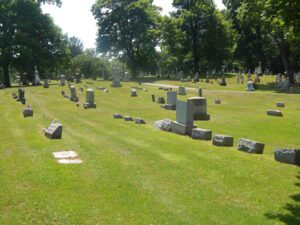
For more than two centuries, this burial ground has been a final resting place for those individuals whose lives represented the community history of Canfield. The earliest existing tombstone marks the death of Huldah Tanner in 1803. Seven earlier deaths in Canfield Township are recorded from 1798 to 1803, but the gravesites are unknown. Elijah and Rhoda Hopkins Wadsworth formally deeded the cemetery to the citizens of Canfield in 1810 with a first edition of land donated by Matthew B. Whittlesey in 1811. In 1862-1863, the graveyard was again enlarged. For seventy years the cemetery and fencing were maintained on a volunteer basis. When the Village of Canfield was incorporated in 1869, the care and management was vested in a board of trustees. (continued on other side)
, OH
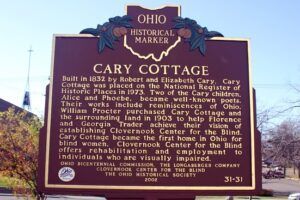
Built in 1832 by Robert and Elizabeth Cary, Cary Cottage was placed on the National Register of Historic Places in 1973. Two of the Cary children, Alice and Phoebe, became well-known poets. Their works include reminiscences of Ohio. William Procter purchased Cary Cottage and the surrounding land in 1903 to help Florence and Georgia Trader achieve their vision of establishing Clovernook Center for the Blind. Cary Cottage became the first home in Ohio for blind women. Clovernook Center for the Blind offers rehabilitation and employment to individuals who are visually impaired.
, OH
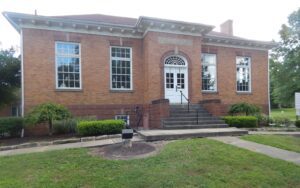
In 1912, an endowment of $6,000 from Andrew Carnegie made it possible for the Bristol Public Library to become a reality. Four years earlier, the newly organized Bristol Library Association, headed and promoted by retired Judge Norman A. Gilbert, had established a subscription book service at the Congregational Church in Bristolville with books loaned from the state library. The Bristol Board of Education appointed a six-member Library Board of Trustees and a one mill levy provided financial support. Charles C. Thayer and Son designed the building in accordance with Carnegie’s recommendations and the local trustees’ suggestions. With Judge Gilbert’s unexpected death in November 1911, Board Secretary Dr. Edward Brinkerhoff was elected president to complete the vision of Judge N. A. and Mrs. Anna Gilbert for the library. (Continued on other side)
, OH
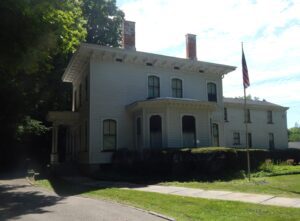
Niles’ industrialist James Ward, Sr. built the house that shares his family’s name in 1862. The house has a low-pitched roof, wide, bracketed eaves, and rounded window and door openings, all characteristics of the Italianate style. John R. Thomas, another industrialist, acquired the house in 1887. His daughter Mary Ann Waddell, wife of Jacob Waddell, lived there until 1969. In 1978, the Thomas family deeded the property to the city of Niles and it became the home of the Niles Historical Society. The house was listed on the National Register of Historic Places in 1984.