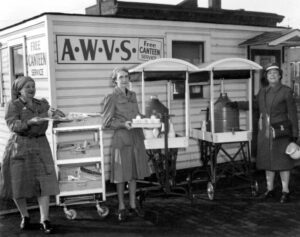
The Lima Chapter of the American Women’s Voluntary Services Organization established a community-based, free canteen during World War II for troops traveling on the Pennsylvania Railroad and adjacent Baltimore & Ohio-Nickel Plate Railroads. Meeting as many as forty trains a day, the ladies served 2.5 million troops between 1942-1945. Food, coffee, and other items were donated to the canteen from a twelve county area. The “AWVS” disbanded in 1945, but succeeding volunteers continued to provide service throughout the Korean Conflict and Viet Nam War. Lima’s “Servicemen’s Free Canteen” was the longest, continuously operated service canteen in the United States. An estimated four million soldiers, sailors, and marines were served between 1942-1970.
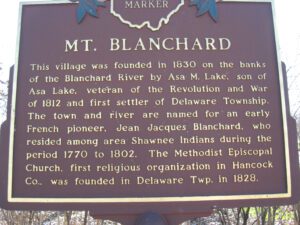
This village was founded in 1830 on the banks of the Blanchard River by Asa M. Lake, son of Asa Lake, veteran of the Revolution and War of 1812 and first settler of Delaware Township. The town and river are named for an early French pioneer, Jean Jacques Blanchard, who resided among area Shawnee Indians during the period 1770 to 1802. The Methodist Episcopal Church, first religious organization in Hancock Co., was founded in Delaware Twp. in 1828.
Born on September 28, 1769 in New Bedford, Massachusetts, Bathsheba Rouse is recognized as the first woman to teach in the Northwest Territory. Rouse arrived in the region along with other pioneers in 1788. The following year, the Belpre community employed Rouse to teach young children in the Farmers’ Castle near the Ohio River. Instruction in reading, writing, and sewing was reserved for the girls, while boys received lessons in reading, writing, and arithmetic. Rouse taught in Belpre for several terms before marrying Richard Greene and settling at nearby Marietta. Their descendants attained civic prominence in Washington County for generations. Bathsheba Rouse Greene died on February 27, 1843 at the age of seventy-three and is buried alongside her husband in Marietta’s Mound Cemetery.
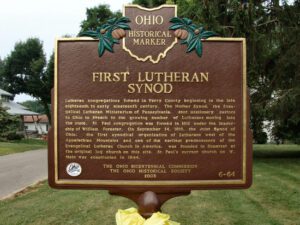
Lutheran congregations formed in Perry County beginning in the late eighteenth to early nineteenth century. The Mother Synod, the Evangelical Lutheran Ministerium of Pennsylvania, sent missionary pastors to Ohio to preach to the growing number of Lutherans moving into the state. St. Paul congregation was formed in 1812 under the leadership of William Forester. On September 14, 1818, the Joint Synod of Ohio, the first synodical organization of Lutherans west of the Appalachian Mountains and one of the earliest predecessors of the Evangelical Lutheran Church in America, was founded in Somerset at the original log church on this site. St. Paul’s current church on W. Main was constructed in 1844.
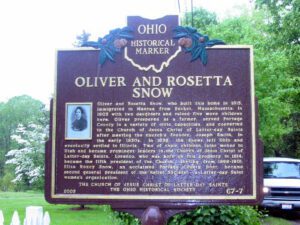
Oliver and Rosetta Snow, who built this home in 1815, immigrated to Mantua from Becket, Massachusetts, in 1805 with two daughters and raised five more children here. Oliver prospered as a farmer, served Portage County in a variety of civic capacities, and converted to the Church of Jesus Christ of Latter-day Saints after meeting the church’s founder, Joseph Smith, in the early 1830s. In 1838, the Snows left Ohio and eventually settled in Illinois. Two of their children later moved to Utah and became prominent leaders in the Church of Jesus Christ of Latter-day Saints. Lorenzo, who was born on this property in 1814, became the fifth president of the Church, serving from 1898-1901. Eliza Roxcy Snow, an acclaimed Portage County poet, became second general president of the Relief Society, a Latter-day Saint women’s organization.
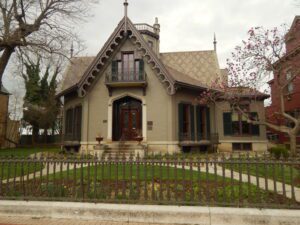
James Elrick, a local carpenter, built the Lane-Hooven House in 1863 for Clark Lane (1823-1907), a Hamilton industrialist and philanthropist. Lane, who first came to the area at age twenty-one as a blacksmith, resided in the house for more than eleven years. In 1866, Lane built the library, also originally an octagon, across the street. In 1868, he conveyed the library to the city. The C. Earl Hooven family resided in the house from 1895 to 1942. In 1943, Bertrand Kahn purchased the residence and presented it to the community for civic and charitable uses. It was donated as a memorial to his father, Lazard Kahn, a Hamilton industrialist and civic leader. The Lane-Hooven House was added to the National Register of Historic Places in 1973. (Continued on other side)
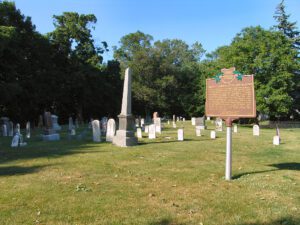
Israel Harrington (1779-1841) established a tavern at Lower Sandusky (now Fremont) shortly after the War of 1812. As a judge and land speculator, Harrington influenced the organization of much of northwestern Ohio. In 1824 he traded the tavern for land a short distance from this site, where an Indian trail crossed the Portage River. Elmore grew from this settlement. Harrington and his father (also Israel Harrington, a veteran of the American Revolution) are interred here, along with many of the pioneers who transformed this section of the Black Swamp into productive farmland.
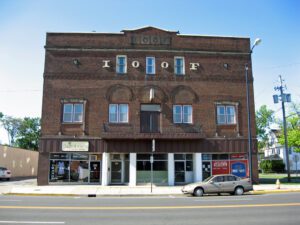
The Independent Order of Odd Fellows (IOOF), a world-wide fraternal organization, was introduced to the United States from England in 1819 and was established in Ohio in 1830. Mahoning Lodge #29 in Warren, Ohio, received its jurisdictional charter on May 21, 1844, and is currently the oldest active lodge in northeast Ohio. The lodge was originally located at the southwest corner of Park Avenue and Market Street, but was subsequently moved several times within the city. The present Odd Fellows Temple was dedicated in 1925. Friendship, Love, and Truth. Erected May 21, 1994, in commemoration of the 150th anniversary of Mahoning Lodge #29 in Warren, Ohio