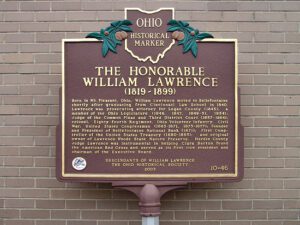
Born in Mt. Pleasant, Ohio, William Lawrence moved to Bellefontaine shortly after graduating from Cincinnati Law School in 1840. Lawrence was prosecuting attorney for Logan County (1845); a member of the Ohio Legislature (1846, 1847, 1849-51, 1854); Judge of the Common Pleas and Third District Court (1857-1864); colonel, Eighty-fourth Regiment, Ohio Volunteer Infantry, Civil War; United States Congressman (1865-1871, 1873-1877); Founder and President of Bellefontaine National Bank (1871); First Comptroller of the United States Treasury (1880-1885); and original owner of Lawrence Woods State Nature Preserve, Hardin County. Judge Lawrence was instrumental in helping Clara Barton found the American Red Cross and served as its first vice president and chairman of the Executive Board.
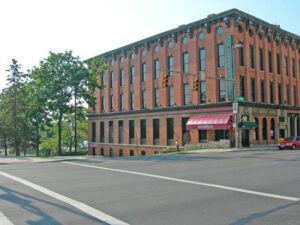
This pioneer village, which was united with its downriver rival, Vistula, to be incorporated as Toledo in 1837, was platted by Cincinnati businessmen in 1817. The “Panic” of 1819 caused the enterprise to default. The village was re-platted in 1832. A two-story log warehouse along Swan Creek was the first important structure. The village was named for Captain James Lawrence, War of 1812 naval hero.
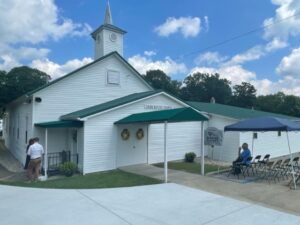
Union Baptist Church, established in 1819, is one of Ohio’s early Black churches. Its pastor and members were active on the Underground Railroad from that early date. Between the 1840s-1860s Black churches along the route to and from nearby Poke Patch assisted over 200 escaped slaves. Members met in their homes until able to obtain a log cabin (circa 1879) on a Blackfork farm. In 1919, a larger church was built on land given by The Cambria Clay Products Company. The adjacent cemetery has over fifty veterans from the Civil, Spanish American, both World, Korean, and Vietnam wars. Donald Russell Long, laid to rest in 1966, received a posthumous Congressional Medal of Honor. Union Baptist Church, the historic foundation of the Poke Patch-Blackfork community, celebrates an annual Church Anniversary to honor its legacy.
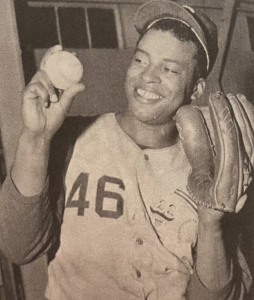
Ulysses Brooks Lawrence was born in Springfield on January 30, 1925. Nicknamed “The Bull,” he broke numerous color barriers throughout his baseball career. In 1976, Lawrence was the first Black player inducted into the Cincinnati Reds Hall of Fame. An all-around athlete at Springfield High School, Lawrence lettered in basketball, track, and football (the school’s first Black starting quarterback). After graduation in 1943, he was drafted into the U.S. Army and earned a Bronze Star in Guam during World War II. Lawrence enrolled at Ohio’s Miami University, becoming that school’s first Black baseball player (1947-1949), before signing with the Cleveland Indians. Acquired by the St. Louis Cardinals (1954), he was assigned to the Columbus Red Birds Triple-A farm team, breaking another team’s color barrier. (Continued on other side)
907 Scioto Street-Marker was inadvertently numbered 11-14 instead of 14-11
Urbana
, OH
Robert L. Eichelberger was born in Urbana on March 9, 1886, the youngest of the five children of George Maley Eichelberger, an Urbana lawyer, and Emma (Ring) Eichelberger. After graduating from Urbana High School in 1903, he attended Ohio State University and then was appointed to the United States Military Academy at West Point. Graduating in 1909, he was appointed a second lieutenant of infantry. Four years later he married Emma Gudger, daughter of Judge H. A. Gudger of Asheville, North Carolina. For several years, he saw service in Panama and the Mexican border before joining the American Expeditionary Forces in Siberia. From 1918 to 1920 Major Eichelberger observed the Japanese incursion into Siberia and became aware of Japanese methods. In 1940 he was appointed Superintendent of the Military Academy at West Point where he established regular courses to include flight training for Flying Army Officers. [continued on other side]
Henry Kelsey Devereux was born into an aristocratic family on October 10, 1859 in Cleveland, Ohio. Ohio artist, Archibald Willard, chose Harry, as he was fondly known, to portray the drummer boy in one of America’s most famous patriotic paintings, “The Spirit of ’76”. At the time Willard approached him to pose, young Harry was a cadet at Brooks Military Academy. He married socialite Mildred French in 1885 and in 1910 they settled in her father’s pretentious country estate in Wickliffe, Ohio (presently Telshe Yeshiva College). His passion for harness racing and for breeding horses culminated in the organization of the American Association of Trotting Horse Breeders and his position as president of the Grand Circuit. The affluent and charitable Wickliffe resident died in 1932 at the age of 72.
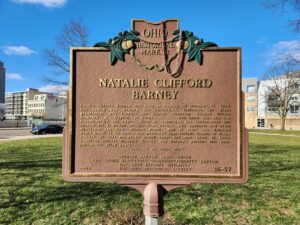
Natalie Clifford Barney was born in Dayton on October 31, 1876. Her family was wealthy and industrious, including her great grandfather who founded the Dayton Academy, Cooper Female Seminary, and Dayton Car Works. Natalie, who knew that she was a lesbian by age twelve, lived an outspoken and independent life unusual for a woman of this time period. Her openness and pride about her sexuality, without shame, was at least one hundred years ahead of its time. She published Some Portrait-Sonnets of Women, a book of love poems to women under her own name in 1900. American painter Romaine Brooks was Barney’s partner and companion for fifty years. (continued on other side)
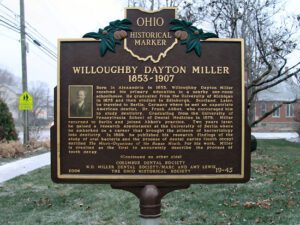
Born in Alexandria in 1853, Willoughby Dayton Miller received his primary education in a nearby one-room schoolhouse. He graduated from the University of Michigan in 1875 and then studied in Edinburgh, Scotland. Later, he traveled to Berlin, Germany where he met an expatriate American dentist, Dr. Frank Abbot, who encouraged him to study dentistry. Graduating from the University of Pennsylvania School of Dental Medicine in 1879, Miller returned to Berlin and joined Abbot’s practice. Two years later, he gained a research appointment at the University of Berlin where he embarked on a career that brought the science of bacteriology into dentistry. In 1889, he published his research findings of the study of oral bacteria and the process of dental caries (tooth decay) entitled The Micro-Organisms of the Human Mouth. For his work, Miller is credited as the first to accurately describe the process of tooth decay. (Continued on other side)