

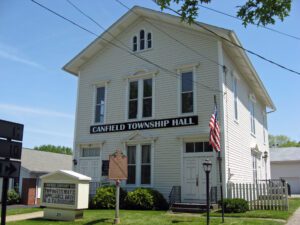
, OH
The Canfield Township Hall was erected in 1884. It served as the first public building in which the Canfield citizens could conduct town business, elections, and public meetings. An example of Renaissance Revival or “Italianate” architecture, the building is typical of late Victorian commercial buildings, but constructed of wood rather than of the customary brick. Drafted by Colonel S. Kinney, it was originally constructed for the sum of $2,389 by G.W. Strock at the corner of South Broad and East Main streets, on a lot purchased for $500. In 1936, R.J. Neff moved the hall several hundred feet south to its present location. In addition to official township meetings, the second floor has been used for a variety of activities, including social meetings, lectures, contests, dances, and roller-skating. The building served as an early home of the Canfield Historical Society and operated continuously for over one hundred and twenty-five years.
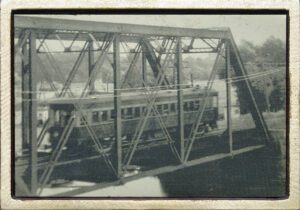
, OH
At this site the Lake Shore Electric Railway crossed a bridge that spanned the Vermilion River. The western abutment of the former bridge is plainly visible just below along the river bank. Widely known as the “Greatest Electric Railway in the United States,” the flaming orange trolley cars of the Lake Shore Electric Railway transported people and freight for thirty-seven years (1901-1938) along the southern Lake Erie shores from Cleveland to Toledo often reaching speeds of sixty miles per hour. The interurban line played a primary role in the development of the western Cleveland suburbs and also carried throngs of summer visitors to Lake Erie recreation facilities at Avon Beach Park, Linwood Park, Crystal Beach, Mitiwanga, Ruggles Grove, Rye Beach, and Cedar Point. The power lines still standing along the system’s right-of-way attest to the fact that it also assisted in bringing electric power to the entire region.
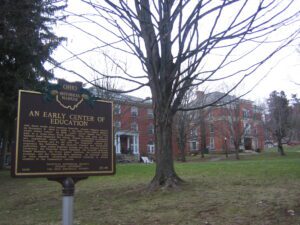
, OH
Just three weeks after reaching Granville, pioneer villagers decided on December 9, 1805 to build a log cabin where eighty children would attend school. By 1820, public school classes were being held in a three-story brick building. When rail lines and the National Road bypassed the village, dreams of becoming an industrial and commercial center were dashed. Educational institutions, however, thrived and by the Civil War Granville’s citizens had organized the following: the Granville Literary and Theological Institution, later called Granville College and then renamed Denison University; the Granville Female Seminary, the Granville Episcopal Female Seminary, the Young Ladies’ Institute, the Granville Female Academy, and the Granville Male Academy. As Granville enters its third century, educational excellence continues to attract students to the community’s schools.
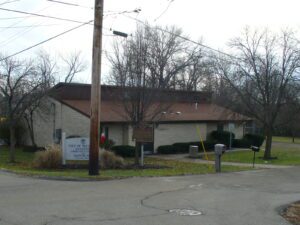
, OH
Civic organizations played pivotal roles in the development of the residential community of Hazelwood, founded as a subdivision of Blue Ash in 1888. The Hazelwood Civic Association, initially established as the Brothers Civic Society in 1941, addressed community needs by working for public improvements and promoting civic relations through social events and educational programs. Efforts by the HCA led to the construction of a new civic center and the introduction of the Boy and Girl Scouts and other programs that were previously unavailable to African-American children. Hazelwood’s deterioration and the threat of encroaching industrial development led to the formation of the Hazelwood Improvement Corporation in 1968. The HIC, acting as an agent of the city of Blue Ash, helped to upgrade housing, pave roads, build new homes to ensure a residential nature, install water and sewage systems, and erect streetlights. In 1997, the Hazelwood Community Association was organized to assist residents during Hazelwood’s transition to a racially integrated community.
, OH
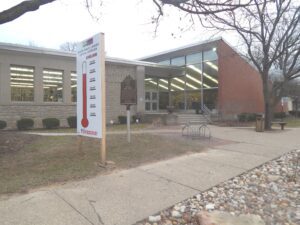
The American Sheet and Tin Plate Company founded the first Dover Public Library for the benefit of its employees at the corner of Front Street and Factory Street in 1902. Five years later, the library moved to a residence on Cherry and Fifth Streets. In 1916 the city dismantled “the old Downey residence” and built a high school in its place, with the public library occupying the basement. In 1934, the library moved to a converted residence at 417 North Walnut Street. Over time, however, the building became inadequate to house this beloved institution. In 1953 the city of Dover passed a bond issue to build a new library for the community. The new building, located at this site, opened in 1955.
, OH
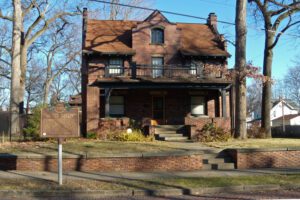
Akron, an industrial boomtown in the early twentieth century, grew in population nearly fivefold between 1900 and 1920. As the city industrialized, middle class residents sought homes on West Hill, away from the smoke and soot of heavy industry on the East Side. The Hall Park Allotment Historic District in West Hill represents a notable early twentieth century neighborhood. Developed by Philander Hall between 1902 and 1919 during the height of Akron’s “rubber boom,” it consists of several houses representing the picturesque styles of the period, including the American Foursquare, Craftsman, Colonial, and Medieval Revival Styles. With its gently curving brick streets, hilly topography, and mature trees, the Hall Park Allotment Historic District evokes the feeling of a distinct period of time in Akron’s history and constitutes a neighborhood of distinctive historical character and architectural merit.
, OH
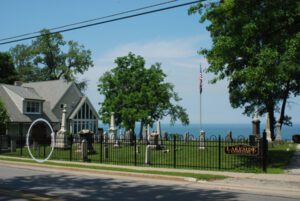
Laid out in 1814, Lakeside Cemetery became the first public burying ground in Dover Township, an area that now includes Bay Village, Westlake, and the northern portion of North Olmsted. Reuben Osborn (1778-1860) arrived in Dover on October 10, 1810, but returned to New York. He settled on this land with his wife Sarah Johnson Osborn (1779-1856) and family in 1811, later purchasing most of the plot where the cemetery would be established from Philo Taylor. Sarah’s sister, Rebecca Porter, and her infant son were the first to be buried here; they were killed when their boat capsized at the mouth of the Rocky River in 1814. Including land purchased in 1877, the cemetery currently spans half an acre. Although not recorded until 1879, there are over 270 known burials. Among those interned here are veterans from the Revolutionary War, the War of 1812, the Civil War, the Spanish-American War, and World War I.
, OH
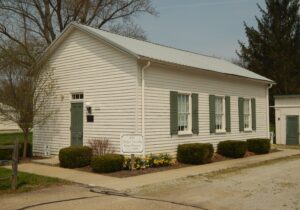
On April 20, 1857, the trustees of Morgan Township met in Okeana to obtain a lot for the township house. From a quarter mill tax levy, $850 was budgeted for a house and lot. Money expended on the project included $50 for the lot, $650 for the construction of the building, $41 for fencing, $12.60 for twelve chairs, and $10.25 for a table. Since its completion in 1858, this meeting house has been used for trustee meetings, a voting precinct, village singing schools and concerts, public school, bank, and township garage. The trustees moved to a new building across the street in 1972 and into their Chapel Road complex in 2000.