

, OH
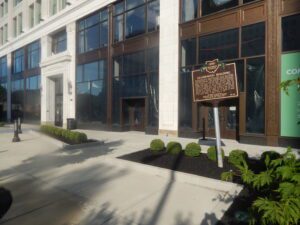
Steel-frame skyscrapers and retail buildings replaced wood-frame residences as the downtown evolved into a commercial district. A small public library branch occupied the north side of the square from 1923 to 1954. The Keith-Albee Theater (later the Palace) in the northeast corner of the square from 1926 to 1964, featured vaudeville performances and movies. Streetcar tracks around the square were removed for scrap during World War II. With expansion of suburban shopping malls, downtown theaters and department stores gradually closed. In 1973-74 Central Square was converted to a pedestrian Federal Plaza by closing off traffic on Federal Street one block east and west of Market Street. Central Square reopened in 2004 with a new traffic pattern, planting beds, and street furniture. Marker for “Central Square (1798-1899)” across the street.
, OH
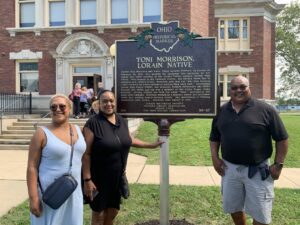
Author Toni Morrison was born, Chloe Ardelia Wofford, in Lorain on February 18, 1931. Her passion for language was nurtured by her family and while working at the Lorain Public Library during high school. Then housed in the Carnegie Center, the library hired her to reshelve and catalog books. Morrison said that she “was slow because I kept reading the books instead of putting them back fast.” Graduating Lorain High School (1949), she attended Howard University (BA 1953), Cornell (MA 1955), and she was a member of the Alpha Kappa Alpha sorority. During college she took the name “Toni,” shortening her saint name Anthony. Morrison worked as a literary editor and professor while also writing award-winning novels. She maintained a lifelong connection with Lorain. Morrison died August 5, 2019.
, OH
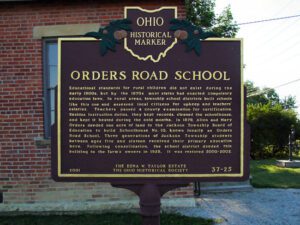
Educational standards for rural children did not exist during the early 1800s, but by the 1870s most states had enacted compulsory education laws. In rural areas, township school districts built schools like this one and assessed local citizens for upkeep and teacher’s salaries. Teachers passed a county examination for certification. Besides instruction duties, they kept records, cleaned the schoolhouse, and kept it heated during the cold months. In 1879, Allen and Mary Orders deeded one acre of land to the Jackson Township Board of Education to build Schoolhouse No. 10, known locally as Orders Road School. Three generations of Jackson Township students between ages five and sixteen received their primary education here. Following consolidation, the school district deeded this building to the farm’s owners in 1928. It was restored in 2000-2002.
, OH
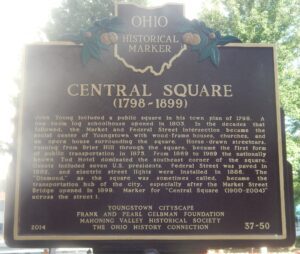
John Young included a public square in his town plan of 1798. A one-room log schoolhouse opened in 1803. In the decades that followed, the Market and Federal Street intersection became the social center of Youngstown with wood-frame houses, churches, and an opera house surrounding the square. Horse-drawn streetcars, running from Brier Hill through the square, became the first form of public transportation in 1875. From 1869 to 1969 the nationally known Tod Hotel dominated the southeast corner of the square. Guests included seven U.S. presidents. Federal Street was paved in 1882, and electric street lights were installed in 1886. The “Diamond,” as the square was sometimes called, became the transportation hub of the city, especially after the Market Street Bridge opened in 1899. Marker for “Central Square (1900-2004)” across the street.
, OH
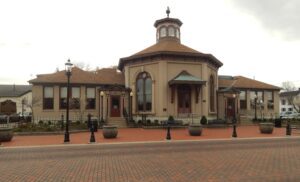
Clark Lane (1823-1907), industrialist and philanthropist, was a son of John Lane (1793-1880) and Rosanah Crum (1795-1877). John came with his family to the Ohio Country when it was still part of the Northwest Territory. As a young man, Clark worked in his family’s blacksmith shop, and eventually helped found Owens, Lane & Dyer Machine Company in 1854. It built agricultural machinery, sawmills, papermaking machines, and other products, initiating Hamilton’s prominence in metals manufacturing. Lane funded the Butler County Children’s Home, an orphanage for over a century, and constructed an octagon house as his residence on Third Street. He built this library in 1866, also as an octagon, and donated it to the people of Hamilton. A 19th century admirer wrote, “The name and generous deeds of Clark Lane will never fade from the memories of a grateful people who have been recipients of his favor.”
, OH
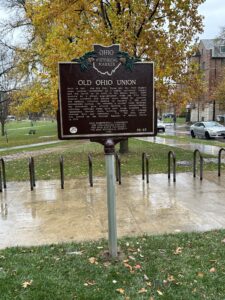
Built in 1910, the old Ohio Union was the first student union building constructed on a public university campus and the fourth to be built in the United States. Made possible by a direct appropriation from the 77th Ohio General Assembly and private funds raised by students, the building officially opened on January 11, 1911 with considerable fanfare. By erecting a student union building, the university gave official sanction to extracurricular activities. Although there have been seven additions, this Jacobethan Revival style building retains its original exterior form and character. The “Old Ohio Union” was placed on the National Register of Historic Places in 1979.
, OH
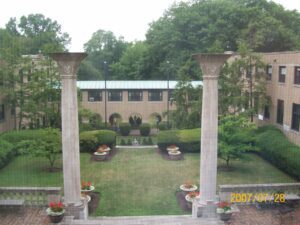
Elm Court, designed by Howard Van Doren Shaw of Illinois, was built in 1912 for Arthur Hudson Marks. The original mansion exemplifies the Italian Renaissance Revival style. Elm Court included the mansion, barn, stables, carriage house, pond, and a variety of trees, especially elms, on 33 acres. Arthur Marks was the inventive genius in chemistry and business who revolutionized the rubber industry in Akron. He was best known for inventing the alkaline-recovery vulcanization process in 1899, the cord tire, the chemical research laboratory system, and placing rubber research on a scientific basis. In World War I he served as director of chemical warfare services. Marks served as vice-president of B.F. Goodrich Company and Curtis Airplane and Engine Company and president of other rubber companies and the Aeolian Skinner Organ Company.
, OH
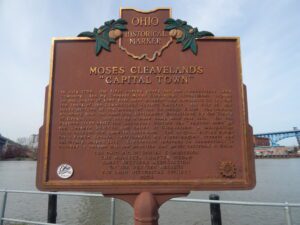
In July 1796, the first survey party for the Connecticut Land Company, led by General Moses Cleaveland (1754-1806), landed on the shore of Lake Erie near present-day Ashtabula to lay out the lands of the Connecticut Western Reserve. On July 22, the party arrived at the mouth of the Cuyahoga River, the western boundary line for American settlement established by the Treaty of Greenville, and set up a base camp near this site. On the eastern river bluff the surveyors platted the “capital town” of the Western Reserve and called it Cleaveland; a misspelling later changed the name to Cleveland. The original survey called for a Public Square, surrounded by right-angled streets and uniformly-shaped lots. Cleaveland returned to Connecticut in October to resume his law practice and never returned to Ohio.