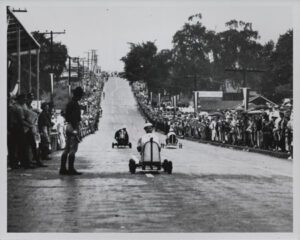
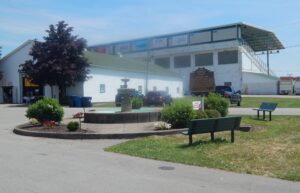
An annual summer tradition for American youth since the 1930s, the All-American Soap Box Derby was the concept of journalist Myron E. (“Scottie”) Scott, who covered an impromptu homebuilt gravity-car race in Dayton in 1933. Scott conceived and promoted a prize-awarding event later that year, and to his surprise 362 boys entered the race. Restrictions on material cost and participants’ ages widened the sport’s appeal; the Soap Box Derby held its first national championship in Akron in 1935, sponsored by the auto and rubber industries. Derby Downs, built as a public works project by the New Deal-era Works Progress Administration (WPA), has been the event’s home since 1936. The Soap Box Derby continues to promote the values of craftsmanship, sportsmanship, and perseverance for generations of American youth.
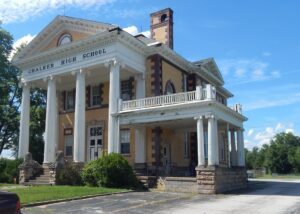
Southington native Newton Chalker built, furnished, and donated Chalker High School to his community in 1907. Chalker was born in 1842 in Southington Township and lived there until adulthood. He later built a prosperous law and real estate practice in Akron. Chalker’s dedication to improve educational opportunities in the township likely originated with his personal struggle to complete high school, which was repeatedly interrupted by financial concerns and family obligations. The Chalker High School building was designed in the Neo-Classical Revival architectural style which was favored for public buildings, churches and schools early in the twentieth century. The building exhibits Classical influences through the use of fluted columns that support a pedimented gable, resembling a Greek temple. Chalker High School and the Civil War Monument were listed in the National Register of Historic Places in 2010. (Continued on other side)
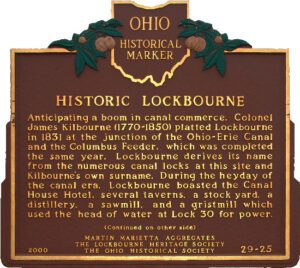
Anticipating a boom in canal commerce, Colonel James Kilbourne (1770-1850) platted Lockbourne in 1831 at the junction of the Ohio-Erie Canal and the Columbus Feeder, which was completed the same year. Lockbourne derives its name from the numerous canal locks at this site and Kilbourne’s own surname. During the heyday of the canal era, Lockbourne boasted the Canal House Hotel, several taverns, a stock yard, a distillery, a sawmill, and a gristmill which used the head of water at Lock 30 for power. (continued on other side)
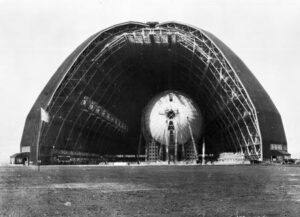
A colossus of engineering acumen and structural steel, the Airdock was built in 1929 as the construction facility for the U.S. Navy’s rigid airships, the USS Akron (1931) and USS Macon (1933). The airships, or dirigibles, served as the fleet’s aerial watchdogs, but with the advancement of aircraft carriers, the Navy no longer needed these leviathans of the skies, which were large enough to carry five biplanes. Eleven steel parabolic arches, cresting at 211 feet, create one of the largest open space interiors in the world and shelter more than 364,000 square feet of floor space. Only one of the arches is fixed to its concrete piling. Its 660-ton spherical doors rest on flatbed railroad cars to open. The Airdock, a National Civil Engineering Landmark, was added to the National Register of Historic Places in 1973.
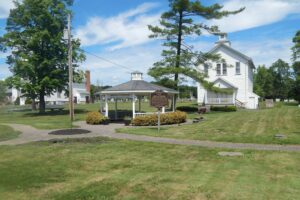
In 1846, the same year that Mahoning County was created, Ohio’s General Assembly passed an act “for the encouragement of agriculture.” An outgrowth of this legislation led to the founding of the Mahoning County Agricultural Society in April 1847. Boasting a membership of 170, the Society agreed to sponsor competitions for premiums to be distributed at an “annual fair and cattle show the next fall.” Canfield was the geographic center of the county and selected as the site for the first fair. In October, from the lawn of the First Congregational Church, Comptroller of the United State Treasury Elisha Whittlesey welcomed participants. Admission was one shilling (twelve and one half cents). The Village Green overflowed with exhibitions of prized livestock, harvests, plowing contests, and horse racing. Early fairs were one-day events attended primarily by gentlemen. However, the church provided a venue for ladies to display their handiwork. (continued on other side)
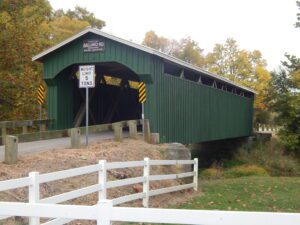
In 1883, James E. Brown built this seven-panel Howe truss bridge over the North Branch of Caesar Creek, near the site of Lyman Ballard’s grist mill and on the property of William C. Dean. At the time it was built, iron, concrete, and steel structures began to surpass the construction of wooden covered bridges. The construction of U.S. Route 35 severed the bridge from its original connection to the Dean property. In 1975, the bridge was added to the National Register of Historic Places. As of 2016, the Ballard Road bridge is one of six covered bridges in Greene County.
The Connecticut Land Company surveyed Vienna Township as Township 4, Range 2, in 1798. The Township’s proprietors were Ephraim Root, Uriel Holmes, Jr., and Timothy Burr. Survey members Dennis Clark Palmer, Isaac Flower, and Samuel Hutchins and their families were the first to settle here in 1799. Between 1810 and 1840, Vienna was a center for the wooden works clock industry in Trumbull County and the Connecticut Western Reserve, with six factories located amid farms, sawmills, and quarries. After coal was discovered in 1866, over twenty mines were opened, bringing boom times for two decades. Vienna’s miners helped to bring about Ohio’s first mining safety law in 1874. Vienna was the birthplace of abolitionist and attorney John Hutchins (1812-1891), who represented Trumbull and Ashtabula counties in the United States Congress (1859-1863) and raised troops during the Civil War.
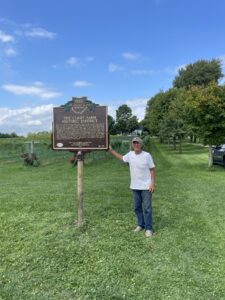
George Curry (1819-1885) was one of seven children born to a tenant sheepherder in the Cheviot Hills of Scotland. He immigrated to Ohio during the 1840s and married Scottish immigrant Agnes Milligan (1830-1893) in 1855. The couple moved to Licking County in 1865, and purchased 160-acres of farmland in 1873 to establish a sheep farm. They soon became known for their fine Spanish Merino herd. In the late nineteenth century, Ohio was a leader in the wool trade, with Licking County leading the state’s wool production by 1870. At the time of his death, George Curry was “a well-known stock dealer, and was greatly esteemed” in the community. Five generations of George and Agnes Curry’s family lived and farmed their Licking County land, until it was divided into parcels and sold in 1979.