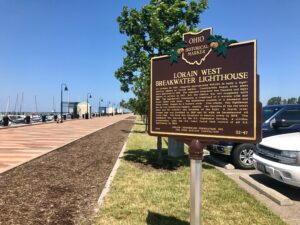
On October 22, 1913, Congress appropriated $35,000 to build a light-and-fog station at Lorain harbor. Construction began after plans were approved in 1916. The concrete structure was finished and light placed in service in 1917, but the station was not completed until 1919. The lighthouse’s foundation is comprised of a wooden crib and boxes filled with stone. The lighthouse consists of a basement and three floors, topped by a lantern room. Like others, this lighthouse had its own identifying signals, namely, the duration of the fog horn’s blast and the rotation and duration of the light. A fourth order Fresnel lens was installed in 1919 and lit with an incandescent oil vapor lamp. The lamp was converted to electric power in 1932. The lighthouse was manned by the U.S. Lighthouse Service, a civilian organization, until the U.S. Coast Guard took control of all U.S. lighthouses in 1939.
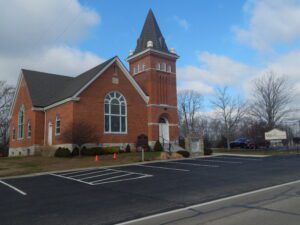
Slifers Presbyterian Church is on land deeded to the local faith community by Philip and Elizabeth Slifer on December 2, 1816. Rev. Thomas Winters of the German Reformed Church and Rev. John C. Dill of the Evangelical Lutheran Church ministered to people of German descent who settled in the area. During the “cold plague” (a malaria-like malady) of 1819, they ministered to the sick and grieving, renewing the faith of many. The community pooled their limited resources and began building their first log church in 1819. It was completed in 1825 and expanded later that year as the congregations grew. They erected their first brick church in 1858 for a cost of $500. Pastors conducted services for both Lutheran and Reformed congregations in German.
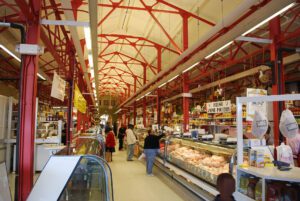
Ohio’s oldest surviving municipal market house, Findlay Market was designed under the direction of City Civil Engineer Alfred West Gilbert (1816-1900). It was listed on the National Register of Historic Places in 1972. The structure was among the first market houses in the United States to use iron frame construction technology. Originally an open pavilion, much of the market was erected in 1852, but disputes with contractors delayed its opening until 1855. The center masonry tower was built in 1902. Soon after, public health concerns prompted enclosure of the market stalls and the addition of plumbing and refrigeration. Until then, vendors found cool storage in deep cellars beneath nearby breweries. The tower bell was brought from Cincinnati’s Pearl Street Market in 1934. Findlay Market was renovated in 1973-74 and again in 2002-03.
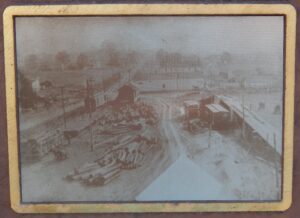
The earliest improved public road west from Lake Erie to the Indiana border, the Territorial-Indiana Road was built by the U.S. Government in 1834-1835 through the Cottonwood Swamp, then a major obstacle to travel. It ran parallel to the Harris Line, the northern boundary of a narrow strip of land contested by Ohio and Michigan from 1803 until 1836, when Ohio annexed it following the “Toledo War.” Completion of the 110-mile road gave farmers and settlers much improved access to markets and new western lands. It became the Indiana Plank Road in 1848 and later Sylvania-Metamora Road. The Toledo and Western Electric Railway’s parallel right-of-way was completed in 1902.
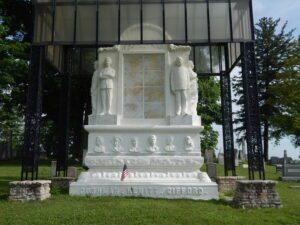
Warren Cushman was a respected painter, sculptor, photographer, musician, and inventor. He created the towering Cushman monument in Woodstock’s Rush Township cemetery and is believed to have shown his painting “Spanish Dancing Girls” at the 1893 World’s Columbian Exposition in Chicago. Warren was born to Franklin and Susan (Gifford) Cushman on January 17, 1845 in Woodstock and had three siblings, Julius, Charles and Lucy. (Continued on other side)
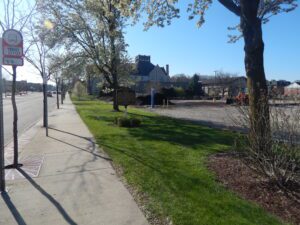
On May 1, 1950, the Akron Community Service Center and Urban League building opened to the public. The Center was a gathering place for African Americans of the community, where they addressed workplace, education, and other issues dividing the city. Directors included the late George W. Thompson, Raymond Brown, and Vernon L. Odom. The Center provided space for meetings, classes and receptions and had a swimming pool and gymnasium. The Center also hosted talent shows, which included the musicians who became Ruby and the Romantics. The group scored a #1 hit in 1963 with “Our Day Will Come.”
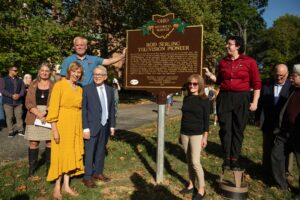
Rodman Edward Serling (1924-1975) enrolled at Antioch College in 1946 following military service in World War II. He began college as a physical education major, but soon discovered writing as a way of working through his war experiences. As a student, he contributed short fiction to The Antiochian literary magazine, managed the student-run Antioch Broadcasting System, and wrote and produced award-winning radio dramas. In July 1948, Serling married classmate Carolyn “Carol” Kramer. Shortly after earning his degree in 1950, he took a copy writer job at Cincinnati’s WLW radio. Serling quickly focused on selling scripts to national television networks. After eight years in Ohio, he and his wife moved to Connecticut. He returned to Antioch after the third season of The Twilight Zone to teach writing, drama, and media during the 1962-1963 academic year.
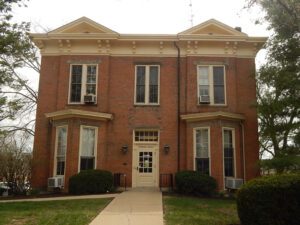
Built by “Old Miami” University President Robert L. Stanton, D.D. (1810-1885) as his private home and president’s office, Stanton’s 1868 Italianate house faced University Square, and welcomed students and guests. The house retains its original symmetrical façade, enclosed portal, grand staircase, double parlors, parlor doors, marbleized slate mantels, and triangular bay windows. Stanton served as president from 1866-1871. Stanton’s son, Robert Brewster Stanton, MU ’71, famed civil engineer, lived here as an undergraduate. His Miami mentor, mathematics professor Robert W. McFarland (1825-1910), purchased the house in 1873. McFarland rented it while distinguishing himself at Ohio State University during Miami’s twelve-year closure, and then resided here while first president of “New Miami” (1885-1888) and until his death. McFarland’s daughter Frances and her husband Llewellyn Bonham sold the home to Miami in 1940.