

, OH
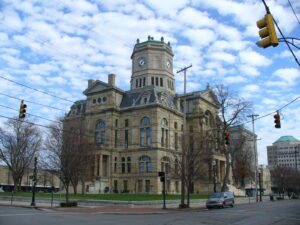
Butler County was created on March 24, 1803, about three weeks after Ohio became a state. Hamilton won the competition for the county seat, thanks to Israel Ludlow, Hamilton’s founder. Ludlow’s donation of the public square secured the county seat. The first Butler County trial court met in July 1803 in a tavern before moving to a two-story military building located at what had been Fort Hamilton (1791-1796). The county built the first courthouse on this public square in 1810. The two-story stone building contained a jail on the first floor and a courtroom on the upper level. A new brick two-story courthouse was built on this square in 1817 at a cost of $10,000. A four-sided clock was added to the top of the building in 1837. (continued on other side)
, OH
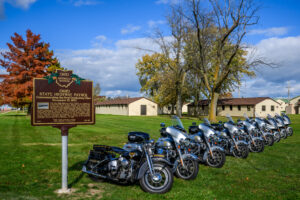
This location marks the site where the first Ohio State Highway Patrol cadet class graduated on November 15, 1933. Known as the Camp Perry School, Colonel Lynn Black opened the training on October 3, 1933, after House Bill 270 created the Division. Colonel Black received over 5,000 applications for the inaugural class, which was trimmed to approximately 125 individuals who formed the first training class. The Ohio National Guard graciously volunteered the use of this facility for the training. The newly formed Highway Patrol purchased 54 new motorcycles to be used for patrol duties. Many of the cadets had no prior experience operating motorcycles and had to be trained in short order. Cadets faced extreme adversity, including frigid temperatures and a lack of heating in the facilities. Severe weather shortened training for the cadets. The first class of 60 new Patrolmen graduated on November 15, 1933.
The Ohio State Highway Patrol’s core values are instilled into all new recruits and continually reinforced. They are the foundation upon which a trooper can be a consummate public servant; Adaptability, Attention to Detail, Diversity, Family, Honesty, Officer Safety, Performance Driven, Professionalism, Self-Discipline, Sense of Urgency and Team Oriented.
, OH
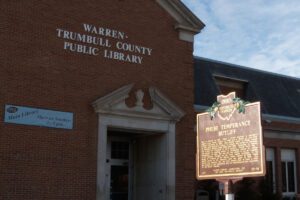
Born in Warren in 1859, Phebe T. Sutliff received a Bachelor’s degree from Vassar College in 1880 and a Master of Arts from Cornell University in 1890. Miss Sutliff taught at Hiram College in Ohio and Rockford College in Illinois and served as President of Rockford College from 1896 until 1901. Returning to Warren, she turned her attention to civic matters. During World War I, she started an evening school of citizenship classes for foreign immigrants. In 1924, she was the first woman to run for Congress in her district. Elected as the first woman president of the Board of Trustees of the Warren Public Library in 1938, Phebe Sutliff served in this capacity until her death in 1955. Miss Sutliff was inducted into the Ohio Women’s Hall of Fame in 1990. Her legacy to the community was the establishment and endowment of the Sutliff Museum.
, OH
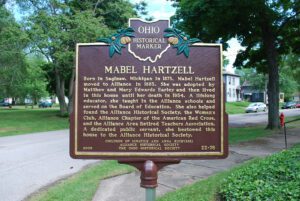
Born in Saginaw, Michigan in 1875, Mabel Hartzell moved to Alliance in 1883. She was adopted by Matthew and Mary Edwards Earley and then lived in this house until her death in 1954. A lifelong educator, she taught in the Alliance schools and served on the Board of Education. She also helped found the Alliance Historical Society, the Woman’s Club, Alliance Chapter of the American Red Cross, and the Alliance Area Retired Teachers Association. A dedicated public servant, she bestowed this house to the Alliance Historical Society.
, OH
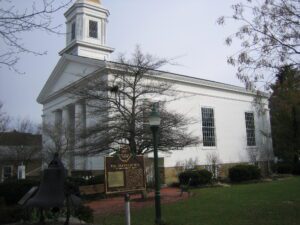
In 1804 a group of neighbors in Granville, Massachusetts and Granby, Connecticut formed The Licking Company for the purpose of moving to “Newlands” in Ohio. Inspired and informed by the settlement of Worthington in 1803, the Company purchased 29,040 acres in the U.S. Military District. Advance parties surveyed and mapped a site, established a mill, and planted grain. The Company planned a public square, a school, library, quarry, burying ground, and property for the support of churches. In November and December 1805, some 150 emigrants in ox-drawn wagons arrived in their new home and built temporary shelters on the designated public square. On December 9 through 12 1805, Company members selected their Granville lots in an auction that was described as peaceable and honest.
, OH
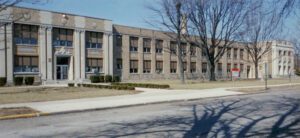
The North Baltimore Elementary and High School stood at 124 S. Second St. and was dedicated November 11, 1927. The tan and brown brick building replaced a school (built 1884) that a fire destroyed on January 26, 1926. The new school building, for children in grades 1-12, also included classrooms for home economics and business courses, as well as a 900-seat auditorium (including balcony), second floor cafeteria, gymnasium, administrative offices, and a public library. E.E. Leidy was the school’s superintendent and R. Vern Northup was the high school principal. The members of the board of education were Dr. E.A. Powell, President, D.B. Bushey, Vice President, C.G. Nigh, Clerk, and Nellie Roberts and R.E. Simon. Previously known as the “Independents,” the school’s sports teams became the “Tigers” in 1931. (Continued on other side)
, OH
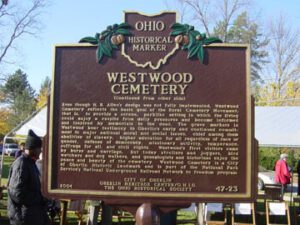
Shortly after Oberlin Colony was established in 1833, a two-acre burying ground was set aside south of Plum Creek in the area bounded by Main, Morgan, and Professor streets. By 1861, however, with the town and Oberlin College growing and the Civil War escalating, the need for a larger cemetery became clear. After an extensive search, 27.5 acres of land belonging to Henry Safford were acquired one mile west of the center of Oberlin. H.B. Allen was hired to create a design in the style of the Rural Cemetery Movement, and in July 1864 Westwood Cemetery was formally dedicated. Burials in Westwood had actually begun in August 1863, and over the next few years hundreds of remains were reinterred from Oberlin’s “Old Cemetery” and from burying grounds in surrounding communities. In the mid-1860s the cemetery was enlarged to its present 47 acres, and in 2004 burials and memorials were estimated to number almost ten thousand. (Continued on other side)
, OH
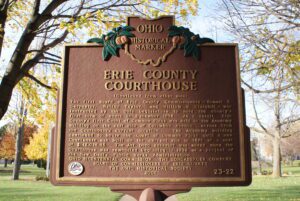
Jury of Erie County Women, First to be Impaneled Under Federal Suffrage proclaimed the headline of the Sandusky Register on August 28, 1920. One of the first female Court of Common Pleas juries in the nation was impaneled in Erie County on August 26, 1920, moments after the 19th amendment to the Constitution of the United States was declared ratified. On that date, Judge Roy Williams was to conduct a trial and jurors were needed. Out of the ten men he contacted, only one could serve. Frustrated, Judge Williams later told the women, “When I learned shortly after 10:30 this morning that suffrage had been proclaimed, I decided to impanel a woman jury. Twelve women were summoned. Twelve women served.” (continued on other side)