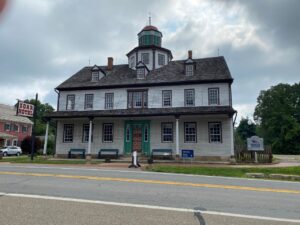
Zoar Separatists built the hotel in 1833 to accommodate overflow travelers from their original Ohio & Erie Canal inn. The hotel proved an economic boon to the Zoar community, but, by bringing the outside world into Zoar, ultimately became a source of discontent for members. During its heyday, the Zoar Hotel catered to curiosity-seekers, visiting artists, and families escaping the summer heat of nearby cities. Notable guests included Marcus Hanna and President William McKinley. The original structure was enlarged several times, including the now demolished 1892 Queen Anne addition which doubled the accommodations. By the mid-twentieth century, the hotel remained open as a popular restaurant with Rathskeller bar until closing to the public in July 1983. The exterior was restored by the Ohio History Connection in 2001-2002.
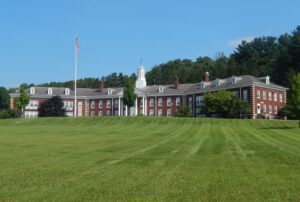
Tuberculosis, or TB, is a contagious disease that was responsible for the deaths of one out of every seven people in the U.S. in the early 20th century. The Licking County Tuberculosis Sanatorium, known as the TB San, was constructed in 1931-1932 at a cost of $250,000. The facility kept TB patients separate from the general population, controlling the spread of disease. The location provided patients with rest, fresh air, food, and exercise, the main treatments for TB in the 19th through mid-20th centuries. (Continued on other side)
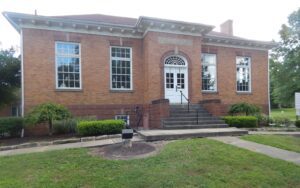
In 1912, an endowment of $6,000 from Andrew Carnegie made it possible for the Bristol Public Library to become a reality. Four years earlier, the newly organized Bristol Library Association, headed and promoted by retired Judge Norman A. Gilbert, had established a subscription book service at the Congregational Church in Bristolville with books loaned from the state library. The Bristol Board of Education appointed a six-member Library Board of Trustees and a one mill levy provided financial support. Charles C. Thayer and Son designed the building in accordance with Carnegie’s recommendations and the local trustees’ suggestions. With Judge Gilbert’s unexpected death in November 1911, Board Secretary Dr. Edward Brinkerhoff was elected president to complete the vision of Judge N. A. and Mrs. Anna Gilbert for the library. (Continued on other side)
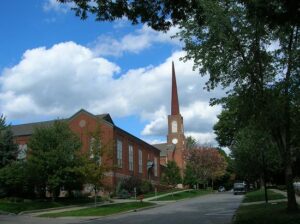
On this site, the first meetinghouse owned by the Hudson Congregational Church was dedicated March 1, 1820, twenty-one years after David Hudson first came to the Hudson area. Its members met here until they completed their sanctuary on Aurora Street in 1865. In August 1835, church members unanimously adopted a resolution declaring that slavery is”a direct violation of the law of Almighty God.” At a November 1837 prayer meeting, church member and anti-slavery leader John Brown made his first public vow to destroy slavery.
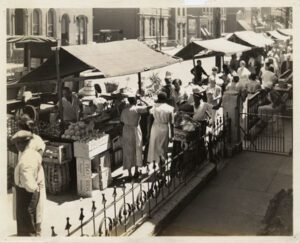
Public markets housing butchers, fish merchants, and produce vendors were once the primary source of perishable foods for residents of America’s cities. Cincinnati operated nine in 1859. Only Findlay Market, built here in 1852, survives. Cincinnati’s lost indoor markets include: Fifth Street Market: 1829 to 1870, Fifth between Vine and Walnut Wade Street Market: 1848 to 1898, corner of Wade and Bauer Avenue Canal Market: 1829 to 1864, Court between Vine and Walnut Court Street Market: 1864 to 1914, replaced Canal Market Jabez Elliott Flower Market: 1890 to 1950, Sixth between Elm and Plum Sixth Street Market: 1895 to 1960, Sixth between Plum and Western Row Pearl Street Market: 1901 to 1934, Market between Sycamore and Broadway
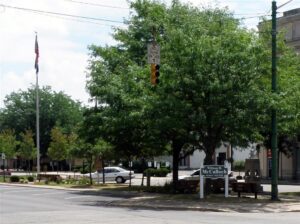
William McCulloch was born in Holmes County where he was educated in a one-room schoolhouse before moving to Wooster to attend high school and the College of Wooster. He attained prominence as Ohio’s Speaker of the House from 1939-1943 and House member from the Fourth Ohio Congressional District from 1948-1973. During his time in Washington, McCulloch was best known as a co-sponsor and staunch advocate of the Civil Rights Act of 1964. He was recognized by President Lyndon Johnson as the prime mover for passage of this landmark legislation. As a conservative Republican voice in the House, he was instrumental in championing other civil rights legislation, including fair housing and public accommodations. McCulloch was a founding partner in 1928 of the Piqua law firm that bears his name.
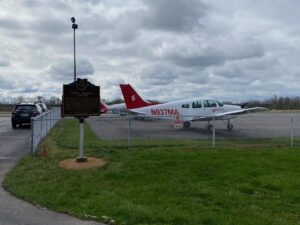
Lewis Albert Jackson (December 29, 1912-January 8, 1994) was an African American aviator remembered for training Tuskegee Airmen during World War II. As a teenager in Indiana, he began flight lessons and soloed in 1932, flying his own Waco 10. Jackson spent 1932-1937 barnstorming to save money for college while earning his Transport Pilot’s License. He re-rated to a Commercial License with Instructor Rating in 1939, and then completed advanced acrobatic training at Coffey School of Aeronautics. In late 1940, he was appointed Director of Training in the Army Air Force 66th Flight Training Detachment at Tuskegee Institute. After the war he moved to Ohio and served as an FAA Flight Examiner from 1947 to 1960. The Lewis A. Jackson Greene County Regional Airport was posthumously renamed to honor this true aviation pioneer.
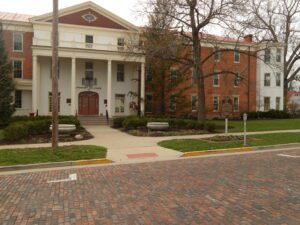
Chartered in 1849, the Institute was the first of three women’s colleges established in Oxford. The original brick building was completed in 1850, and forms the core structure. The Reverend John Witherspoon Scott, a member of Miami University’s early faculty, headed the Institute. In 1867, the Institute merged with Oxford Female College and later became the Oxford College for Women. Miami University acquired the building in 1928; in 1930 the Daughters of the American Revolution rededicated it as the “Caroline Scott Harrison Memorial.” From 1929-1998 it served as a Miami dormitory, nicknamed “Ox College.” Since 2003, the three-story building has housed the Oxford Community Arts Center. The structure is the oldest extant women’s college building in Ohio. It was placed on the National Register of Historic Places in 1976.