On May 1, 1950, the Akron Community Service Center and Urban League building opened to the public. The Center was a gathering place for African Americans of the community, where they addressed workplace, education, and other issues dividing the city. Directors included the late George W. Thompson, Raymond Brown, and Vernon L. Odom. The Center provided space for meetings, classes and receptions and had a swimming pool and gymnasium. The Center also hosted talent shows, which included the musicians who became Ruby and the Romantics. The group scored a #1 hit in 1963 with “Our Day Will Come.”
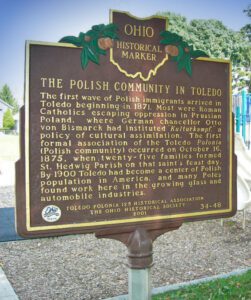
The first wave of Polish immigrants arrived in Toledo beginning in 1871. Most were Roman Catholics escaping oppression in Prussian Poland, where German chancellor Otto von Bismarck had instituted “Kulturkampf,” a policy of cultural assimilation. The first formal association of the Toledo Polonia (Polish community) occurred on October 16, 1875, when twenty-five families formed St. Hedwig Parish on that saint’s feast day. By 1900 Toledo had become a center of Polish population in America, and many Poles found work here in the growing glass and automobile industries.
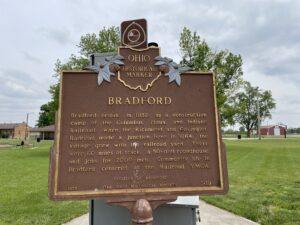
Bradford began, in 1852, as a construction camp of the Columbus, Piqua, and Indiana Railroad. When the Richmond and Covington Railroad made a junction here in 1864, the village grew with the railroad yard. There were 60 miles of track, a 50-stall roundhouse, and jobs for 2000 men. Community life in Bradford centered at the Railroad YMCA.
Bradford began, in 1852, as a construction camp of the Columbus, Piqua, and Indiana Railroad. When the Richmond and Covington Railroad made a junction here in 1864, the village grew with the railroad yard. There were 60 miles of track, a 50-stall roundhouse, and jobs for 2000 men. Community life in Bradford centered at the Railroad YMCA.
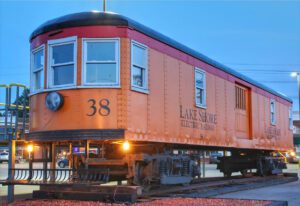
From the 1890s to the 1930s, interurban railways were an important form of travel in the Midwest. Beach Park Station had an interurban carhouse, where repairs were performed and passengers boarded. The Lorain & Cleveland Railway (L&C) built the 65½ by 200 foot brick station in 1897. By 1901, the L&C became part of the Lake Shore Electric Railway (LSE) and Beach Park became stop 65 on a line that ran from Cleveland to Toledo and then to Detroit. Requiring power and water, the LSE built an electric plant and water tower at Avon Lake. This infrastructure spurred the community’s development and growth. (Continued on other side
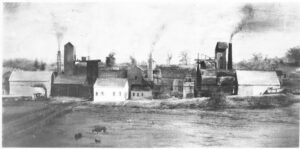
The discovery in the mid-19th century of iron-rich black band ore in this region helped revitalize Mahoning Valley’s iron industry. The land now called Mineral Ridge was primarily a farming community before the 1850s. In the 1830s, coal was discovered and mining began on a small scale. For years, it was believed that the coal seam sat on top of a layer of slate, which was considered to be of little worth. In the mid-1850s, however, John Lewis, superintendent of the Mineral Ridge Coal Mines, identified what was previously thought to be slate as valuable black band ore instead. (Continued on other side)
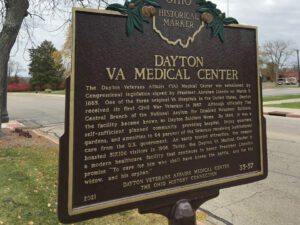
The Dayton Veterans Affairs (VA) Medical Center was established by Congressional legislation signed by President Abraham Lincoln on March 3, 1865. One of the three original VA Hospitals in the United States, Dayton received its first Civil War Veterans in 1867. Although officially The Central Branch of the National Asylum for Disabled Volunteer Soldiers, the facility became known as Dayton Soldiers Home. By 1884, it was a self-sufficient planned community, providing hospital, living quarters, gardens, and amenities to 64 percent of the Veterans receiving institutional care from the U.S. government. An early tourist attraction, the campus boasted 517,106 visitors in 1906. Today, the Dayton VA Medical Center is a modern healthcare facility that continues to honor President Lincoln’s promise “To care for him who shall have borne the battle, and for his widow, and his orphan.”
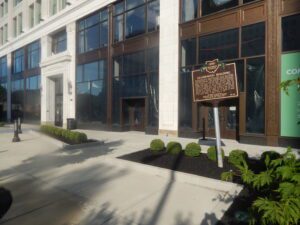
Steel-frame skyscrapers and retail buildings replaced wood-frame residences as the downtown evolved into a commercial district. A small public library branch occupied the north side of the square from 1923 to 1954. The Keith-Albee Theater (later the Palace) in the northeast corner of the square from 1926 to 1964, featured vaudeville performances and movies. Streetcar tracks around the square were removed for scrap during World War II. With expansion of suburban shopping malls, downtown theaters and department stores gradually closed. In 1973-74 Central Square was converted to a pedestrian Federal Plaza by closing off traffic on Federal Street one block east and west of Market Street. Central Square reopened in 2004 with a new traffic pattern, planting beds, and street furniture. Marker for “Central Square (1798-1899)” across the street.