

, OH
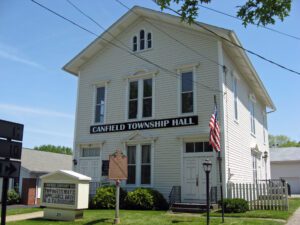
The Canfield Township Hall was erected in 1884. It served as the first public building in which the Canfield citizens could conduct town business, elections, and public meetings. An example of Renaissance Revival or “Italianate” architecture, the building is typical of late Victorian commercial buildings, but constructed of wood rather than of the customary brick. Drafted by Colonel S. Kinney, it was originally constructed for the sum of $2,389 by G.W. Strock at the corner of South Broad and East Main streets, on a lot purchased for $500. In 1936, R.J. Neff moved the hall several hundred feet south to its present location. In addition to official township meetings, the second floor has been used for a variety of activities, including social meetings, lectures, contests, dances, and roller-skating. The building served as an early home of the Canfield Historical Society and operated continuously for over one hundred and twenty-five years.
, OH
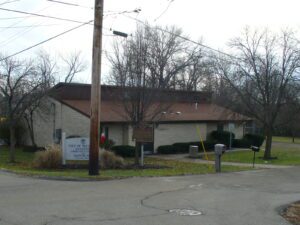
Civic organizations played pivotal roles in the development of the residential community of Hazelwood, founded as a subdivision of Blue Ash in 1888. The Hazelwood Civic Association, initially established as the Brothers Civic Society in 1941, addressed community needs by working for public improvements and promoting civic relations through social events and educational programs. Efforts by the HCA led to the construction of a new civic center and the introduction of the Boy and Girl Scouts and other programs that were previously unavailable to African-American children. Hazelwood’s deterioration and the threat of encroaching industrial development led to the formation of the Hazelwood Improvement Corporation in 1968. The HIC, acting as an agent of the city of Blue Ash, helped to upgrade housing, pave roads, build new homes to ensure a residential nature, install water and sewage systems, and erect streetlights. In 1997, the Hazelwood Community Association was organized to assist residents during Hazelwood’s transition to a racially integrated community.
, OH
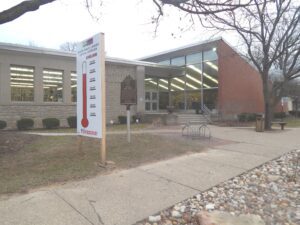
The American Sheet and Tin Plate Company founded the first Dover Public Library for the benefit of its employees at the corner of Front Street and Factory Street in 1902. Five years later, the library moved to a residence on Cherry and Fifth Streets. In 1916 the city dismantled “the old Downey residence” and built a high school in its place, with the public library occupying the basement. In 1934, the library moved to a converted residence at 417 North Walnut Street. Over time, however, the building became inadequate to house this beloved institution. In 1953 the city of Dover passed a bond issue to build a new library for the community. The new building, located at this site, opened in 1955.
, OH
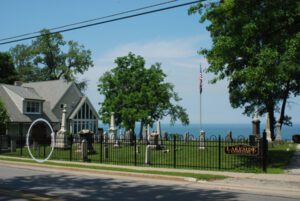
Laid out in 1814, Lakeside Cemetery became the first public burying ground in Dover Township, an area that now includes Bay Village, Westlake, and the northern portion of North Olmsted. Reuben Osborn (1778-1860) arrived in Dover on October 10, 1810, but returned to New York. He settled on this land with his wife Sarah Johnson Osborn (1779-1856) and family in 1811, later purchasing most of the plot where the cemetery would be established from Philo Taylor. Sarah’s sister, Rebecca Porter, and her infant son were the first to be buried here; they were killed when their boat capsized at the mouth of the Rocky River in 1814. Including land purchased in 1877, the cemetery currently spans half an acre. Although not recorded until 1879, there are over 270 known burials. Among those interned here are veterans from the Revolutionary War, the War of 1812, the Civil War, the Spanish-American War, and World War I.
, OH
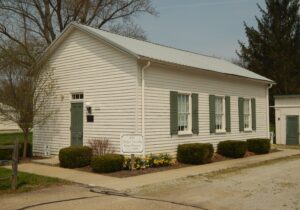
On April 20, 1857, the trustees of Morgan Township met in Okeana to obtain a lot for the township house. From a quarter mill tax levy, $850 was budgeted for a house and lot. Money expended on the project included $50 for the lot, $650 for the construction of the building, $41 for fencing, $12.60 for twelve chairs, and $10.25 for a table. Since its completion in 1858, this meeting house has been used for trustee meetings, a voting precinct, village singing schools and concerts, public school, bank, and township garage. The trustees moved to a new building across the street in 1972 and into their Chapel Road complex in 2000.
, OH
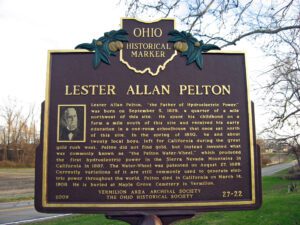
Lester Allan Pelton, “the Father of Hydroelectric Power,” was born on September 5, 1829, a quarter of a mile northwest of this site. He spent his childhood on a farm a mile south of this site and received his early education in a one-room schoolhouse that once sat north of this site. In the spring of 1850, he and about twenty local boys, left for California during the great gold rush west. Pelton did not find gold, but instead invented what was commonly known as “the Pelton Water-Wheel,” which produced the first hydroelectric power in the Sierra Nevada Mountains in California in 1887. The Water-Wheel was patented on August 27, 1889. Currently variations of it are still commonly used to generate electric power throughout the world. Pelton died in California on March 14, 1908. He is buried at Maple Grove Cemetery in Vermilion.
, OH
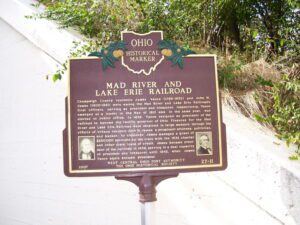
Champaign County residents Joseph Vance (1786-1852) and John H. James (1800-1881) were among the Mad River and Lake Erie Railroad’s first officers, serving as president and treasurer, respectively. Vance emerged as a leader in the War of 1812 and, in the same year, was elected to public office. In 1836, Vance resigned as president of the railroad to become the twelfth governor of Ohio. Finances for the Mad River and Lake Erie Railroad were obtained in large measure through the efforts of Urbana resident John H. James, a prominent attorney, politician, and banker. As treasurer, James managed a grant of $200,000 provided by the state with the 1832 charter and other state loans of credit. James became president of the railroad in 1836, serving in a dual capacity of president and treasurer until 1842, when James Vance again became president.
, OH
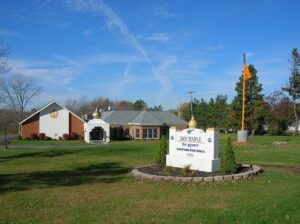
This marks the site of the first Sikh Gurdwara in the state of Ohio. Sikhs began to arrive in Ohio after India’s freedom from British rule in 1947. They came for advanced education at universities in the state. With liberalization of immigration laws in the 1960s, many Sikhs settled in metropolitan areas and set up organizations to hold congregational prayer. The Guru Nanak Foundation of Greater Cleveland Area was named after Guru Nanak, the founder of Sikh Faith. The Foundation, which at first used rental facilities for religious activities, was incorporated in 1976. However, by 1980 it was able to purchase a building at 3305 West 25th Street in Cleveland. Membership swelled during the 1980s, and in 1991 the congregation decided to move the Gurdwara to its present location in Richfield.