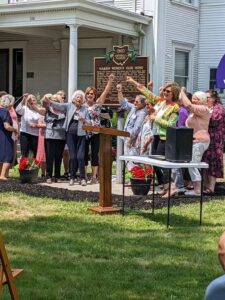
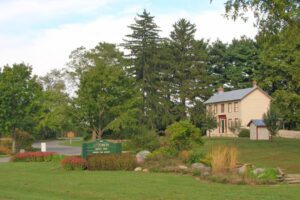
Marion civic leaders Shauck Elah Barlow and Ida Harsh Barlow built “Waldheim,” their Colonial Revival residence, between 1903-1905. Ida Barlow, then president of the Marion Women’s Club, hosted a December 1905 meeting in her new home. Members discussed art, music, literature, and ideas for “civic improvement.” In 1909, this and other Marion clubs reorganized as the Marion County Federation of Women’s Clubs. Federation members soon organized into action: providing college loans to young women; sponsoring visiting city and later school nurses; purchasing trash receptacles; providing dental clinics for low-income residents; and funding railroad crossing safety equipment. Upon her death in 1945, Barlow bequeathed her house to the Federation as the “Women’s Club Home.” The new Federation headquarters offered meeting space for the Executive Board and the many associated clubs. (Continued on other side)
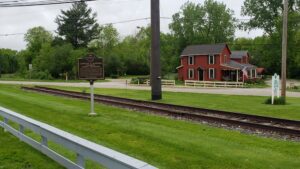
The Randall Secondary rail line dates to the 1850s when the independent Cleveland & Mahoning Railroad (C&M) laid tracks through Aurora, Ohio. C&M, chartered in 1848, linked the Mahoning Valley coal and iron ore fields to the industries and lake port at Cleveland. For over a century, the Randall Secondary contributed to Aurora’s economic life ? fueling the region’s rapid growth during the late 19th and early 20th centuries. In its heyday, the line was an important route for commuter transport and freight service along the 67 miles between Cleveland and Youngstown. Although passenger service into Aurora Train Station stopped in the 1960s, freight service continued into the 1990s. The last remaining track of the Randall Secondary in Aurora stands near the station it served.
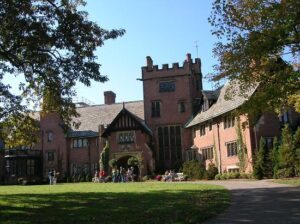
The former “country estate” of the Frank A. Seiberling family, Stan Hywet Hall is one of the finest examples of Tudor Revival architecture in the United States. “F.A.” Seiberling (1859-1955) co-founded the Goodyear Tire & Rubber Company in 1898 and later the Seiberling Rubber Company, thus greatly contributing to Akron’s distinction as “The Rubber Capital of the World.” Built between 1912 and 1915, The 65-room Manor House and service buildings are situated on more than 70 acres of restored historic gardens and wooded landscapes, all reflecting the Seiberlings’ tastes in the decorative and cultural arts. Stan Hywet Hall and Gardens was listed on the National Register of Historic Places in 1975 and designated a National Historic Landmark in 1982.
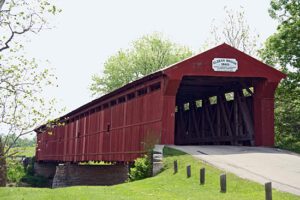
Originally known as Allen’s Mill Bridge, the Eldean Covered Bridge was built over the Great Miami River in 1860 for Miami County by the Hamilton Brothers of nearby Piqua. Its 224 feet place it among Ohio’s longest covered bridges and the longest in the nation that follows an 1830 Stephen H. Long patent, considered America’s first science-based bridge design. The Long system added strength through a series of hand-driven wedges. Placed on the National Register of Historic Places in 1975, the bridge was restored in 2005/2006.
This area of western Hancock County is a part of the Maumee River Watershed known as “Indian Green.” Wyandot Indians chose this area for hunting and ceremonial grounds along the Blanchard River in the 1700s because it was next to the river, yet high enough to avoid frequent flooding. One-half mile east of this location is a Liberty Township cemetery. It is located upon a sand ridge once used as a burial ground by Indians, hence the name “Indian Green.”
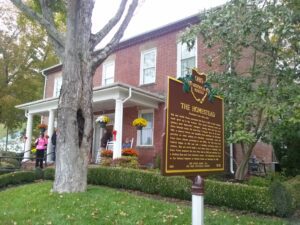
The Homestead was built in 1820 by Nehemiah Wood with an addition completed in 1822 by his son, Harrison. The Wood family, a pioneer family of Gallia County, arrived in 1805. The Homestead remained in the Wood family for over 100 years. The two-story Federal style building is constructed of bricks made on site by freed slaves who accompanied Nehemiah Wood from Virginia. The lane just below the house was a stagecoach route that ran between Chillicothe and Gallipolis. In the mid-1800s the Homestead served as an inn and stagecoach stop. The Wood family sold the farm to Rio Grande College in 1938 which used the land for college gardening and farming programs. (Continued on other side)
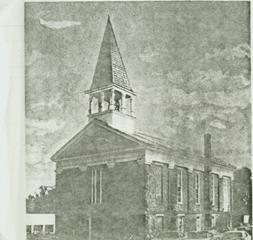
This site has long served the religious, education, and public interests of the residents of Mechanicsburg. A local Methodist congregation built its first church here in 1820, and the townspeople also used the structure as its village school. The Methodists replaced their original structure in 1837, using brick as the main building material. As the Methodist congregation grew, however, it was determined that a larger, more permanent structure was needed. As a result, the Mechanicsburg First Methodist Church was built here in 1858, and it served the congregation until 1894 when an African American based Second Baptist congregation purchased the building at a cost of $2,850. Besides religion and education, the site was also used as Mechanicsburg’s first cemetery. That cemetery lasted until the Maple Grove Cemetery was established and burials at this site were relocated there. [continued on other side]
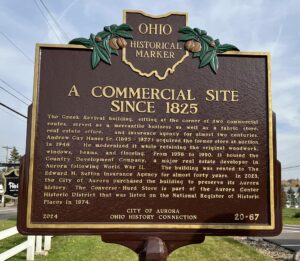
James Willard Converse (1806-1892) opened his store in 1825 at 10 South Chillicothe Road. Serving residents, merchants, and travelers, the store proved central to Aurora’s early commercial development. Converse’s Daybook survives as a glimpse into the habits of early citizens, who, along with household items, regularly purchased whiskey. Surprisingly, such sales surged on George Washington’s February 22 birthday. Converse deeded the business to employee Seth A. Gillett in 1834. Hopson Hurd Sr. (1793-1869) purchased it from Gillett in 1845. Hurd’s store was popular with local farmers who used their home made cheese as legal tender and enjoyed the barrel of whiskey kept in Hurd’s basement for customers who paid their bills. Hurd added a cheese warehouse to his store and, as a major exporter of cheese to Cleveland, Warren, and Pittsburgh, amassed a sizeable fortune.