Ottawa Park, the largest city park, was developed in the early 1890s on the 280-acre farm of John B. Ketcham. Based on a design by the famous landscape architect, Frederick Law Olmsted, Ottawa Park was intended to be central to a vast park and boulevard system. By 1920 the Toledo Park movement had provided fifteen parks totaling nearly 1400 acres.
In April 1784, the Continental Congress adopted the Report of Government for the Western Territory, a broad plan drafted primarily by Thomas Jefferson for organizing the United States’ new western lands that were ceded by the states and purchased from Native Americans. One of the most far-reaching legislative acts in American history, the resulting Land Ordinance of 1785, passed on May 20th, established the public land system by which all federal land was surveyed and distributed. The Ordinance established a rectilinear survey system that divided land into townships of six miles square aligned by north-south and east-west baselines, and set aside certain lands for Revolutionary War veterans and for public schools.
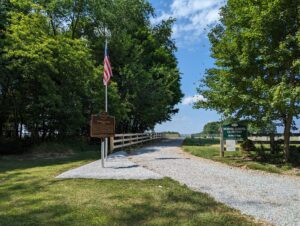
Near this location on May 15, 1823, the first murder trial in Geauga County concluded with the public execution of Benjamin Wright, Jr. On February 1, 1823, Wright stabbed Zophar Warner over a financial dispute, wounding him mortally. The following month, a jury found Wright guilty of murder and ordered that “he be hung by the neck until he be dead.” At the time, executions in Ohio were carried out locally and public hangings were seen by some as social events. The “hanging bee” drew more than 4,000 people, some of whom traveled from upwards of 50 miles to witness the spectacle. One witness wrote, “I felt that he deserved to be hung…but it was an awful site I hope to never the like see again.” Wright’s body was taken to nearby LeRoy for burial and the gallows was dismantled.
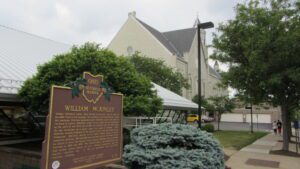
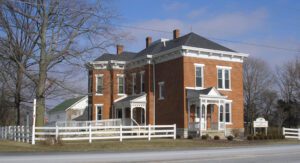
William McKinley’s house, once located at this site, was the scene of his 1896 front porch campaign for President of the United States. During the campaign McKinley addressed about 750,000 people who came to his home in Canton. McKinley’s public service began when he volunteered at the start of the Civil War in 1861 as a private with the Union Army. He was discharged as a major after four years of service. Later McKinley became President of the Canton Y.M.C.A. and the Stark County Prosecutor. McKinley served in the United States House of Representatives between 1877 and 1891 and was then elected Governor of Ohio. He helped to found the Canton Public Library. McKinley won presidential elections in 1896 and 1900. His administration was characterized by high tariffs, money backed by gold, national prosperity, and the Spanish-American War. In 1901 an anarchist shot and killed President McKinley.
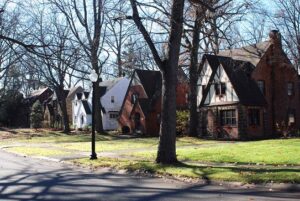
Situated in the township of Boardman and developed in the 1920s, Newport Village was one of Youngstown’s earliest automobile accessible suburban developments. The twenty four and a half acre district is comprised of Jennette Drive, Chester Drive, seven lots on Overhill Road, and a majority of the area on Market Street’s west side. Gently curving streets with both Tudor and Colonial architecture blend into the natural landscape of the area and Mill Creek Park. Newport Village became part of the National Register of Historic Places in 2006.
The Snowden Family Band was an acclaimed African-American stringband who performed in and around Knox County for nearly seventy years, from the 1850s into the 1920s. Buried in Morris Chapel Cemetery are Thomas Snowden (1803-1856), his wife Ellen Cooper Snowden (1817-1894), and their nine children: Oliver, Sophia, Mary, Ben, Lew, Phebe, Martha, Elsie, and Annie. Born into slavery in Maryland, Thomas and Ellen separately relocated to Knox County and to freedom during the 1820s. They married in 1834. In the 1850s, the six surviving children formed a band under Ellen’s direction. Talented musicians, the Snowden Family performed banjo and fiddle music for public events and at their homestead near Mount Vernon. Many believe that the song “Dixie,” attributed to minstrel Daniel Decatur Emmett (1815-1904), originated with the Snowden Family Band.
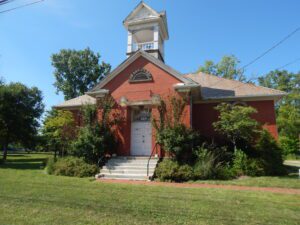
A fine example of the district school building common to Ohio in the early years of the twentieth century, this two-room, red-brick schoolhouse was completed in 1913. Accommodating elementary school children in east Berea and adjacent areas of Middleburg Township, the Berea “Little Red Schoolhouse” replaced an original wood-frame, one-room school built in the late nineteenth century on the same site. No longer active as a school, the building was used by the Berea Fine Arts Club from 1935 to 1980, and subsequently by the Berea Jaycees for meetings and community projects. This historic structure has been carefully restored and opened to public gatherings by the Berea Little Red Schoolhouse Foundation, Inc. It was placed on the National Register of Historic Places in 1975.
Garbry Conference Center and Learning Center, US 36
Piqua
, OH
J. Scott Garbry, a 1986 inductee into the Ohio Conservation Hall of Fame, had a lifelong commitment and passion for conservation, historic preservation, and education. His gift of land and artifacts to the Upper Valley JVS led to the creation of the Willowbrook Environmental Education Center and Garbry Museum. He was also instrumental in providing land for the site of the Piqua High School and for Garbry Woods of the Miami County Park District. These gifts make it possible to appreciate and experience Ohio’s natural and historic heritage.