

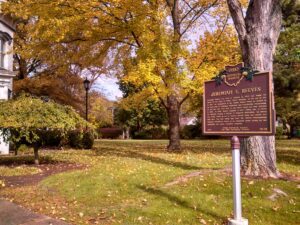
, OH
Jeremiah Reeves was born in England in 1845 and began his career in the mills of Wales, United Kingdom, at the age of ten. In 1867, he immigrated to the United States where he worked in the steel mills of Cleveland, Pittsburgh, and Connellsville, Pennsylvania. He met his wife Jane Rees in the latter place and they married in 1869. In 1883, Reeves acquired a steel rolling mill in Dover for $14,000. Despite a history of financial difficulties, the Reeves Iron Works would go on to expand several times and employ over 800 men. The iron works and later the Reeves Manufacturing Company established Dover as an industrial center during the late nineteenth and early twentieth centuries.
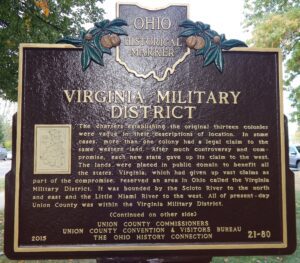
, OH
The charter establishing the original thirteen colonies were vague in their descriptions of location. In some cases, more than one colony had a legal claim to the same western land, After much controversy and compromise, each new state gave up its claim to the west. The lands were placed in public domain to benefit all the states. Virginia, which had given up vast claims as part of the compromise, reserved an area in Ohio called the Virginia Military District. It was bounded by the Scioto River to the north and east and by the Little Miami River to the west. All of present-day Union County was within the Virginia Military District. (Continued on other side)
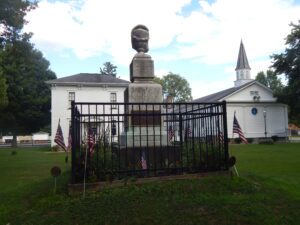
, OH
With the outbreak of the Civil War in 1861, many young men of Bristol Township enlisted in the army when President Abraham Lincoln issued his call to defend the Union cause. The death toll of some of these men at the Battle of Shiloh in Tennessee in April 1862 touched the local community as did the loss of Bristol Township lives at the Battle of Perryville in Kentucky, the Battle of Cedar Mountain in Virginia, and other theaters of war later in the year. The local citizenry responded to a plan for a lasting public memorial at the Town Park through a fund raising campaign. In 1863 the town square was transformed with a marble monument placed on an elevated mound at its center. The monument was designed by local artist Frank J. Hammond and manufactured by Myers, Uhl & Company of Cleveland at a cost of $500. [continued on other side]
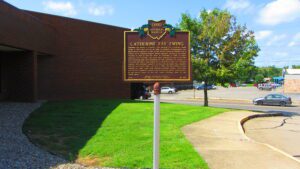
, OH
Frances Dana (Barker) Gage was born on October 12, 1808, in Marietta. She married James L. Gage in 1829 and they raised eight children, including four sons who served with Union forces during the Civil War. Throughout much of her life, Frances was deeply involved with the Temperance and Anti-Slavery movements and Women’s Rights issues. Presiding over the Women’s Rights Convention in Akron in 1851, she invited Sojourner Truth to give her famous “Ain’t I a Woman” speech. The Gage family moved in 1853 to St. Louis, the western extension of the Mason-Dixon Line, where her life was threatened whenever she spoke out against slavery. During the Civil War, she traveled south to aid Union soldiers and teach freed slaves. Though crippled and permanently disabled by a stroke, she continued to lecture on social issues until 1867. Frances Dana Gage died on November 10, 1884, in Greenwich, Connecticut.
, OH
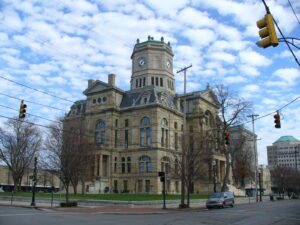
Butler County was created on March 24, 1803, about three weeks after Ohio became a state. Hamilton won the competition for the county seat, thanks to Israel Ludlow, Hamilton’s founder. Ludlow’s donation of the public square secured the county seat. The first Butler County trial court met in July 1803 in a tavern before moving to a two-story military building located at what had been Fort Hamilton (1791-1796). The county built the first courthouse on this public square in 1810. The two-story stone building contained a jail on the first floor and a courtroom on the upper level. A new brick two-story courthouse was built on this square in 1817 at a cost of $10,000. A four-sided clock was added to the top of the building in 1837. (continued on other side)
, OH
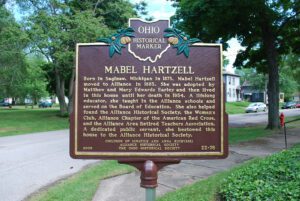
Born in Saginaw, Michigan in 1875, Mabel Hartzell moved to Alliance in 1883. She was adopted by Matthew and Mary Edwards Earley and then lived in this house until her death in 1954. A lifelong educator, she taught in the Alliance schools and served on the Board of Education. She also helped found the Alliance Historical Society, the Woman’s Club, Alliance Chapter of the American Red Cross, and the Alliance Area Retired Teachers Association. A dedicated public servant, she bestowed this house to the Alliance Historical Society.
, OH
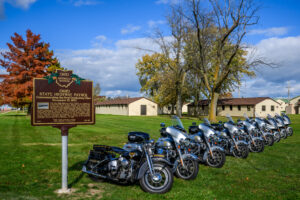
This location marks the site where the first Ohio State Highway Patrol cadet class graduated on November 15, 1933. Known as the Camp Perry School, Colonel Lynn Black opened the training on October 3, 1933, after House Bill 270 created the Division. Colonel Black received over 5,000 applications for the inaugural class, which was trimmed to approximately 125 individuals who formed the first training class. The Ohio National Guard graciously volunteered the use of this facility for the training. The newly formed Highway Patrol purchased 54 new motorcycles to be used for patrol duties. Many of the cadets had no prior experience operating motorcycles and had to be trained in short order. Cadets faced extreme adversity, including frigid temperatures and a lack of heating in the facilities. Severe weather shortened training for the cadets. The first class of 60 new Patrolmen graduated on November 15, 1933.
The Ohio State Highway Patrol’s core values are instilled into all new recruits and continually reinforced. They are the foundation upon which a trooper can be a consummate public servant; Adaptability, Attention to Detail, Diversity, Family, Honesty, Officer Safety, Performance Driven, Professionalism, Self-Discipline, Sense of Urgency and Team Oriented.
, OH
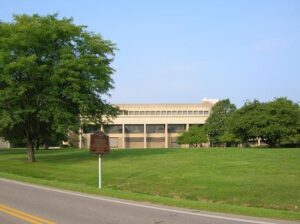
Wilberforce University, founded at Tawawa Springs in 1856 by the Methodist Episcopal Church, is the first private historically black college or university in America. The inspirations for Wilberforce were an unwavering faith in God, an acknowledgement of the contribution of the British abolitionist and Member of Parliament William Wilberforce, the leadership of AME Bishop Daniel Payne, and the belief in the potential of all women and men to learn and prosper. Wilberforce embraces the love of learning and the use of education as a tool of personal and community empowerment. Wilberforce seeks to cultivate and meet the historic hunger for freedom and liberty of all people. Today, Wilberforce is affiliated with the African Methodist Episcopal Church and educates diverse students from across the nation and around the world. Wilberforce continues to serve as a beacon for learning and research.