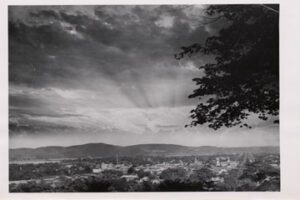
The hills before you were inspiration for the design of The Great Seal of the State of Ohio. The seal, first depicted in 1803, was often reconfigured until the present image was sanctioned by the Ohio General Assembly in 1967 and modified in 1996. In 1803 the law prescribed the sheaf of wheat to represent Ohio’s agricultural roots and the bundle of seventeen arrows to symbolize Ohio’s place as the seventeenth state in the Union. In the background is a range of hills, including Mount Logan, as viewed from Thomas Worthington’s estate, Adena, now a state memorial. (continued from other side)
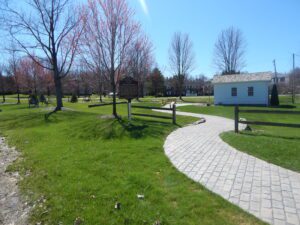
Ebenezer Sheldon (1754-1825) was born in Suffield, Connecticut. On April 19, 1775, he answered the “Lexington Alarm,” fought in the Revolution, and, in 1789, was appointed a captain in Connecticut’s militia. Following the Revolution, Sheldon, like many others, suffered financial hardships and sought a new beginning in the Western Reserve. In 1799, he established a homestead in Aurora and returned to Connecticut the following year to bring his wife Lovee and their six children to the area. A family legend relates that when Lovee saw the family’s home she “shed a few tears over the cheerless prospects” of her new life in the wilderness.
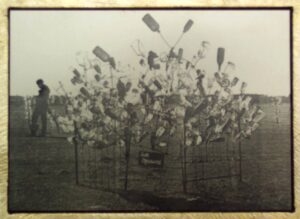
A direct descendent of original settlers in Jackson Township, Winter Zellar (Zero) Swartsel was born in 1876. Throughout his life he was a natural born showman, teacher, eccentric, anarchist, and “possibly the grandfather of American Pop Culture.” At a young age and tired of the routines of Farmersville, he declared that, “He would live by his wits while his brothers lived by the sweat of their brows.” He and a friend bicycled first to New York City and then turned around to head west and eventually the world. Later his home would overflow with items collected while traveling the world. Outside was a similar story. While chiding the American people for their wastefulness and abusing their environment, his 22 acres of farmland became his artist’s canvas filled with the thousands of items he collected from the “wasteful.” [continued on other side]
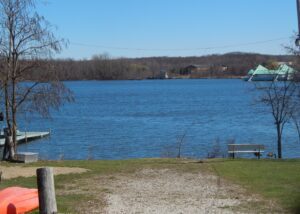
Geauga Lake, a scenic destination for visitors to northeast Ohio, was initially named “Giles Pond” after settler Sullivan Giles (1809-1880). In 1856, the predecessor of the Erie Railroad stopped at “Pond Station,” spurring the area’s growth. In the 1880s, locals established picnic grounds, a dance hall, and other facilities for those seeking a country getaway. Picnic Lake Park, later Geauga Lake Park, opened in 1887 and thereafter offered rides, a roller rink, photo gallery, billiard hall and bowling alley, among other attractions. In 1888, the Kent House hotel opened on the southeast side of the lake. In the century that followed, more attractions were added, including SeaWorld of Ohio, and the park expanded. In 2007, the melodic sounds of the carousel and the echoing screams from the “Big Dipper” roller coaster ceased when the park closed. (Continued on other side)
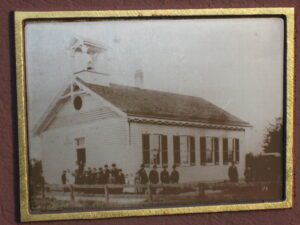
A school has stood on this site almost continuously since the late 1840s. The first school here was the Newell School, a white-frame, one-room school in use from approximately 1847 to 1939. The building was a part of the Newell Rural School District, which extended from the north border of Greenhills to present-day Interstate 275. Area schools consolidated in 1939 and the Newell district was absorbed into the Science Hall Rural School District and then into the Greenhills Rural School District (later renamed the Greenhills/Forest Park School District). The site of the old Newell School is now a part of the Winton Woods City Schools. The building directly behind this marker opened in 1968 as Forest Park High School and later became Winton Woods High School.
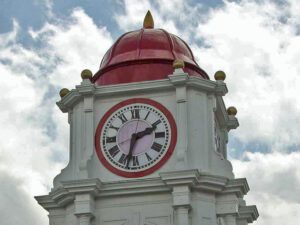
The Bellaire High School Clock Tower was erected in 1925 as the second town clock to be mounted on Bellaire’s public schools. C.W. Bates of Wheeling designed this tower, built by C.D. Keyser & Co. of Bellaire. The school building stretches 256 feet along 35th Street, and the tower rises 40 feet above the 3rd floor parapet of the roof. The clock faces are 6 feet, 7 inches in diameter. At the exterior corners of the bell room are 11 foot columns. The tower dome is painted red. E. Howard & Co. of Boston made the clock works and the McShane Bell Foundry of Baltimore cast the bell in August 1888. The BHS Alumni Association lighted the tower in 1998 to honor all “faithful and true-hearted” graduates of the school.
John Graham (1798-1849), pastor of the West Union Associate Reformed Presbyterian Church from 1841-1849, erected the house he called Pleasant Hill in 1842. An outspoken abolitionist who preached against the evils of slavery, Graham used his house as a station on the Underground Railroad. “Black Joe” Logan, an escaped slave who lived nearby, conducted runaways from Pleasant Hill to stations north. Reverend Graham died of Asiatic cholera in 1849 and is buried in the old West Union South Cemetery.
Paul E. Brown, born September 7, 1908 in Norwalk, Ohio, and raised in Massillon, is a member of the Professional Football Hall of Fame and was one of the greatest coaches in the history of football at all levels. From 1932 until 1940, he led Massillon High School to a record of 80-8-2. He coached Ohio State to the 1942 national collegiate championship, and joined the professional football ranks in 1946 as coach of the new franchise in Cleveland. He coached his namesake Cleveland Browns to seven league championships in 17 seasons.