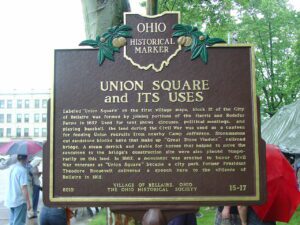
Labeled “Union Square” on the first village maps, block 12 of the City of Bellaire was formed by joining portions of the Harris and Rodefer Farms in 1857. Used for tent shows, circuses, political meetings, and playing baseball, the land during the Civil War was used as a canteen for feeding Union recruits from nearby Camp Jefferson. Stonemasons cut sandstone blocks here that make up “Great Stone Viaduct” railroad bridge. A steam derrick and stable for horses that helped to move the sandstone to the bridge’s construction site were also placed temporarily on this land. In 1882, a monument was erected to honor Civil War veterans as “Union Square” became a city park. Former President Theodore Roosevelt delivered a speech here to the citizens of Bellaire in 1912.
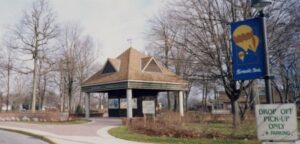
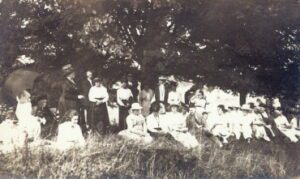
One of the earliest and largest amusement parks in Northwest Ohio dedicated in 1906 on site of old waterworks. Trains brought visitors from as far away as Cleveland. 1907: Dance Pavilion and 2,000 seat auditorium built. 1908: Bathing beach made in old reservoir. 1925: Green Mill Dance Hall built on side near dam. Big name bands highlight entertainment. 1936: Shelters, band shell, and pool bath house made from bricks of old waterworks. 1978: Renovation of waterfront begins new era.
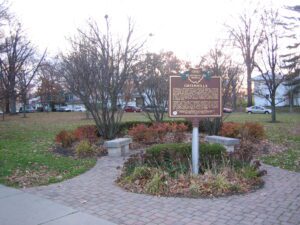
Considered a bold experiment in community planning, Greenhills was intended to relieve an acute housing shortage and to provide jobs during the Great Depression. In 1935, the administration of President Franklin Roosevelt authorized the construction of three greenbelt communities: Greendale, Wisconsin; Greenbelt, Maryland; and Greenhills, Ohio. The construction of Greenhills began on December 16, 1935. The project generated thousands of jobs and, ultimately, 676 units of housing for working people. On April 1, 1938, the first Greenhills “Pioneers” moved into homes on Avenell Lane. Greenhills reflects the town planning principles of the English “garden city” movement. Planners clustered homes around a common green space and a community shopping area was within easy walking distance. Like the original greenbelt of forests and farms, today Winton Woods Park serves as a buffer for the Village. The original federally built center of Greenhills was added to the National Register of Historic Places in 1989.
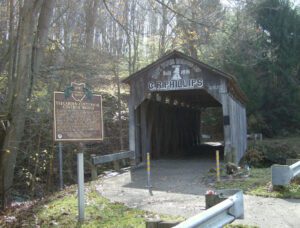
The Teegarden-Centennial Covered Bridge, constructed primarily of white oak is of Multiple King Post design spanning 67 feet. It was built nearly 100 years after the birth of the nation. Located on Eagleton Road, just off Teegarden Road, it is still at its original location, spanning the Middle Fork of the Little Beaver Creek in Eagleton’s Glen Park. It remained in use until 1992 when it was bypassed by a new concrete structure. The official contract for the construction of the bridge was awarded to Jeremiah C. Mountz in June of 1875. The stonework for the abutments was awarded to David Reese and painting of the original structure to George W. Akin in 1876. Members of Highland Christian Church came here to be baptized by immersion. There were over 250 covered bridges in Columbiana County, including at least 16 railroad covered bridges. The Teegarden-Centennial Covered Bridge is one of only five still remaining.
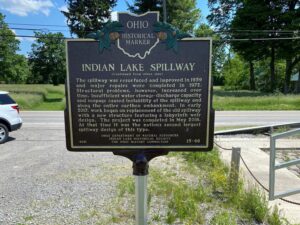
Indian Lake Dam was built 1851-1860 to create a feeder lake, known as the Lewistown Reservoir, for the Miami and Erie Canal. The dam included a 700-foot long concrete ogee weir spillway that discharged water from the lake into the Great Miami River. In 1898, the Ohio General Assembly designated the lake as a public recreation area and renamed it Indian Lake. The lake and dam structure have been owned and operated by the Ohio Department of Natural Resources since the creation of ODNR in 1949. (Continued on other side)
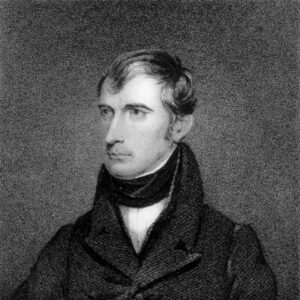
During the War of 1812, Northwestern Army Commander General William Henry Harrison led troops through northwest Ohio on the way to Detroit and Ft. Malden in Michigan. After the decimation of General James Winchester’s division at Frenchtown (Monroe, Michigan) by British and Indian forces, Harrison retreated and led his troops southward to the Portage River. Near this site, now the William Henry Harrison Park, Harrison’s men waited for supplies and reinforcements, which were delayed due to heavy rains and flooding in the Black Swamp. With the addition of General Leftwich’s brigade at the end of January 1813, Harrison’s forces reached approximately 1,700. The troops endured the harsh, wet weather and several soldiers died of exposure and were buried at the camp. Once the winter freeze set in, Harrison led the remaining troops to the rapids of the Maumee River where construction of Fort Meigs began.
After embracing the cause of women’s suffrage, Harriet Taylor Upton (1854-1945) devoted her life to the movement. Born in Ravenna, she moved to Warren as a child and lived in this house beginning in 1873. Upton was treasurer of the National American Woman Suffrage Association from 1895 to 1910 and brought its headquarters to Warren in 1903, where it remained until 1910. She served as president of the Ohio Woman Suffrage Association for 18 years. As the first woman vice chair of the National Republican Executive Committee, Upton was instrumental in the passage of child labor laws and securing governmental appointments for women. Her devotion to women’s causes and skills as a public speaker earned her nationwide respect.
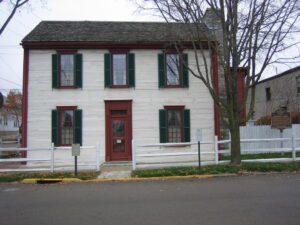
Benjamin Overfield (1774-1831), son of a Revolutionary War soldier, opened his tavern in this log house on September 13, 1808. Never moved, it is the oldest surviving building in Troy. The tavern provided food, lodging and space for business and social gatherings. Overfield agreed to let the county use a room on the second floor of the building as a temporary courtroom. Behind the tavern, Benjamin built a small log cabin that was home to his family. He prospered here until 1825 when he moved to the Public Square. Today’s structure includes the tavern, the cabin, and later additions. Used as a dwelling from 1825 until 1948, the building now houses the Overfield Tavern Museum. Benjamin Overfield and his first wife Mary are buried in Rose Hill Cemetery.