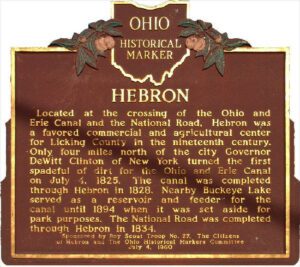
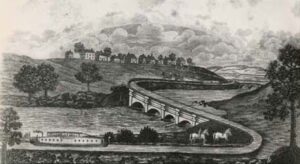
Located at the crossing of the Ohio and Erie Canal and the National Road, Hebron was a favored commercial and agricultural center for Licking County in the nineteenth century. Only four miles north of the city Governor DeWitt Clinton of New York turned the first spadeful of dirt for the Ohio and Erie canal on July 4, 1825. The canal was completed through Hebron in 1828. Nearby Buckeye Lake served as a reservoir and feeder for the canal until 1894 when it was set aside for park purposes. The National Road was completed through Hebron in 1834.
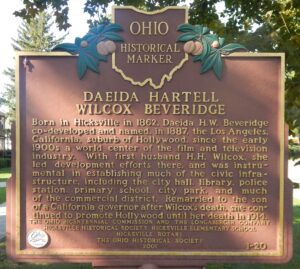
Born in Hicksville in 1862, Daeida H.W. Beveridge co-developed and named, in 1887, the Los Angeles, California, suburb of Hollywood, since the early 1900s a world center of the film and television industry. With first husband H.H. Wilcox, she led development efforts there, and was instrumental in establishing much of the civic infrastructure, including the city hall, library, police station, primary school, city park, and much of the commercial district. Remarried to the son of a California governor after Wilcox’s death, she continued to promote Hollywood until her death in 1914.
Davey Moore was the Featherweight Champion of the World from 1959 to 1963, punching his way to a 56-6-1 record while always admitting that “Only 10 seconds separate me from being champion or nothing.” A tough little boxer with a powerful punch, he died at the age of 29, a victim of the sport he loved. Born November 1, 1933, a fighter from the age of 14, he died March 25, 1963.
Construction began in 1825 on the 20-mile segment of the Miami Canal from two miles north of Middletown to the head of Mill Creek. Canal boats were operating from Hartwell’s Basin near Cincinnati to Middletown by Nov. 28, 1827. This early link in what became the Miami and Erie Canal joining in 1845 Toledo and Cincinnati by water was restored in 1971 by the Butler County Park district.
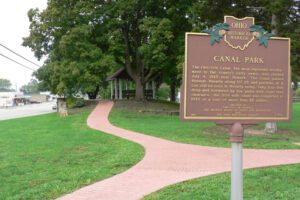
The Ohio-Erie Canal, the most important development in the county’s early years, was started July 4, 1825 near Newark. The canal passed through Waverly along US 23 and portions of it can still be seen in Waverly today. Only four feet deep and bordered by tow paths with eight feet clearance, the 309 mile canal was completed in 1833 at a cost of more than $7 million.
As a member of the Connecticut Land Company, Judge Samuel Hinckley of North Hampton, Massachusetts purchased township 4N Range 13W of the Western Reserve in 1795 for a sum equivalent to 23 cents an acre. The township remained unsettled until Abraham Freeze was commissioned by Judge Hinckley in 1819 to survey the township into 100 plots of 160 acres each. In return for having the township, founded in 1825, named “Hinckley,” the judge gave land for two burying grounds and one-half acre for a public square. In 1919, upon the 101st anniversary of the “Great Hinckley Hunt,” where men from surrounding counties gathered on Christmas Eve to rid the township of wild animals, Judge Amos Webber spoke for the deceased Judge Hinckley: “When I last saw this country, it was a howling wilderness – by industry and frugality you and your ancestors have made these ever lasting hills and pleasant valleys blossom as the rose.”
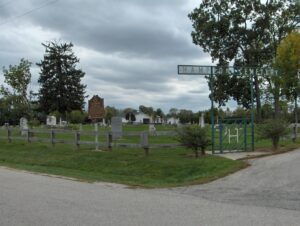
On September 8, 1803, the year that Ohio became a state, the Associate Judges of Franklin County ordered that a road be constructed “leading from the Public Square in Franklinton to Springfield, Greene County.” This road came to be known as The Old State Road or Ludlow’s Road. On this spot in the summer of 1822, the Village of New Hampton was laid out, the road being Main Street of the village. New Hampton was the forerunner of West Jefferson. It fell into oblivion eight to nine years later when West Jefferson was developed along the National Road. All that remains of New Hampton is the cemetery and this part of the road.
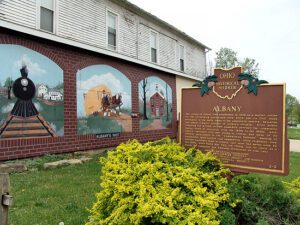
The village of Albany was established in 1838 as a market center for the surrounding agricultural area, which saw its first white settlement in the early years of the nineteenth century. Education was always a major concern of Albany’s citizens. Since public schooling was minimal, private academies provided the community various levels of education from the 1840s to the 1880s. Anti-slavery sentiment also was strong in Albany, and many of its citizens participated in the “Underground Railroad.” Because of educational opportunities and sympathetic white neighbors, free African-Americans came to Albany, but most had moved away by the 1930s. After World War Two, the village lost its status as a center for commerce and business.