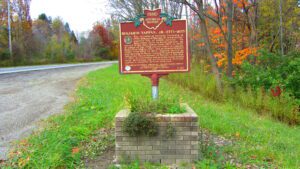
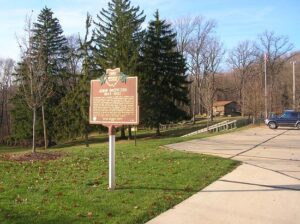
The founder of Ravenna Township in 1799, Benjamin Tappan Jr. led a distinguished life of public service. An aggressive force in local politics, he served in the Ohio Senate from 1803 to 1805, as judge of the fifth circuit court of common pleas from 1816 to 1823, and as federal district judge from 1826 to 1833. Tappan served as aide-de-camp to Major General Elijah Wadsworth following the surrender of Detroit in the War of 1812, provisioning and arming local militia units defending the northwestern frontier against a possible British invasion. (continued on other side)
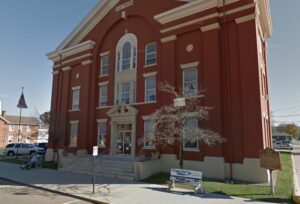
The Pike County Courthouse was at Piketon from 1815-1861 when county residents voted to move the county seat to Waverly. The Waverly Public Square was donated to the county by the Meschech Downing family in September, 1861. A committee was appointed to oversee the courthouse construction and the completed structure was deeded to the county in December 1866 for $5. An addition was added to the front in 1909. Inside, the common pleas courtroom houses busts of entrepreneur-businessman and first millionaire of Pike County, James Emmitt, and his wife, Louisa, and a mural of “Blind Justice” painted by late local lawyer, W. T. Reed.
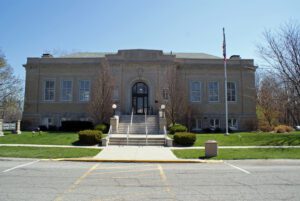
In 1912, the president of the Public Library Association in Paulding requested funding from philanthropist Andrew Carnegie to build a library in Paulding. At first the Carnegie Corporation of New York refused, stating that it only provided funding to communities with larger populations, but when the Library Association said it would serve the entire county, which had a larger population, the request was granted. As a result Paulding became the site for the first “county” Carnegie library in the United States, built for a total cost of $40,000. Carnegie provided funding for 2,811 libraries, of which 1,946 were built in the United States. Placed on the National Register of Historic Places in 1984, the Paulding County Carnegie Library continues to service the needs of all citizens of Paulding County.
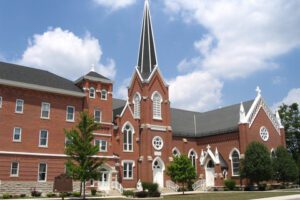
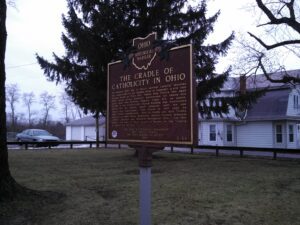
The Sisters of the Precious Blood, founded in Switzerland by Maria Anna Brunner in 1834, began their ministry of prayer and education in Mercer County here at Maria Stein (Our Lady of the Rock). Father Francis de Sales Brunner, a Missionary of the Precious Blood, brought the Sisters to America in 1844, and in 1846 established the foundation at Maria Stein, named after a Benedictine Abbey in Switzerland. The convent was the Motherhouse of the Sisters of the Precious Blood until 1923. Relics of the saints were brought to this site from Italy in 1875. The present convent and relic chapel (National Marian Shrine of the Holy Relics), built during 1890-1902, were placed on the National Register of Historic Places in 1976.
As a member of the Connecticut Land Company, Judge Samuel Hinckley of North Hampton, Massachusetts purchased township 4N Range 13W of the Western Reserve in 1795 for a sum equivalent to 23 cents an acre. The township remained unsettled until Abraham Freeze was commissioned by Judge Hinckley in 1819 to survey the township into 100 plots of 160 acres each. In return for having the township, founded in 1825, named “Hinckley,” the judge gave land for two burying grounds and one-half acre for a public square. In 1919, upon the 101st anniversary of the “Great Hinckley Hunt,” where men from surrounding counties gathered on Christmas Eve to rid the township of wild animals, Judge Amos Webber spoke for the deceased Judge Hinckley: “When I last saw this country, it was a howling wilderness – by industry and frugality you and your ancestors have made these ever lasting hills and pleasant valleys blossom as the rose.”
Jefferson Street, between N. 5th and N. 6th Streets
Greenfield
, OH
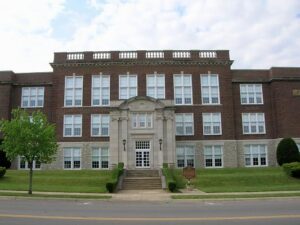
A focal point of community pride for generations, McClain High School was the gift of textile manufacturer Edward Lee McClain to his hometown, “as promising the greatest good to the greatest number for the longest time.” Designed by nationally prominent school architect William B. Ittner, the school was dedicated in September 1915. Lauded as one of the most complete and state-of-the-art school plants of its time, McClain High School embodied the ideals of the progressive education movement in the early 20th century. A fully equipped gymnasium, motion-picture equipment, and a pipe organ were rare luxuries for any school during this era. Additional gifts by McClain also furnished a vocational training center and an athletic field. Numerous sculptures, paintings, and other works of art displayed throughout the school continue to enhance the atmosphere of Greenfield’s acclaimed halls of learning.
In April 1830 four Dominican sisters from St. Catherine’s, Kentucky, founded St. Mary’s Academy, the first Catholic school in Perry County. Bishop Edward Fenwick, first Bishop of Ohio, donated a small brick house and attached building situated on an acre of land for the school’s use. Classes began with forty students. The following year the sisters built a three-story structure with a dormitory for boarders; by the end of the Civil War, enrollment had increased to 134 students, and St. Mary’s gained recognition as one of the finest schools in Ohio. An 1866 fire destroyed the academy, and in 1885 the Dominican sisters reestablished the academy as a parish school. The present Holy Trinity School building dates to 1968.
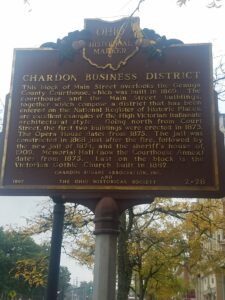
This block of Main Street overlooks the Geauga County Courthouse, which was built in 1869. The courthouse and the Main Street buildings, together which compose a district that has been entered on the National Register of Historic Places, are excellent examples of the High Victorian Italianate architectural style. Going north from Court Street, the first two buildings were erected in 1873. The Opera House dates from 1875. The jail was constructed in 1868 just after the fire, followed by the new jail of 1874, and the sheriff’s house of 1909. Memorial Hall (now the Courthouse Annex) dates from 1875. Last on the block is the Victorian Gothic Church built in 1882.