Intersection of Springfield Street and Centennial Blvd
Riverside
, OH
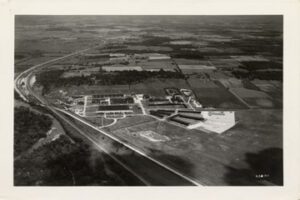
Named for the 1903 co-inventors of the airplane, Wilbur and Orville Wright of Dayton, Ohio, Wright Field has been the center of aeronautical research, development, and weapon system acquisition since its establishment. Wright Field assumed this mission and was dedicated on October 12, 1927 after McCook Field (1917-1927), America’s “Cradle of Aviation” near downtown Dayton, closed its gates. ?Here on this ground where Wilbur and Orville Wright brought to full life man’s age-old dream of rising in flight above the earth, we of Wright Field consecrate ourselves to the splendid vision and unswerving purpose which motivated those great and honored pioneers of the sky. Their patience, their firm determination, their untiring devotion to their aim ” these we take as a light to guide and inspire us.” –Creed of Wright Field, December 17, 1942
The history of New Knoxville provides one of the best examples of chain migration to America. After the Shawnee were removed from what would become Auglaize County, James Knox Lytle, cousin to James Knox Polk, purchased land in Washington Township. Lytle platted a village of 102 lots in 1836, calling it Knoxville to honor his mother’s family. Meanwhile, newly married Wilhelm and Elisabeth Fledderjohann Kuckhermann (later Kuck) immigrated from Ladbergen in northwest Germany. Having missed their boat to St. Louis, the couple lived briefly in Stallostown (Minster) and Bremen (New Bremen). They wrote home, encouraging others to emigrate; in the summer of 1835 the Fledderjohanns (Elisabeth’s family), Meckstroths, and Lutterbecks arrived. The families bought land near the site of Knoxville. (continued on other side)
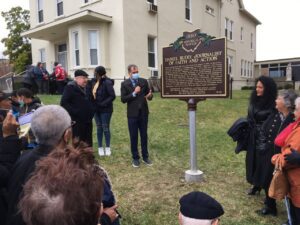
Daniel Arthur Rudd was born into slavery on August 7, 1854, in Bardstown, Kentucky. He became a newspaperman, lecturer, publicist, and tireless advocate for the Roman Catholic Church. After the Civil War Rudd moved to Springfield. Baptized and raised in Catholicism, he joined St. Raphael Parish, where the philosophy of racial equality offered by the church solidified his vision of justice. By 1885 he had established his own weekly newspaper, The Ohio State Tribune. He rebranded it The American Catholic Tribune (ACT) after moving to Cincinnati. Rudd claimed ACT was the only Catholic newspaper owned by an African American. At the height of its popularity in 1892, the publication had a circulation of 10,000. In 1893 Rudd was asked to chair the Afro-American Press Association, representing more than 200 black-owned newspapers.
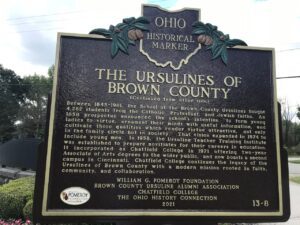
On July 21, 1845, eleven Ursuline sisters from Boulogne-sur-Mer and Beaulieu, France, arrived in St. Martin, Brown County, Ohio. A Catholic order of sisters known for providing quality education to young women, the Ursulines were invited by Cincinnati Archbishop John Baptist Purcell (1800-1883) to establish a school in the diocese and granted approximately 400 acres in St. Martin for that purpose. Led by Mother Julia Chatfield (1808-1878), the sisters quickly established their convent, a day school, and, within the year, admitted their first boarders. Originally known as The Saint Ursula Literary Institute, the school operated for the next 136 years. The Ursulines educated local students from their adopted Brown County as well as many who came from across the U.S. and farther abroad to board on campus. (Continued on other side)
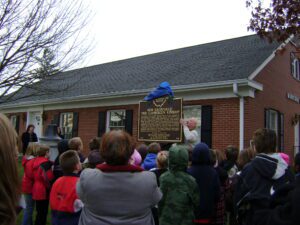
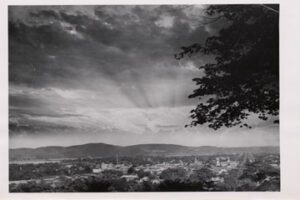
The hills before you were inspiration for the design of The Great Seal of the State of Ohio. The seal, first depicted in 1803, was often reconfigured until the present image was sanctioned by the Ohio General Assembly in 1967 and modified in 1996. In 1803 the law prescribed the sheaf of wheat to represent Ohio’s agricultural roots and the bundle of seventeen arrows to symbolize Ohio’s place as the seventeenth state in the Union. In the background is a range of hills, including Mount Logan, as viewed from Thomas Worthington’s estate, Adena, now a state memorial. (continued from other side)
Oscar D. Boggess (1832-1907) was born in Virginia, the son of a slave and her master. He and his family were granted freedom in the will of his father and master. The will was contested up to the United States Supreme Court, which upheld Boggess’ freedom. Boggess moved to Pennsylvania at age 20, and during the Civil War, joined the 43rd United States Colored Troops. He earned the Butler Medal of Honor for bravery at the Battle of the Crater near Petersburg, Virginia, in July 1864. Boggess moved to Youngstown after the war, and worked as a stonemason. He was a charter member of Tod Post 29, Grand Army of the Republic, in Youngstown, and a co-founder of the Oak Hill Avenue African Methodist Episcopal Church, the city’s first African American religious congregation. The Boggess home, formerly located near this site, hosted the church’s first meetings in 1870.
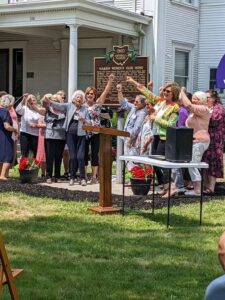
Marion civic leaders Shauck Elah Barlow and Ida Harsh Barlow built “Waldheim,” their Colonial Revival residence, between 1903-1905. Ida Barlow, then president of the Marion Women’s Club, hosted a December 1905 meeting in her new home. Members discussed art, music, literature, and ideas for “civic improvement.” In 1909, this and other Marion clubs reorganized as the Marion County Federation of Women’s Clubs. Federation members soon organized into action: providing college loans to young women; sponsoring visiting city and later school nurses; purchasing trash receptacles; providing dental clinics for low-income residents; and funding railroad crossing safety equipment. Upon her death in 1945, Barlow bequeathed her house to the Federation as the “Women’s Club Home.” The new Federation headquarters offered meeting space for the Executive Board and the many associated clubs. (Continued on other side)
791 Farmview Rd (located on OH 588 just off US Route 35)
Bidwell
, OH
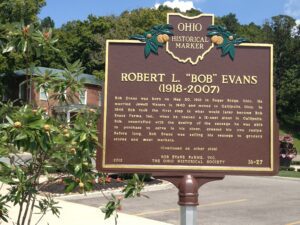
Bob Evans was born on May 30, 1918 in Sugar Ridge, Ohio. He married Jewell Waters in 1940 and moved to Gallipolis, Ohio. In 1946 Bob took the first step in what would later become Bob Evans Farms, Inc., when he opened a 12-seat diner in Gallipolis. Bob, unsatisfied with the quality of the sausage he was able to purchase to serve in his diner, created his own recipe. Before long, Bob Evans was selling his sausage to grocery stores and meat markets.