Near 444 Olive Green Marengo Fulton Road (County Road 26)
Pagetown
, OH
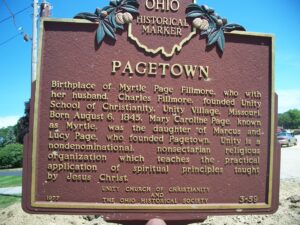
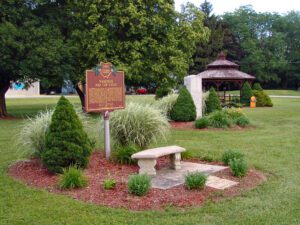
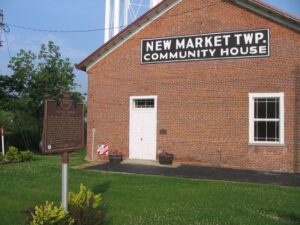
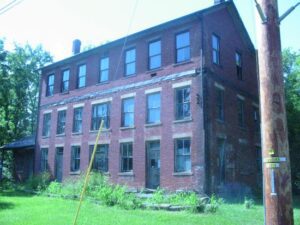
Birthplace of Myrtle Page Fillmore, who with her husband, Charles Fillmore, founded Unity School of Christianity, Unity Village, Missouri. Born August 6, 1845, Mary Caroline Page, known as Myrtle, was the daughter of Marcus and Lucy Page, who founded Pagetown. Unity is a nondenominational, nonsectarian religious organization which teaches the practical application of spiritual principles taught by Jesus Christ.
The Wakeman Red Caps, perhaps one of the area’s best semi-pro baseball teams during the 1930s and 40s, first played night baseball under lights installed at Wakeman Field on July 24, 1935. The Field, no longer extant, was bounded by Hyde, Clark, Pleasant, and Townsend (Ohio Route 303) streets. The game was played only two months after Franklin D. Roosevelt switched on lights at Crosley Field for the Cincinnati Reds. The Red Caps were part of the Wakeman Baseball Club, an organization which was founded in 1889 and was sponsored by Charles S. Clark, Sr., and others. For aspiring local baseball players, playing night baseball for the Red Caps was a great honor. Wakeman Field was annually graced with Abe Saperstein’s Ethipian Clowns, an African-American traveling baseball team, and also saw appearances by Tom Manning, Satchel Paige, Josh Gibson, Al Schacht, Jesse Owens, and other sports greats.
In 1798, Henry Massie, brother of General Nathaniel Massie, platted a town, the earliest permanent settlement in Highland County, covering 400 acres and named it New Market after a town in his native Virginia. New Market served as the unofficial county seat until Hillsboro assumed that title in 1807. Despite being traversed by the Cincinnati-Chillicothe Post Road with seven other roads (including one from Manchester) leading in, New Market ceased being an active trade and civic center. It is now a small hamlet with a cluster of dwellings, a church, and a few businesses.
This historic inn began serving travelers on the old Portage-Columbiana stage road (now Tallmadge Road) in 1832. Two major stage lines, one from Cleveland to Wellsville (the closest Ohio River port) and the other from Cleveland to Pittsburgh, passed through Palmyra in the early 1800s. Originally a simple two-story Greek Revival-style building, it had its third story added in 1888 when it became a lodge for the Knights of Pythias fraternal organization. It served as a private residence and store for most of the 20th century. The Palmyra Center Hotel was added to the National Register of Historic Places in 1976.
The West Liberty area, in the Mad River Valley, was the location of at least seven Shawnee Indian villages. This elevated site was the location of one of those villages. Several septs or divisions of the Shawnee nation lived in this area after being forced from their homes in southern Ohio. In 1786, together with Simon Kenton, Colonel Benjamin Logan’s army destroyed all the Shawnee villages in retaliation for the Indian raids in southern Ohio and Kentucky. Consequently, the remaining Shawnees moved to northwest Ohio near the present-day site of Maumee.
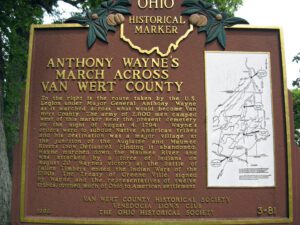
To the right is the route taken by the U.S. Legion under Major General Anthony Wayne as it marched across what would become Van Wert County. The army of 2,800 men camped west of this marker near the present cemetery on the night of August 4, 1794. Wayne’s orders were to subdue Native American tribes and his destination was a major village at the junction of the Auglaize and Maumee Rivers (now Defiance). Finding it abandoned, Wayne marched down the Maumee River and was attacked by a force of Indians on August 20. Wayne’s victory at the Battle of Fallen Timbers ended the Indian Wars of the 1790s. The Treaty of Greene Ville, signed by Wayne and the representatives of twelve tribes, opened much of Ohio to American settlement. Side one includes a map on the right hand side of the marker showing the route of Wayne’s army through the eastern third of Van Wert County.
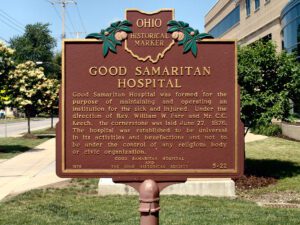
Good Samaritan Hospital was formed for the purpose of maintaining and operating an institution for the sick and injured. Under the direction of Rev. William W. Farr and Mr. C.C. Keech, the cornerstone was laid June 27, 1876. The hospital was established to be universal in its activities and benefactors and not to be under the control of any religious body or civic organization.
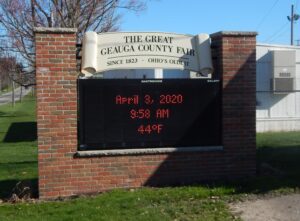
The Great Geauga County Fair is the longest continuously operating county fair in Ohio. The fair is a major county gathering event each year, pulling together people from the whole county. Geauga’s settlers imported the idea of the county fair with them from New England. The fair’s parent organization, the Geauga County Agricultural and Manufacturing Society, began holding fairs on Chardon Square in 1823. Since then, the Geauga County Fair has served as a gathering place and form of education to promote local agriculture and introduce farmers to new farming developments and each other. Controversy arose between 1840 and 1854 after Lake County ceded and Chardon, Claridon, and Burton vied for the permanent fair grounds. Burton’s proposal was accepted, improvements began immediately, and the fair grew quickly. The Great Geauga County Fair continues as a time-honored tradition.