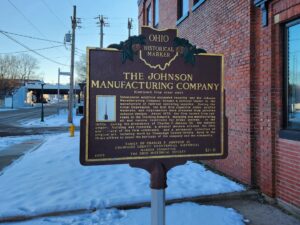
The Johnson Manufacturing Company was incorporated in 1902 by brothers James B., J. Will, Isaac T., and Charles F. Johnson, all of Quaker heritage. The company manufactured tin and galvanized iron ware for railroad lines across the United States. The initial product was the No. 1 long-spouted locomotive oiler with the patented dripless spout. That was quickly followed by other types of oil cans, signaling equipment, engine buckets, tallow pots, torches, track inspection devices, tin cups, and caboose and cabin car lamps, all carrying the Diamond J trademark. The makers created the patterns and everything was cut, riveted, and soldered by hand. As production expanded, the original frame building at 605 Miami Street was replaced by a brick structure in 1910, the southernmost part of the present building. (continued on other side)
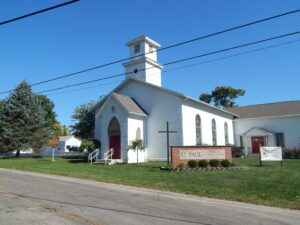
On July 30, 1816, the year before the establishment of Butler Township, a group of farmers of German background founded the Stillwater Church. The log structure with adjoining cemetery was located on three acres between Dog Leg Road and Frederick Pike. In 1842, the congregation replaced the log building with a brick one. In 1873, they moved the building to the northeast corner of Dog Leg and Little York Roads and renamed it St. Paul Lutheran Church. With a fruitful history of sharing God’s love, St. Paul celebrated it’s 200th anniversary on Sunday, July 31, 2016.
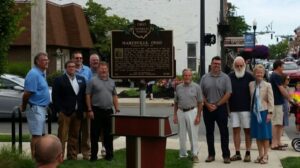
Marysville, Ohio. On August 10, 1819, Samuel W. Culbertson (1780-1840), a Zanesville lawyer, established Marysville at the convergence of Mill Creek and the road connecting Delaware to Urbana. Culbertson purchased 450 acres of land on July 10, 1817 and authorized Charles Roberts to survey the village, which originally contained 96 lots. Culbertson named the village in honor of his daughter, Mary Ellen (1810-1853), who later married US Congressman, Joshua Mathiot (1800-1849). The village was originally in Delaware County, located in part of the Virginia Military District. It was land given as bounties to soldiers from Virginia after the Revolutionary War. Union County, which included Marysville, was created in 1820, and Marysville became the county seat in 1822. (Continued on other side)
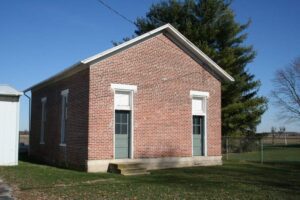
Elizabeth Township was founded in 1807. The Elizabeth Township House was built about 1870, serving as the community’s assembly hall. The building is similar to the seven remaining one-room, brick schoolhouses, built throughout the township between 1868 and 1873. In 1997, the township was added to the National Register of Historic Places as Ohio’s first rural historic district. The district includes all of Elizabeth Township and parts of Staunton and Bethel townships. This marker erected to commemorate the 200th anniversary of the township’s founding.
Slifers Presbyterian Church is on land deeded to the local faith community by Philip and Elizabeth Slifer on December 2, 1816. Rev. Thomas Winters of the German Reformed Church and Rev. John C. Dill of the Evangelical Lutheran Church ministered to people of German descent who settled in the area. During the “cold plague” (a malaria-like malady) of 1819, they ministered to the sick and grieving, renewing the faith of many. The community pooled their limited resources and began building their first log church in 1819. It was completed in 1825 and expanded later that year as the congregations grew. They erected their first brick church in 1858 for a cost of $500. Pastors conducted services for both Lutheran and Reformed congregations in German.
Thomas Cowan Bell, James Parks Caldwell, Daniel William Cooper, Isaac M. Jordan, William Lewis Lockwood, Benjamin Piatt Runkle, and Franklin Howard Scobey met in a second floor room of this building to found Sigma Chi (ΣΧ) in early 1855. All but Lockwood had been members of Delta Kappa Epsilon (ΔΚΕ) but left over a disagreement as to who should be elected poet of Erodelphian, one of Miami University’s literary societies. Runkle and Caldwell, who lived here, designed Sigma Chi’s badge, the White Cross. Reflecting the ideals of Friendship, Justice, and Learning, the Brothers donned the badge and established Sigma Chi on Commencement Day, June 28, 1855. The founding of Sigma Chi completed the Miami Triad, which includes Alpha (founding) chapters of Beta Theta Pi (ΒΘΠ, 1839) and Phi Delta Theta (ΔΘ, 1848). Miami University and Union College in Schenectady, New York are known as the “Mother of Fraternities.” (Continued on other side)
Considered the first citizen of the East Side, Peter Navarre, along with his brother Robert, first settled the land east of the Maumee River in 1807. A fur trader by profession, Navarre was experienced in wilderness survival and had a deep understanding of Native American life. He died on March 20, 1874, and was buried at Mt. Carmel Cemetery across the river from his beloved East Toledo. In 1922, the City of Toledo declared September 9th Peter Navarre Day, an official city holiday. This marker commemorates the 200th anniversary of the founding of East Toledo.
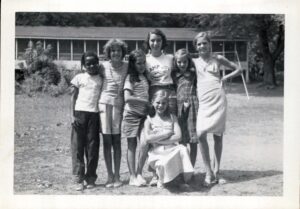
Camp Joy was born at the site of Seven Hills Neighborhood House and original location of St. Barnabas Episcopal Mission Church. Displacement and loss caused by Ohio River flood of 1937 inspired St. Barnabas’ rector and his wife, Laurence “Cap” and Sadie Hall, to act on behalf of the children of Cincinnati’s West End. The Halls conceived of Camp Joy as a haven where kids could find a respite from impoverished surroundings in the city and its sweltering summer heat. The camp was a success and continued after the Halls’ assignment to another parish. From 1940-1944, Rev J. Brooke and Mrs. Betty Mosley continued to nurture the people of the West End through St. Barnabas and Camp Joy. (Continued on other side)