

, OH
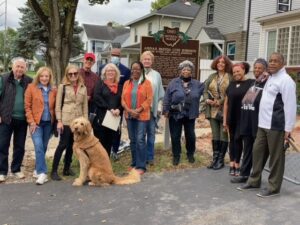
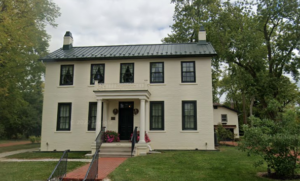
Aminah Brenda Lynn Robinson (1940-2015) and her son Sydney moved into this home in 1974. The artist, a visual historian, lived and worked here in the Shepard community until her passing. Raised in Columbus’s Poindexter Village and educated in the local public schools, Robinson also studied at Columbus College of Art and Design and The Ohio State University. Her art reflected stories handed down from her elders, experienced within her community, and the local history she researched while working at the Columbus Metropolitan Library. She received a 2004 MacArthur Award for her celebration of “family, ancestry, and the grandeur of simple objects in drawings, paintings, and large-scale, mixed-media assemblages.” (Continued on the other side)
, OH
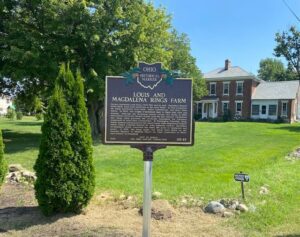
German immigrant Louis Rings (1826-1911) and his wife, Magdalena Wolpert (1835-1924), built their farmhouse in the early 1860s. As they prospered, the Rings purchased more land, added outbuildings, and grew their family. In 1904, the couple transferred land to their sons John and William. Although the farmhouse passed outside the family in 1929, descendants lived and farmed nearby until the 21st century. Farmsteads like Rings Farm provided the economic foundation for European immigrants to build Ohio communities. In Washington Township, Rings family members participated in the school board while Magdalena’s Wolpert family helped establish Dublin’s St. John Lutheran Church. Spreading development slowly converted the farm’s 150 acres to businesses and homes. In 1979, the Rings house and barns were listed on the National Register of Historic Places for their connection to Ohio’s agricultural development.

, OH
Iuka Ravine, developed on land from the “Indianola Farm” that belonged to the Neil Family, is significant for its early 20th century architecture. The ravine’s natural beauty influenced architects to design homes for the upper middle class that incorporated “features of the old oak forest and glacial boulders.” Several ravine homes were designed by Frank Packard and Charles Inscho. Two classically-designed bridges built in 1912 insulated the area from traffic to create what became known during the 1920s-1950s as a “quiet professor enclave.” Iuka’s curvilinear street, one of the first in Columbus, as well as its stone walls, glacial erratics, and mature hardwoods created a “unique urban experience.” The Iuka Ravine Historic District was listed in The National Register of Historic Places in 1986 and added to the Columbus Register of Historic Properties in 1985.
, OH
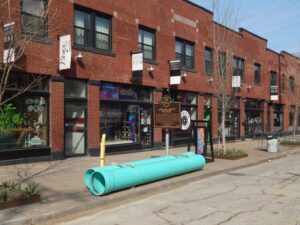
This block of W. 29th Street was home to Cleveland’s vibrant LGBT community and central to the development of the modern LGBT civil rights movement. In 1988, the Striebinger Building, at 1418 W. 29th, housed Cleveland’s Lesbian-Gay Community Services Center, which addressed the needs of the LGBT community. Cleveland’s first Pride Festival since the mid-1970s was held on the block in 1989, and in 1990 Cleveland’s first Pride Parade culminated here. During the HIV/AIDS crisis, The Living Room and ACT UP were located in the Striebinger Building and gave support to those with HIV/AIDs and provided a platform for political activism. It was on this block where many people could find their voices to “come-out” and advocate for their rights and their humanity. (Continued on other side)
, OH
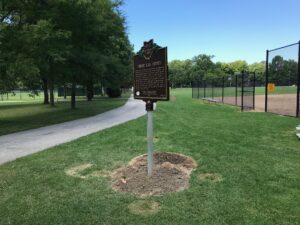
Beginning in 1873, oil magnate and philanthropist John D. Rockefeller purchased 700 acres of land in East Cleveland Township, now located in East Cleveland and Cleveland Heights. A failed hotel built in 1874-1875 served as the family’s summer home until it was destroyed by fire in 1917, although Rockefeller’s son, John, Jr., continued to visit the grounds. The Rockefellers spent much of their time outdoors, where they built on the land’s natural beauty and carefully designed and built carriage, foot and bridle paths, scenic views, lakes, a lily pond, stone bridges, a horse track and a gold course. John, Jr. purhcased all of his father’s Forest Hill property in 1923 and continued to buy adjacent land.
, OH
Hugh Grant Sr. (1769-1806) owned a gristmill and land in Pittsburgh, Pennsylvania, during the 1790s. He married Catharine Barr Grant (unknown-1836) and they had 6 children: Alexander, Jacob, Isabella, Nancy, Mary, and Hugh Grant Jr. (born posthumously). In 1804 Grant purchased 450 acres of federal land at the Chillicothe land office. In 1805 he and his family moved to Jackson Township, Ohio. Uncertain of the location of his tracts, he settled his family in a log structure along the Scioto River. During the winter of 1806-1807, Grant died in a freak accident climbing a honeybee tree. Catharine Barr Grant realized they were on the wrong land and moved her family to the right property holdings where the Grant Homestead remains. She died August 17, 1836, and is buried in Union Methodist Cemetery.
, OH
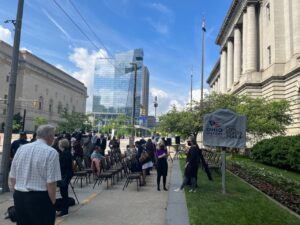
Carl Stokes was born in Cleveland on June 21, 1927. Recognized for his trailblazing service as a public official, Stokes is one of the few American politicians whose career spanned all three branches of state government. Over 30 years, he served 3 terms as an Ohio legislator (1963-1967), 2 terms as Cleveland’s mayor (1967-1971), and 8 years as a municipal court judge (1983-1994). In 1972, he became the first Black anchorman for a television station in New York City. After a decade working in television, Stokes returned to Cleveland to work as an attorney for the United Auto Workers. In 1994, President Bill Clinton appointed him U.S. Ambassador to the Republic of Seychelles. While serving as Ambassador, he was diagnosed with cancer. Carl Stokes died, in Cleveland, on April 3, 1996.
, OH
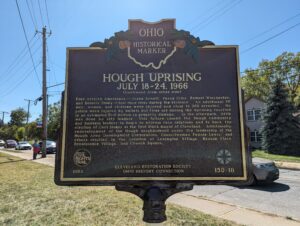
Civil unrest rocked the Hough neighborhood for five nights during the summer of 1966.When the white owners of the Seventy-Niners Cafe refused to serve a Black customer a glass of water, a sign bearing a racial epithet subsequently appeared outside the bar. Decades of institutionalized racial practices that had caused Hough’s substandard and overcrowded housing, high unemployment, economic exploitation, lack of access to quality education, and systemic police harassment sparked an urban uprising in response on July 18. Angry crowds gathered outside the bar only to be confronted by the owners brandishing firearms. When the police belatedly responded, tensions escalated into targeted firebombing, looting, and vandalism. On Tuesday night, July 19, Cleveland’s Mayor Ralph Locher requested that the Ohio National Guard restore order. (Continued on other side)