

, OH
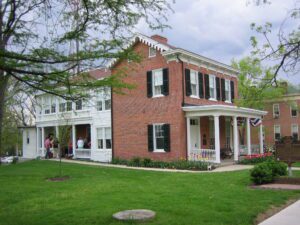
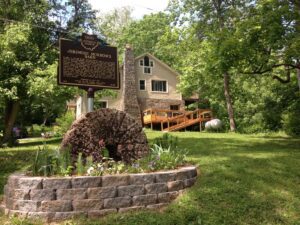
William Holmes McGuffey (1800-1873) was a Miami University faculty member in 1836 when he compiled the first edition of the McGuffey Eclectic Reader in this house. His Reader taught lessons in reading, spelling, and civic education by using memorable stories of honesty, hard work, thrift, personal respect, and moral and ethical standards alongside illustrative selections from literary works. The six-edition series increased in difficulty and was developed with the help of his brother Alexander Hamilton McGuffey. After the Civil War the Readers were the basic schoolbooks in thirty-seven states and by 1920 sold an estimated 122 million copies, reshaping American public school curriculum and becoming one of the nation’s most influential publications. (Continued on other side)
, OH
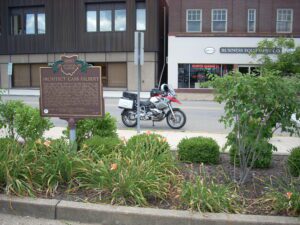
One of America’s leading architects of the early 20th century, Cass Gilbert (1859-1934), was born in a home that stood at this site. After studying at the Massachusetts Institute of Technology, Gilbert apprenticed with prominent architectural firm McKim, Mead, and White. The critical success of his first major public building, the design of the 1895 Minnesota State Capitol, established his national reputation. His influential 1912 Woolworth building, at 792 feet, was then the world’s tallest building, earning Gilbert’s nickname of “Father of the Modern Skyscraper.” Combining classical designs with modern technology, Gilbert also created the United State Supreme Court building (1932) in Washington, D.C., an enduring icon of American justice and democracy. His other achievements include the Arkansas and West Virginia capitols, the U.S. Custom House in New York, and several buildings at Oberlin College. Gilbert served as the president of the American Institute of Architects and the National Academy of Design.
, OH
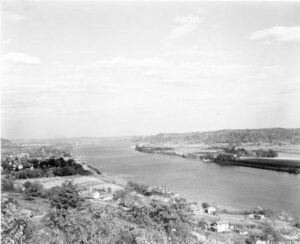
The Ohio River, the southeast border of Gallia County, played a significant role in the development of Gallipolis and Gallia County. One of the state’s first thoroughfares, this waterway enabled pioneers to settle in what was known as the Northwest Territory. On October 17, 1790, approximately 500 French immigrants arrived in Gallipolis, traveling by flatboats from Pittsburgh, and settled in log cabins in what is now City Park, in the heart of Gallipolis. This established the second oldest permanent settlement in the territory. The settlers relied on the River for communication, commerce, and transportation, and the River brought postal service to Gallipolis in 1794. As local business and river trade developed in the 1800s, Gallipolis became a thriving port. The scenic Ohio River is an important inland waterway, providing transportation for many commodities between major cities. The River also provides recreational opportunities for both visitors and residents, including water sports, fishing, and boating.
, OH
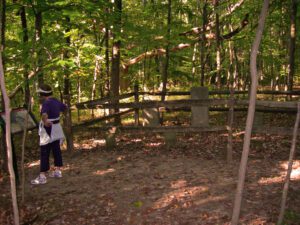
Congress established the United States Military District in 1796 by an act to provide bounty land for Revolutionary War officers and soldiers. District lands consisted of 2.6 million acres in twelve Ohio counties, including Delaware County. The Union Land Company, organized by James Kilbourne of Connecticut in 1806, was formed to purchase Military District land. Kilbourne purchased 4,000 acres in southeast Liberty Township, Delaware County for $7,000, and, in turn, sold the land to 26 Union Land Company members for $2.00 per acre. Five members were from the Case family, and they purchased 950 acres–Ambrose, George, Jonathan, Seth, and Silas. George and Seth were Revolutionary War veterans who did not claim their bounty lands. George purchased lot 11, a part of which is in northwest Highbanks Park today, and Seth purchased 300 acres north of this site. By 1849 the Case family owned over 1,000 acres.
, OH
In 1795, at the age of 23, Jeremiah Morrow came to the Northwest Territory from Pennsylvania. He purchased land along the Little Miami River in Deerfield Township and in 1799 married Mary Parkhill of Pennsylvania. Around 1800 he built this barn which is one of Warren County’s oldest standing structures. In 1801, Morrow was sent to the Second Territorial Assembly and to the first Ohio Constitutional Convention in 1802. In 1803, he was elected the new state’s first U. S. Congressman and was Ohio’s only congressman for ten years. In 1813 the Ohio legislature elevated him to U.S. Senate. In 1822 he became Ohio’s ninth governor. He went on to serve in both the Ohio House and Senate and at age 69 returned to Congress. An extraordinary man, Jeremiah Morrow gave his country 43 years of public service.
, OH
“I thought of the great bandits of the old West [like] the James Brothers…They knocked over trains, and I was going to pull the same stunt,” exclaimed notorious gangster Alvin “Creepy” Karpis. On November 7, 1935, Karpis and his bandits held up Erie Train #626 at this former location of the Garrettsville Train Depot, escaping with over $46,000 in cash and securities. Because of this last great train heist in American history, FBI Director J. Edgar Hoover and his Government Men (G-Men) improved their surveillance methods to capture Karpis. Once labeled “Public Enemy Number One,” Alvin Karpis became Hoover’s first arrest on May 1, 1936. Local legend holds that FBI agents flooded this town searching for Karpis and his accomplices, and this led the James A. Garfield School District to adopt the G-Men as the mascot for its athletic teams.
, OH
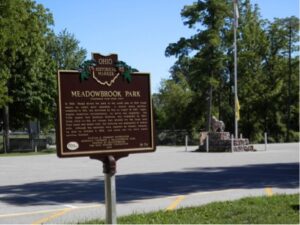
Meadowbrook Park began as a Tiffin, Fostoria & Eastern Electric Railway plan to draw weekend riders. Laura Stephenson Sneath, wife of a major company stakeholder, led the park development. Originally north of Wolf Creek, Meadowbrook included a baseball diamond and a 1902 dance pavilion. In 1923, William Richards purchased the buildings and leased the land from Henry Matthews of Matthews Boat Company. The pavilion was destroyed by fire under suspicious circumstances on October 12, 1925, but no one was charged. James Garfield Haugh, president of the Gem Manufacturing Company, purchased the land in 1925. (Continued on other side)
, OH
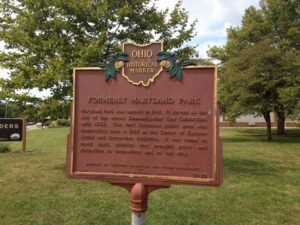
Maryland Park was opened in 1921. It served as the site of the annual Emancipation Day Celebration until 1933. The first Columbus public pool was constructed here in 1929 as the Center of Eastside Social and Recreation Activities. It was home to many black athletes who brought pride and distinction to themselves and to the city.