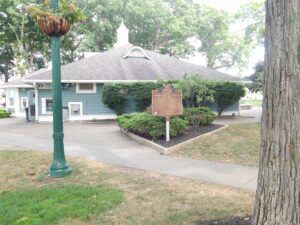
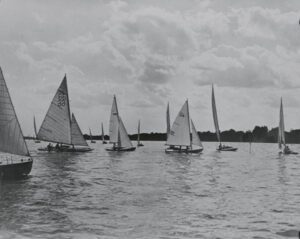
Entrepreneur and philanthropist Joseph (Jose) de Rivera was born in Barcelona, Spain, and built an import business in New York City. In 1854, he bought six Lake Erie Islands and had South Bass Island surveyed and subdivided into ten-acre lots. De Rivera traveled between New York and South Bass Island, initially turning Put-in-Bay into a sheep farm. He encouraged settlement on the island and its wine industry by helping German immigrants purchase land to plant vineyards. He donated five acres for this waterfront park, the site for the first school, and the land for the first church. To promote travel to the island, de Rivera opened the island’s largest cave as a tourist attraction. He is buried in the island’s cemetery, which is on land he donated for that purpose.
Formed by the retreating glacier more than 14,000 years ago, Buckeye Lake first existed as a shallow, swampy pond, named “Buffalo Swamp” by Ohio Company explorer Christopher Gist in 1751. Beginning in 1826 the State developed it as a water source for the Licking Summit of the Ohio and Erie Canal, it being the highest level between the Scioto and Licking rivers. Engineers dammed the north and west sides of the swamp, inadvertently creating a unique floating sphagnum-heath bog surrounded by water. Cranberry Bog, with boreal vegetation typical of glacial-era Ohio, is a registered National Natural Landmark. (continued on other side)
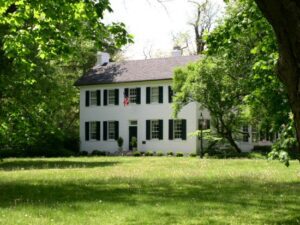
John Anderson Ward had this Federal style house constructed from 1823-1825 on land inherited from his father, Urbana’s founder Colonel William Ward. The Colonel’s will stipulated that a local mason use 26,500 bricks to build the house and be paid $80.00. The original house is thought to have had four rooms, two rooms each on the first and second floors and both divided by central hallways. John and his wife Eleanor Ward reared seven children in the house, two of whom became nationally recognized artists, John Quincy Adams Ward and Edgar Melville Ward. The farmstead, consisting of 172 acres, was also the site of a huge feast held in honor of General William Henry Harrison’s visit to Champaign County during his 1840 presidential campaign. Twelve 300 foot-long tables were spread across the lawn where thousands of people from the surrounding countryside dined on barbecued beef and lamb and drank barrels of cider.
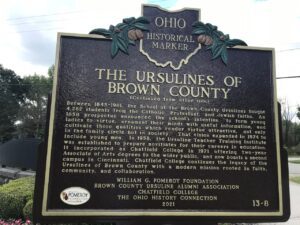
On July 21, 1845, eleven Ursuline sisters from Boulogne-sur-Mer and Beaulieu, France, arrived in St. Martin, Brown County, Ohio. A Catholic order of sisters known for providing quality education to young women, the Ursulines were invited by Cincinnati Archbishop John Baptist Purcell (1800-1883) to establish a school in the diocese and granted approximately 400 acres in St. Martin for that purpose. Led by Mother Julia Chatfield (1808-1878), the sisters quickly established their convent, a day school, and, within the year, admitted their first boarders. Originally known as The Saint Ursula Literary Institute, the school operated for the next 136 years. The Ursulines educated local students from their adopted Brown County as well as many who came from across the U.S. and farther abroad to board on campus. (Continued on other side)
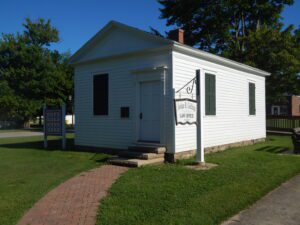
This building served as the law office to Joshua Reed Giddings, a Whig congressman who advocated for the abolition of slavery and an end to the domestic slave trade. Born in 1795, much of Giddings’ young life was occupied by working on his father’s farm. After serving in the War of 1812, he began to study law, gaining admittance to the bar in 1821. A successful lawyer, Giddings was elected to the Ohio House of Representatives in 1826. In 1837, he was elected as a Whig to the U.S. House of Representatives, where he quickly established himself as a staunch opponent of slavery. In 1854, he joined the Republican Party, contributing greatly to the platform during the party’s conventions of 1856 and 1860. As reward for his dedication, President Abraham Lincoln appointed him as consul- general to Canada, where he served until his death in 1864.
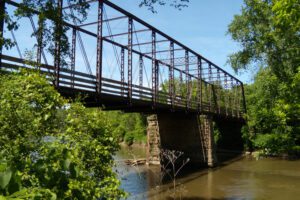
Construction of the Ohio and Erie Canal, beginning in Cleveland and running south to Portsmouth, began in 1825. As a means to pay for debts on the community’s 5,500 acres of Tuscarawas County land, members of the Society of Separatists of Zoar contracted to construct this portion of the canal. They received $21,000 for this work, which was completed in 1827. Surplus goods were transported on Society owned and operated canal boats to outside markets via the Ohio and Erie Canal, which also brought manufactured items into Zoar. (continued on other side)
Toledo High School opened in 1854 on the site of the city’s first log schoolhouse. After an 1895 fire, it was rebuilt and named Central High School. The facility closed in 1914 with the opening of Scott and Waite high schools. It reopened as Woodward Technical School and later became Vocational High. The building was razed in 1938 for construction of the Toledo Public Library.
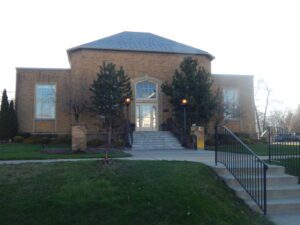
Listed on the National register of Historic Places in 1974, this building was the post office from 1940 through 1986. It is an example of the Colonial Revival style common in the 1930s and 1940s. The exterior brick work, large Palladian window, and simple design were common in the building plans for era post offices. This simplicity enabled unskilled workers to be employed in public works projects. The building’s interior still has the original portico, wood and marble-paneled walls, terrazzo floors, and mailing lobby. (Continued on other side)