

, OH
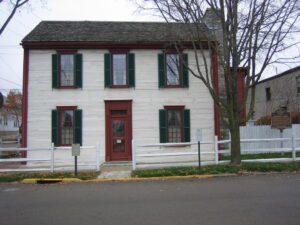
Benjamin Overfield (1774-1831), son of a Revolutionary War soldier, opened his tavern in this log house on September 13, 1808. Never moved, it is the oldest surviving building in Troy. The tavern provided food, lodging and space for business and social gatherings. Overfield agreed to let the county use a room on the second floor of the building as a temporary courtroom. Behind the tavern, Benjamin built a small log cabin that was home to his family. He prospered here until 1825 when he moved to the Public Square. Today’s structure includes the tavern, the cabin, and later additions. Used as a dwelling from 1825 until 1948, the building now houses the Overfield Tavern Museum. Benjamin Overfield and his first wife Mary are buried in Rose Hill Cemetery.
, OH
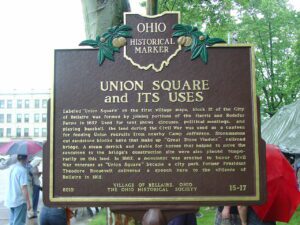
Labeled “Union Square” on the first village maps, block 12 of the City of Bellaire was formed by joining portions of the Harris and Rodefer Farms in 1857. Used for tent shows, circuses, political meetings, and playing baseball, the land during the Civil War was used as a canteen for feeding Union recruits from nearby Camp Jefferson. Stonemasons cut sandstone blocks here that make up “Great Stone Viaduct” railroad bridge. A steam derrick and stable for horses that helped to move the sandstone to the bridge’s construction site were also placed temporarily on this land. In 1882, a monument was erected to honor Civil War veterans as “Union Square” became a city park. Former President Theodore Roosevelt delivered a speech here to the citizens of Bellaire in 1912.
, OH
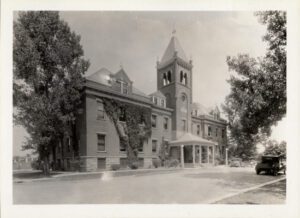
Central State University originated on March 19, 1887, when the Ohio General Assembly passed an act establishing a Combined Normal and Industrial (CN&I) Department at Wilberforce University. Through various transitional changes, it emerged as an independent, state university. In 1941, the General Assembly expanded the CN&I, which offered two-year courses, into the College of Education and Industrial Arts, with four-year programs. In 1947, it separated from Wilberforce University. The history of Central State University tells the history of higher education and advancement for African Americans in Ohio. It is within the walls of these structures, and others unfortunately demolished or destroyed by the 1974 tornado, that thousands of African Americans received valuable training for successful and rewarding careers. Thus, many of the contributions of African Americans to the promotion and betterment of education, medicine, law, social justice, technology, and the arts in Ohio have their roots here on the campus of Central State University.
, OH
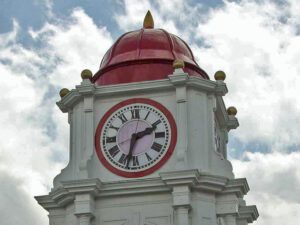
The Bellaire High School Clock Tower was erected in 1925 as the second town clock to be mounted on Bellaire’s public schools. C.W. Bates of Wheeling designed this tower, built by C.D. Keyser & Co. of Bellaire. The school building stretches 256 feet along 35th Street, and the tower rises 40 feet above the 3rd floor parapet of the roof. The clock faces are 6 feet, 7 inches in diameter. At the exterior corners of the bell room are 11 foot columns. The tower dome is painted red. E. Howard & Co. of Boston made the clock works and the McShane Bell Foundry of Baltimore cast the bell in August 1888. The BHS Alumni Association lighted the tower in 1998 to honor all “faithful and true-hearted” graduates of the school.
, OH
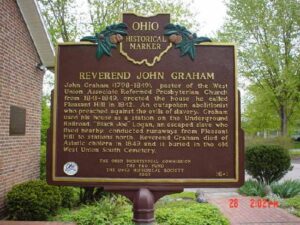
John Graham (1798-1849), pastor of the West Union Associate Reformed Presbyterian Church from 1841-1849, erected the house he called Pleasant Hill in 1842. An outspoken abolitionist who preached against the evils of slavery, Graham used his house as a station on the Underground Railroad. “Black Joe” Logan, an escaped slave who lived nearby, conducted runaways from Pleasant Hill to stations north. Reverend Graham died of Asiatic cholera in 1849 and is buried in the old West Union South Cemetery.
, OH
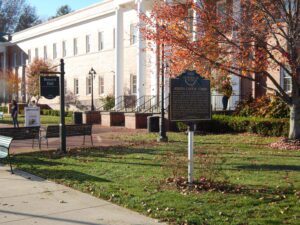
Joseph Carter Corbin’s work in the Reconstruction-era south after the Civil War created many educational opportunities for African Americans. Corbin (1833-1911) was a professor, administrator, journalist, linguist, and musician. Born in Chillicothe, Ohio to free African American parents, he earned his bachelor’s degree and two masters’ degrees from Ohio University, in 1853, 1856, and 1889, respectively. In 1872, Corbin and his wife Mary moved to Arkansas where he served as the state superintendent of public education. In 1875, Corbin was appointed principal of Branch Normal College, which became the University of Arkansas at Pine Bluff. In 1898, he co-founded and became president of the Arkansas Teachers Association. He was also a leader in the Prince Hall Masons, an African American Masonic order. He served as a secretary and Grand Master of the lodge’s Arkansas chapter.
, OH
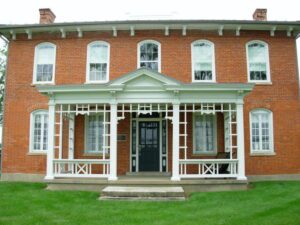
Known as the “Halfway House,” the Gooding House and Tavern was built by George B. Gooding halfway between the towns of Worthington and Delaware in 1827. Its location was influenced by construction of the Columbus and Sandusky Turnpike that was chartered by the State of Ohio the year before. Also known as the “Mud Pike,” the turnpike was slow and difficult for travelers and could take nearly a day to travel 10 miles. The Gooding House was the perfect place for stagecoach drivers to change teams of horses and for travelers to rest and have refreshments. George Gooding also prospered as a farmer with over 1,000 acres of land. This stately brick farmstead remained in the Gooding family for 175 years with each succeeding generation adding its imprint on the property. The Gooding House and Tavern was listed on the National Register of Historic Places in 2005 and restored in 2007.
, OH
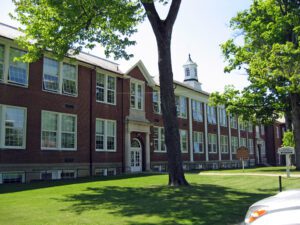
Poland Academy, an elite private school, was established on this site in 1830 and in 1859 graduated its most notable student William McKinley, who became the 25th president of the United States. In 1862, the school changed its name to Poland Seminary and was one of the first schools in northeast Ohio to admit girls on an equal basis. Ida Tarbell, who became a prominent national journalist and author was Preceptress of the Seminary from 1880-1882. William Calhoun graduated from the Seminary and became the U.S. Ambassador to China from 1910-1913. The school became a public institution in 1909 when it became the Poland Seminary High School. In 1972 it was the site of Poland Junior High School and Poland Middle School in 1985.