The Ohio General Assembly established the Ohio Agricultural Experiment Station in 1882. From its inception until 1892, the Station occupied 17 acres on the Columbus campus of The Ohio State University before relocating to 470 acres in Wayne County. In 1965, the Station changed its name to the Ohio Agricultural Research and Development Center (OARDC) to more accurately reflect its mission and programs. In 1982, the Center formally merged with The Ohio State University. Today, the Center encompasses nearly 2,100 acres in Wayne County with 10 branches located across the state for a total of approximately 7,100 acres dedicated to agricultural research.
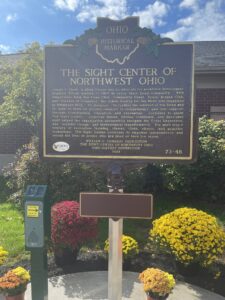
Joseph F. Clunk, a blind Ohioan and an advocate for workforce development, inspired Toledo leaders in 1923 to serve their blind community. With cooperation from the Lions Club, Community Chest, Toledo Rotary Club, and Chamber of Commerce, the Toledo Society for the Blind was organized in November 1923. Its purpose, “to further the interest of the blind and to open to them all possible avenues to independence and self-support, through investigation, education, and recreation,” continues to guide The Sight Center. Generous donors, tireless volunteers, and dedicated staff helped the organization successfully navigate the Great Depression, war, societal change, and technological transformation. For more than a century of innovative training, classes, clubs, clinics, and assistive technology, The Sight Center continues to empower independence and enrich the lives of people who are blind or have low vision.
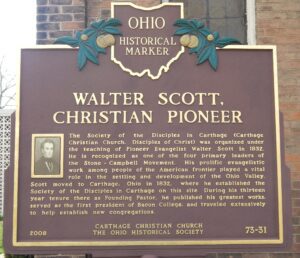
The Society of the Disciples in Carthage (Carthage Christian Church, Disciples of Christ) was organized under the teaching of Pioneer Evangelist Walter Scott in 1832. He is recognized as one of the four primary leaders of the Stone-Campbell Movement. His prolific evangelistic work among people of the American frontier played a vital role in the settling and development of the Ohio Valley. Scott moved to Carthage, Ohio in 1832, where he established the Society of the Disciples in Carthage on this site. During his thirteen year tenure there as Founding Pastor, he published his greatest works, served as the first president of Bacon College, and traveled extensively to help establish new congregations.
The Council of International Programs USA (CIPUSA) promotes international understanding in global communities through professional development and cross-cultural exchange. CIPUSA evolved from the Cleveland International Program, a professional and cultural exchange program for youth leaders and social workers, established by Dr. Henry B. Ollendorff in 1956. By 2003, CIPUSA had grown to include nine affiliate offices nationwide, including two offices in Ohio, the Cleveland International Program and the Columbus International Program. Since its founding, CIPUSA has brought over 10,000 professionals for practical training from 147 countries. As a leader in international exchange CIPUSA continues Ollendorff’s vision–leading people to international training exchange programs in a variety of fields, including social services, business, and education.
George Bellows (1882-1925) is widely recognized as one of America’s premier artists. His vivid portrayals of modern urban life have become indelible icons of American art. Born and reared in Columbus, he retained close ties here throughout his life. Bellows gained fame while a young artist in New York, becoming a key figure among a group of artists nicknamed the “Ashcan School” because of their preference for commonplace subjects painted in dark colors. Bellows also excelled at printmaking, and it was largely through his efforts that lithography came to be accepted as a fine art in America. Bellow’s career was unexpectedly cut short by his death from complications following an appendectomy at the age of forty-two.
Directly across the Cuyahoga River from this spot is the South Park Village. Here, archeologists uncovered the remains of a four-acre, Native American settlement populated by people of the Whittlesey Tradition. The people of South Park lived in communal structures and grew maize, beans, and squash in the floodplain fields that surround you. Food remains found in the village excavations reveal that they hunted deer, elk, black bear, and other game and gathered clams and fish from the Cuyahoga River. South Park was abandoned and reoccupied several times between A.D. 1000 and 1600. Numerous seasonal campsites have been found on the floodplains and terraces on both sides of the river. The first localized cultural development unique to this area, Whittlesey sites have been identified upriver from here in Summit County and in the Chagrin and Grand River valleys to the east.
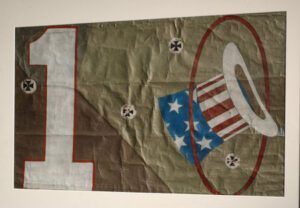
America’s World War I “Ace of Aces,” Edward Vernon Rickenbacker was born in Columbus in 1890 to Swiss immigrant parents, leaving school at age 12 to help support his family. Working for several Columbus automobile companies initiated his love of racing, and he achieved fame as a race driver and team owner between 1910 and 1916. Enlisting in the U.S. Army in 1917, he went to France as staff driver for General John Pershing with ambitions of becoming a combat flier. He managed a transfer to the American Expeditionary Force’s Aviation Instruction Center, learned to fly, and was assigned to the 94th Aero Squadron, the famed “Hat in the Ring” squadron led by ace Raoul Lufbery. (continued on other side)
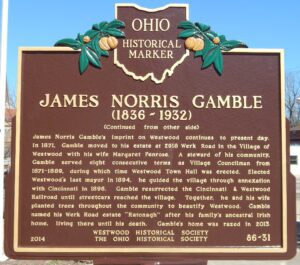
James Norris Gamble, entrepreneur, industrialist, philanthropist and civic leader, is best known for inventing Procter & Gamble’s Ivory Soap, the “soap that floats,” in 1878. Applying a scientific approach, Gamble transformed P&G into a nationally recognized corporate leader and creator of consumer products for a rapidly growing America. Beyond P&G, Gamble financed early efforts to educate freed southern slaves as an original sponsor of the Freedmen’s Aid Society. Later, he underwrote civil rights leader Mary McLeod Bethune’s work to educate poor African American women. In Cincinnati, Gamble’s philanthropy included endowment of Christ Hospital and the founding of its Institute of Medical Research. Gamble funded completion of University of Cincinnati’s Nippert Stadium in 1924 as a tribute to his late grandson.