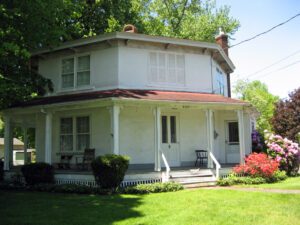
This eight-sided house reflects a widespread pre-Civil War architectural fad. Promoted by phrenologist Orson S. Fowler in his 1848 book A Home for All as a way to “bring comfortable homes within the reach of the poorer classes,” the octagon made efficient use of interior space and natural ventilation. More than thirty octagonal houses are known to have been built in Ohio, and at least twenty-five survive. This example was built circa 1854 and purchased by cabinetmaker Amirus Darrow in 1864. The exterior walls are constructed of chestnut beams between layers of concrete. It was added to the National Register of Historic Places in 1971.
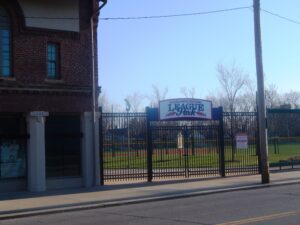
League Park opened on May 1, 1891, with the legendary Cy Young pitching for the Cleveland Spiders in their win over the Cincinnati Redlegs. The park remained the home of Cleveland’s professional baseball and football teams until 1946. In 1920 the Cleveland Indians’ Elmer Smith hit the first grand slam home run, and Bill Wamby executed the only unassisted triple play, in World Series history. Babe Ruth hit his 500th home run over the park’s short right field wall in 1929. With the park as home field, the Cleveland Buckeyes won the Negro World Series in 1945.
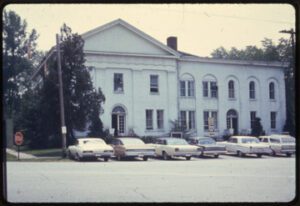
Mahoning County was created in 1846 by combining townships from southern Trumbull and northern Columbiana counties. Canfield engaged in competition with several surrounding communities for the new county seat, and its success was attributed to its central location along with the state and local political influence of Judge Eben Newton and Elisha Whittlesey, Esq., Comptroller of the United States Treasury from 1849-1857. To become the county seat, the State of Ohio required “a suitable lot and $5,000 toward public buildings” Judge Newton donated the land and spearheaded the subscription of the state required bond. Once attained, construction progressed rapidly on the Classical Revival style courthouse, completed in June 1848. The Italianate style West wing was added in 1862, but its government status was challenged when in the early 1870s, Youngstown, by now a city, resumed its earlier challenge for the county seat. (continued on other side)
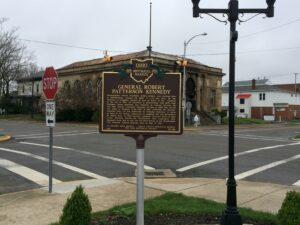
Distinguished citizen, legislator, public servant, and historian born in Bellefontaine, January 23, 1840. A Civil War hero, he was promoted to brigadier general at only 25 years of age. Admitted to the bar in 1866, he practiced in Bellefontaine until 1878 when President Hayes appointed him Collector of Internal Revenue. He was then elected Lieutenant Governor of Ohio in 1885 then served two terms in Congress from 1887 to 1891. Following the Spanish-American War, he was appointed by President McKinley to serve as head of the Insular Commission to establish the new government of Puerto Rico. In 1903 Kennedy published Historical Review of Logan County. Kennedy started the Bellefontaine Tree Commission. Gen. Kennedy’s home was on this site and later served as the Bellefontaine City Building. General Kennedy died on May 6, 1918.
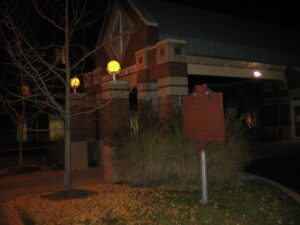
A group of concerned Cincinnati women organized, in 1855, The Protestant Home for the Friendless and Female Guardian Society as a private, not-for-profit maternity home for destitute women and children. These public minded social leaders were aware that Cincinnati had grown beyond the time when the poor or unfortunate were cared for by their neighbors. The Home, which was funded through bequests and personal donations, was founded to care for poor mothers and babies, unmarried pregnant women, wanderers and strangers in the city, and to promote adoptions. (Continued on other side)
E side of Intersection of Symmes Road and Marl Road
Wright Patterson AFB
, OH
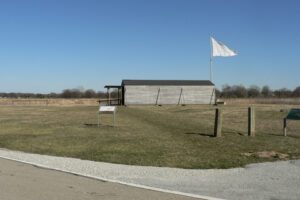
Huffman Prairie Flying Field, a unit of the Dayton Heritage National Historical Park, is the site where Wilbur and Orville Wright flew and perfected the world’s first practical airplane, the 1905 Wright Flyer III, after their first flights in Kitty Hawk, North Carolina in 1903. The Wright brothers mastered the principles of controlled, powered flight at Huffman Prairie during 1904 and 1905. From 1910 to 1915, they operated the Wright School of Aviation here, training many of the world’s first pilots, including many military pilots.
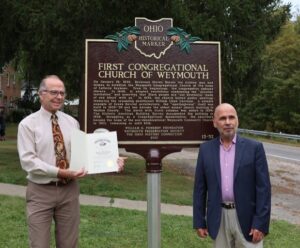
On January 19, 1835, Reverend Steven Barnes led sixteen men and women to establish the Weymouth Congregational Church at the home of Lathrop Seymour. From its beginnings, the congregation opposed slavery. In 1848, it adopted resolutions condemning the “peculiar institution” and asserting that Black people are “our brother[s] ‘made one blood’ with us.” In 1853, the church hosted public meetings featuring the crusading abolitionist William Lloyd Garrison. A notable example of Greek Revival architecture, the “meetinghouse” itself was built in 1835-’36 and has become the oldest extant church building in Medina County. The porch with Doric columns was added in 1854. The Historical American Building Survey documented the building in 1936. Struggling as a Congregational denomination, the sactuary became the home of the non-denominational Weymouth Community Church in 1920, remaining so until 2018.
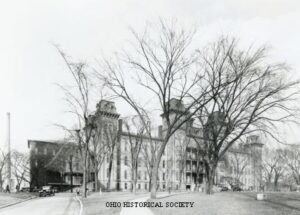
This ten acre site was purchased in 1829 for the Ohio School for the Education of the Deaf. The first school building opened here in 1834; the school was enlarged in 1845. In 1868 the original school was replaced. Another school building was added in 1899 and a hospital in 1908. The Deaf School was relocated on Morse Road in 1953.