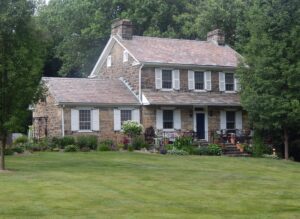
The Kyle-McCollum House, thought to be the oldest continuously inhabited residence still on its original site in Youngstown, was built by War of 1812 veteran Joshua Kyle (c. 1766-1842) and his wife Mary Stewart (c. 1774-1844). The Kyles moved from Westmoreland County, Pennsylvania, to the Mahoning Valley around 1800 and purchased about 1,300 acres of land on a hill above Mill Creek. Using stone quarried from the property, they built a house, completed in 1813. The Federal style of the house is typical of early 19th-century homes built in the Connecticut Western Reserve. The structure is two and a half stories with stone load-bearing walls that are two feet thick. Beside his farm, Kyle built a sawmill on Mill Creek near Slippery Rock, a site now under Lake Glacier. [Continued on other side]
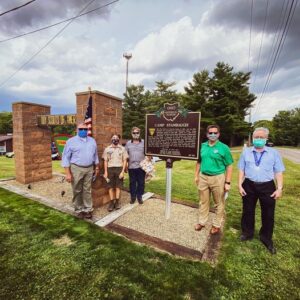
The Boy Scouts of America began in 1910, and by 1912, Scouting was established in the Mahoning Valley. Camp Stambaugh opened in July 1919, thanks to a gift from the estate of prominent local industrialist Henry H. Stambaugh (1858-1919). In his will he had named his friend and business partner Phillip J. Thompson as trustee of Stambaugh’s 86.5 acre Indian Creek Farm. Stambaugh’s expectation was that Thompson would convey the property to the local Scouting organization. In 1919 the property was mostly a treeless pasture and one could see Indian Creek from Stambaugh’s hay barn near Leffingwell Road. That first summer a Council Ring was carved from an old limestone quarry just north of the creek. (Continued on other side)
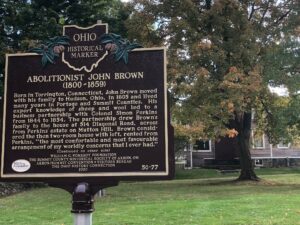
Born in Torrington, Connecticut, John Brown moved with his family to Hudson, Ohio, in 1805 and lived many years in Portage and Summit Counties. His expert knowledge of sheep and wool led to a business partnership with Colonel Simon Perkins from 1844 to 1854. The partnership drew Brown’s family to the house at 514 Diagonal Road, across from Perkins’ estate on Mutton Hill. Brown considered the then two-room house with loft, rented from Perkins, “the most comfortable and most favourable arrangement of my worldly concerns that I ever had.” (Continued on other side)
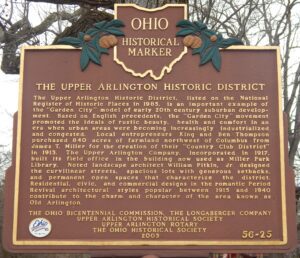
The Upper Arlington Historic District, listed on the National Register of Historic Places in 1985, is an important example of the “Garden City” model of early 20th century suburban development. Based on English precedents, the “Garden City” movement promoted the ideals of rustic beauty, health and comfort in an era when urban areas were becoming increasingly industrialized and congested. Local entrepreneurs King and Ben Thompson purchased 840 acres of farmland northwest of Columbus from James T. Miller for the creation of their “Country Club District” in 1913. The Upper Arlington Company, incorporated in 1917, built its field office in the building now used as Miller Park Library. Noted landscape architect William Pitkin, Jr. designed the curvilinear streets, spacious lots with generous setbacks, and permanent open spaces that characterize the district. Residential, civic, and commercial designs in the romantic Period Revival architectural styles popular between 1915 and 1940 contribute to the charm and character of the area known as Old Arlington.
In the early 1900s, Ohio led the nation in interurban track mileage. The electrically powered interurban was favored over steam railroads for short distance passenger travel and the transport of local freight. Incorporated in 1899, the Columbus, Buckeye Lake, and Newark Traction Railway served Bexley from a terminal on Gay Street in downtown Columbus. Running south on High Street and then east on Mound Street, the line crossed Alum Creek into Bexley, went north up Pleasant Ridge Avenue past Capital University, and continued to the National Road (Main Street). Interurban cars stopped at the northeast corner of Main Street and Remington Road and thence sped on to Buckeye Lake, Newark, and later Zanesville. The popularity of the automobile spelled doom for the interurban. Service on the line ended in 1929.
In 1822, Ralph Russell, a Connecticut pioneer who had settled in Warrensville Township ten years earlier, founded the North Union Shaker Community. The Shakers created Horseshoe Lake in 1852 when they built a dam across Doan Brook and harnessed its waterpower to operate a woolen mill near Lee Road and South Park Boulevard. The community disbanded in 1889; its 1,366 acres were eventually sold to a real estate syndicate from Buffalo, New York, the Shaker Heights Land Company. In 1896, this group deeded the Shaker Lakes Parklands to the City of Cleveland to preserve the green space in perpetuity. Ten years later, the Van Sweringen Company began to develop Shaker Heights Village as a Garden City suburb where William J. Van Aken served as mayor from 1915 until 1950. In the 1960s local residents successfully fought the proposed Clark Freeway, saving Horseshoe Lake and the Parklands from destruction.
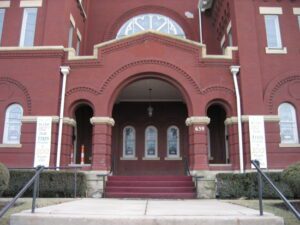
Organized in 1823 as Bethel African Methodist Episcopal Church, St. Paul A.M.E. Church is the oldest congregation of African descent in Columbus. The church, founded by Moses Freeman and 13 other members from the Town Street Church, was originally located on the east side of Lazelle Street. Several buildings were erected to meet the needs of the growing congregation. The present edifice, located at 639 E. Long Street, was completed in 1906. St. Paul has several outreach ministries, including The Prison Ministry, Alzheimer Ministry, Karen’s House, Community Development Corporation, Health Concerns Committee, St. Paul Tutorial and Enrichment Program (STEP), St. Paul Scholarship Program, St. Paul Drama Ministry, Jam’N Jefferson Park Festival, and Church Without Walls.
Intersection of W Woodruff Avenue and Mt. Vernon Avenue
Toledo
, OH
In 1915, real estate developers William B. Welles and Badger C. Bowen formed the Ottawa Park Realty Company and in 1917 platted 323 residential lots near Toledo, Ohio. Named “Westmoreland” for the similarities with the rolling landscapes of Westmoreland County, Virginia, the neighborhood was placed on the National Register of Historic Places in 1986. Westmoreland features 215 original homes, most representing architectural Revival styles of the early 20th century including those of the Colonial, Jacobethan/Tudor, Italianate, French, and Spanish Revivals. This marker commemorates the centennial of the founding of Westmoreland. (Continued on other side)