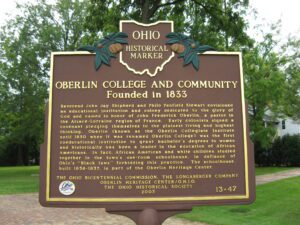
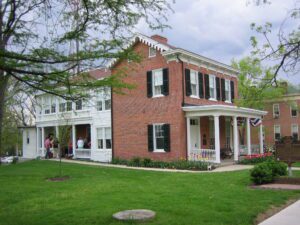
Reverend John Jay Shipherd and Philo Penfield Stewart envisioned an educational institution and colony dedicated to the glory of God and named in honor of John Frederick Oberlin, a pastor in the Alsace-Lorraine region of France. Early colonists signed a covenant pledging themselves to the plainest living and highest thinking. Oberlin (known as the Oberlin Collegiate Institute until 1850 when it was renamed Oberlin College) was the first coeducational institution to grant bachelor’s degrees to women and historically has been a leader in the education of African Americans. In fact, African American and white children studied together in the town’s one-room schoolhouse, in defiance of Ohio’s “Black laws” forbidding this practice. The schoolhouse, built 1836-1837, is part of the Oberlin Heritage Center.
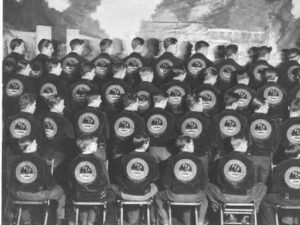
The blue corduroy jacket worn by members is a widely recognized symbol of the National FFA Organization, formerly Future Farmers of America. In 1933, Dr. J.H. “Gus” Lintner, a Fredericktown teacher and advisor to the local FFA chapter, commissioned a jacket for its members to wear to FFA’s national convention in Kansas City, Missouri. Impressed by the design, the organization adopted the jacket as part of FFA’s Official Dress. Millions of members have worn it since. Founded in 1928 to promote agricultural education, FFA continues its mission in 2018 in all 50 U.S. states and two territories.
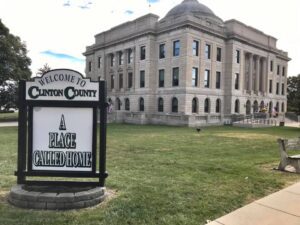
The Clinton County Courthouse was dedicated October 22, 1919. The Cincinnati firm of Weber, Werner and Adkins designed the edifice and it is a local masterpiece that fuses the Beaux-Arts and Neo-Classical architectural styles. A grand marble staircase rises from the basement to the second floor. At the center of the cruciform plan is a dome 32 feet in diameter with a stained-glass window. The murals of four women beneath the dome represent Agriculture, Education, Medicine, and Industry, and are known as the Guardians of the Courthouse. The county built courthouse and former jail for a combined cost of nearly $370,000.
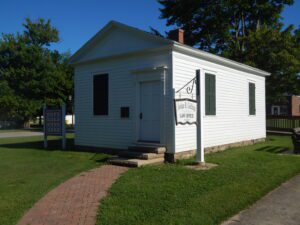
This building served as the law office to Joshua Reed Giddings, a Whig congressman who advocated for the abolition of slavery and an end to the domestic slave trade. Born in 1795, much of Giddings’ young life was occupied by working on his father’s farm. After serving in the War of 1812, he began to study law, gaining admittance to the bar in 1821. A successful lawyer, Giddings was elected to the Ohio House of Representatives in 1826. In 1837, he was elected as a Whig to the U.S. House of Representatives, where he quickly established himself as a staunch opponent of slavery. In 1854, he joined the Republican Party, contributing greatly to the platform during the party’s conventions of 1856 and 1860. As reward for his dedication, President Abraham Lincoln appointed him as consul- general to Canada, where he served until his death in 1864.
Toledo High School opened in 1854 on the site of the city’s first log schoolhouse. After an 1895 fire, it was rebuilt and named Central High School. The facility closed in 1914 with the opening of Scott and Waite high schools. It reopened as Woodward Technical School and later became Vocational High. The building was razed in 1938 for construction of the Toledo Public Library.
William Holmes McGuffey (1800-1873) was a Miami University faculty member in 1836 when he compiled the first edition of the McGuffey Eclectic Reader in this house. His Reader taught lessons in reading, spelling, and civic education by using memorable stories of honesty, hard work, thrift, personal respect, and moral and ethical standards alongside illustrative selections from literary works. The six-edition series increased in difficulty and was developed with the help of his brother Alexander Hamilton McGuffey. After the Civil War the Readers were the basic schoolbooks in thirty-seven states and by 1920 sold an estimated 122 million copies, reshaping American public school curriculum and becoming one of the nation’s most influential publications. (Continued on other side)
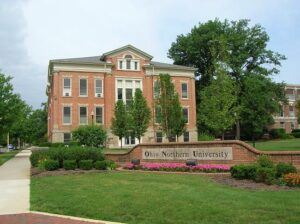
Henry Solomon Lehr founded Ohio Northern University in 1871 as the Northwestern Ohio Normal School. Its purpose was to train teachers and to provide higher education to the people in Northwest Ohio. In 1885, the school became Ohio Normal University. The new name recognized that the institution drew students from all over Ohio and the nation, and offered courses in many disciplines, including literature, music, business, telegraphy, and law, as well as teacher training. Beginning with 131 students, the institution’s enrollment grew rapidly during its first thirty years of existence. Buildings on the early campus included Dukes Memorial (left), built in 1905; the Normal School Building, built in 1871 and demolished in 1915 to make way for Lehr Memorial (center); and Hill building (right) finished in 1879. The Methodist Episcopal Church (predecessor to the United Methodist Church) assumed control in 1899. Ohio Normal University became Ohio Northern University in 1903. On June 3, 1910, President William Howard Taft delivered that year’s commencement address near this spot.
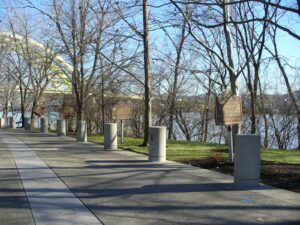
801 E. Pete Rose Way, Bicentennial Commons at Sawyer Point
Cincinnati
, OH
In memory of the Irish people who left a country where only their rivers run free. The Irish came to Cincinnati where they contributed to housing, education, employment, religious freedom, medical care and recreation, and embraced all aspects of life in the city. The descendants of Irish immigrants hope that our hands will ever be extended in friendship and never in want.