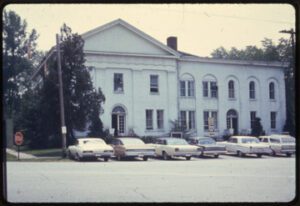
Mahoning County was created in 1846 by combining townships from southern Trumbull and northern Columbiana counties. Canfield engaged in competition with several surrounding communities for the new county seat, and its success was attributed to its central location along with the state and local political influence of Judge Eben Newton and Elisha Whittlesey, Esq., Comptroller of the United States Treasury from 1849-1857. To become the county seat, the State of Ohio required “a suitable lot and $5,000 toward public buildings” Judge Newton donated the land and spearheaded the subscription of the state required bond. Once attained, construction progressed rapidly on the Classical Revival style courthouse, completed in June 1848. The Italianate style West wing was added in 1862, but its government status was challenged when in the early 1870s, Youngstown, by now a city, resumed its earlier challenge for the county seat. (continued on other side)
In April 1797, a committee of Marietta citizens, led by General Rufus Putnam, met to establish an academy suitable for preparatory instruction for their youth. Muskingum Academy, completed late that year, became the first institution of its kind in the Northwest Territory, providing “classical instruction… in the higher branches of an English education.” Its first instructor was David Putnam, a 1793 Yale graduate. The building also served as the home of the Congregationalist Church until 1808. Growing and expanding with Ohio’s first city, the academy served Marietta’s educational needs for more than thirty years as the forerunner of Marietta College.
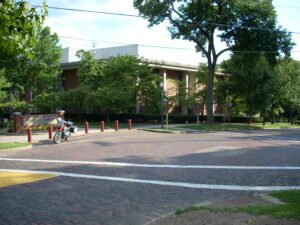
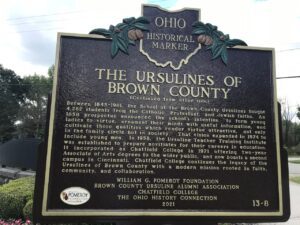
On July 21, 1845, eleven Ursuline sisters from Boulogne-sur-Mer and Beaulieu, France, arrived in St. Martin, Brown County, Ohio. A Catholic order of sisters known for providing quality education to young women, the Ursulines were invited by Cincinnati Archbishop John Baptist Purcell (1800-1883) to establish a school in the diocese and granted approximately 400 acres in St. Martin for that purpose. Led by Mother Julia Chatfield (1808-1878), the sisters quickly established their convent, a day school, and, within the year, admitted their first boarders. Originally known as The Saint Ursula Literary Institute, the school operated for the next 136 years. The Ursulines educated local students from their adopted Brown County as well as many who came from across the U.S. and farther abroad to board on campus. (Continued on other side)
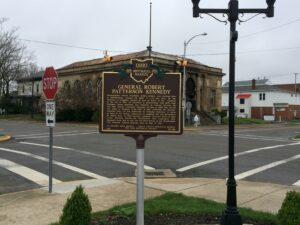
Distinguished citizen, legislator, public servant, and historian born in Bellefontaine, January 23, 1840. A Civil War hero, he was promoted to brigadier general at only 25 years of age. Admitted to the bar in 1866, he practiced in Bellefontaine until 1878 when President Hayes appointed him Collector of Internal Revenue. He was then elected Lieutenant Governor of Ohio in 1885 then served two terms in Congress from 1887 to 1891. Following the Spanish-American War, he was appointed by President McKinley to serve as head of the Insular Commission to establish the new government of Puerto Rico. In 1903 Kennedy published Historical Review of Logan County. Kennedy started the Bellefontaine Tree Commission. Gen. Kennedy’s home was on this site and later served as the Bellefontaine City Building. General Kennedy died on May 6, 1918.
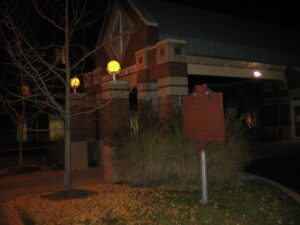
A group of concerned Cincinnati women organized, in 1855, The Protestant Home for the Friendless and Female Guardian Society as a private, not-for-profit maternity home for destitute women and children. These public minded social leaders were aware that Cincinnati had grown beyond the time when the poor or unfortunate were cared for by their neighbors. The Home, which was funded through bequests and personal donations, was founded to care for poor mothers and babies, unmarried pregnant women, wanderers and strangers in the city, and to promote adoptions. (Continued on other side)
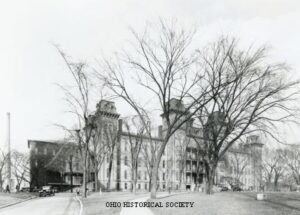
This ten acre site was purchased in 1829 for the Ohio School for the Education of the Deaf. The first school building opened here in 1834; the school was enlarged in 1845. In 1868 the original school was replaced. Another school building was added in 1899 and a hospital in 1908. The Deaf School was relocated on Morse Road in 1953.
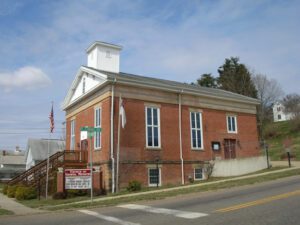
This former Universalist Church, which held a strong conviction for education and the pursuit of knowledge, was built in 1852 at a cost of $3,500. In 1865, its members decorated the first Christmas tree to be placed in a church in McConnelsville. Two years later they installed a pipe organ at a cost of $1,000, the first such organ in the community. The first Sunday School Library was also added, allowing members to borrow books and return them a week later. A number of prominent local families attended the church, including the Manly, Whitiker, Beckett, Arrick, and Murray families from the 1850s through the early twentieth century. Richard Bilbe, a former slave who had been freed, served as an early trustee of the church and attended with his family. The church was restored and reopened as a non-denominational church in 1997.
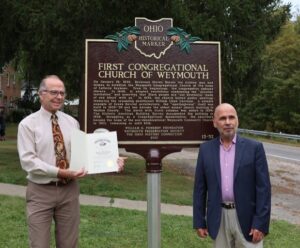
On January 19, 1835, Reverend Steven Barnes led sixteen men and women to establish the Weymouth Congregational Church at the home of Lathrop Seymour. From its beginnings, the congregation opposed slavery. In 1848, it adopted resolutions condemning the “peculiar institution” and asserting that Black people are “our brother[s] ‘made one blood’ with us.” In 1853, the church hosted public meetings featuring the crusading abolitionist William Lloyd Garrison. A notable example of Greek Revival architecture, the “meetinghouse” itself was built in 1835-’36 and has become the oldest extant church building in Medina County. The porch with Doric columns was added in 1854. The Historical American Building Survey documented the building in 1936. Struggling as a Congregational denomination, the sactuary became the home of the non-denominational Weymouth Community Church in 1920, remaining so until 2018.