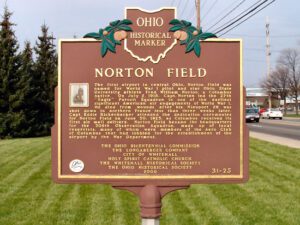
The first airport in central Ohio, Norton Field was named for World War I pilot and star Ohio State University athlete Fred William Norton, a Columbus native. On July 2, 1918, Capt. Norton led the 27th “Eagle” Pursuit Squadron in one of the earliest significant American air engagements of World War I. He died from wounds after his Nieuport 28 was shot down in northern France less than three weeks later. Capt. Eddie Rickenbacker attended the dedication ceremonies for Norton Field on June 30, 1923, as Columbus received its first air mail delivery. Norton Field became the headquarters for the 308th Observation Squadron, made up of local reservists, many of whom were members of the Aero Club of Columbus that had lobbied for the establishment of the airport by the War Department.
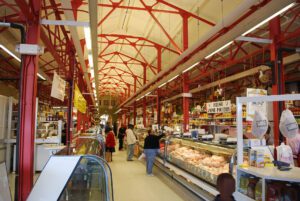
Ohio’s oldest surviving municipal market house, Findlay Market was designed under the direction of City Civil Engineer Alfred West Gilbert (1816-1900). It was listed on the National Register of Historic Places in 1972. The structure was among the first market houses in the United States to use iron frame construction technology. Originally an open pavilion, much of the market was erected in 1852, but disputes with contractors delayed its opening until 1855. The center masonry tower was built in 1902. Soon after, public health concerns prompted enclosure of the market stalls and the addition of plumbing and refrigeration. Until then, vendors found cool storage in deep cellars beneath nearby breweries. The tower bell was brought from Cincinnati’s Pearl Street Market in 1934. Findlay Market was renovated in 1973-74 and again in 2002-03.
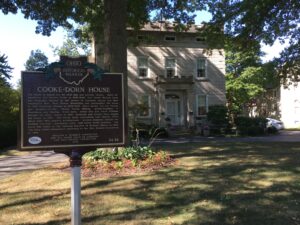
Eleutheros Cooke. The Cooke-Dorn house was the last home of attorney Eleutheros Cooke (1787-1864) who served four years in the Ohio legislature and one term in the 22nd Congress of the United States. An early proponent of railroads, Cooke received one of the first charters granted to a railroad west of the Alleghany Mountains, for the Mad River & Lake Erie line. He and wife Martha had six children, four of whom lived to adulthood. Two rose to prominence in the Civil War era. Jay was a successful banker and became known as the “financier of the Civil War” for his efforts to secure loans from Northern banks to support the Union’s war effort. Henry was appointed as the first governor of the short-lived Territory of the District of Columbia in 1871 (which was replaced in 1874).
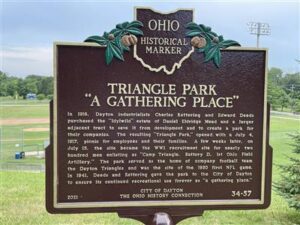
In 1916, Dayton industrialists Charles Kettering and Edward Deeds purchased the “Idylwild” estate of Daniel Eldridge Mead and a larger adjacent tract to save it from development and to create a park for their companies. The resulting “Triangle Park,” opened with a July 4, 1917, picnic for employees and their families. A few weeks later, on July 15, the site became the WWI recruitment site for nearly two hundred men enlisting as “Camp Triangle, Battery D, 1st Ohio Field Artillery.” The park served as the home of company football team the Dayton Triangles and was the site of the 1920 first NFL game. In 1941, Deeds and Kettering gave the park to the City of Dayton to ensure its continued recreational use forever as “a gathering place.”
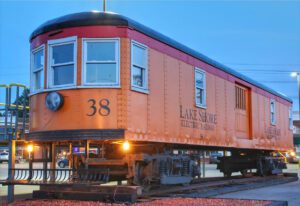
From the 1890s to the 1930s, interurban railways were an important form of travel in the Midwest. Beach Park Station had an interurban carhouse, where repairs were performed and passengers boarded. The Lorain & Cleveland Railway (L&C) built the 65½ by 200 foot brick station in 1897. By 1901, the L&C became part of the Lake Shore Electric Railway (LSE) and Beach Park became stop 65 on a line that ran from Cleveland to Toledo and then to Detroit. Requiring power and water, the LSE built an electric plant and water tower at Avon Lake. This infrastructure spurred the community’s development and growth. (Continued on other side
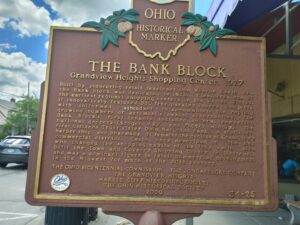
Built by pioneering retail developer Don Monroe Casto Sr., the Bank Block was dedicated in 1928. Considered one of the earliest regional shopping centers in the United States, it innovatively featured 350 free parking spaces-complete with uniformed attendant-to accommodate the rapidly growing numbers of automobile-owning suburbanites. The Bank Block’s first tenants included several competing national grocers (Kroger, A&P, and Piggly Wiggly), the First Citizens Trust (later Ohio National Bank), a stationer, barber shop, and pharmacy. It remains the nucleus of Grandview’s commercial district. Casto, once described as “the man who changed the shopping habits of the free world,” also built the Town and Country Shopping Center in Whitehall and was a dominant figure in retail commercial development in the Midwest for much of the 20th century.
Begun as a partnership between candle maker William Procter and soap maker James Gamble in 1837, Procter & Gamble (P&G) grew from its roots to become one of the world’s largest and best-known consumer products companies. Building on Civil War candle and soap contracts, P&G grew rapidly by nationally marketing its floating Ivory Soap (1879). Innovative product research and creative marketing techniques resulted in the development of dozens of successful, universally recognized brands and expansion into beauty care, paper, and health care products. Its worldwide headquarters remains in Cincinnati.
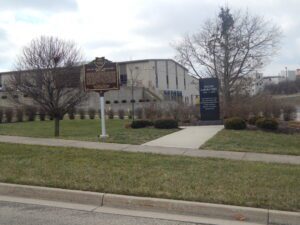
The facilities once here propelled the United States through the Nuclear and Space Ages and were named for the nearby pre-historic Miamisburg Mound. The Manhattan Engineer District of the War Department began construction of Mound Laboratory in 1946. The facility consolidated production of the nuclear-reaction initiators, developed for the United States’ first atomic bombs during World War II. Previously (1943-1946), the work to separate, purify, and process the element polonium used in these initiators occurred at facilities throughout the Dayton area. Mound Laboratory was the nation’s first permanent post-WWII Atomic Energy Commission site. Mound Laboratory had 116 buildings and at its peak employed approximately 2,500 scientists, engineers, and skilled workers. Contractors operating at the site were Monsanto (1947-1988), Edgerton, Germeshausen, and Grier (1988-1997), and Babcock and Wilcox (1997-2002). (Continued on other side)