

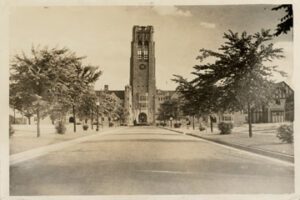
, OH
The Toledo University of Arts and Trades was established in 1872 with an endowment of 160 acres of land from Jesup W. Scott, local pioneer, publisher, and real estate broker. Scott envisioned Toledo as the “Future Great City of the World” and wanted an institution to train young people to fulfill their roles in the city’s bright future.
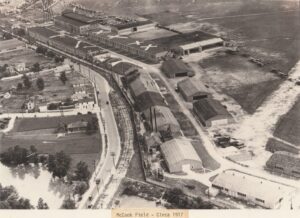
, OH
Interest in the new field of aeronautics grew dramatically when the United States entered the World War I in 1917. The army chose Dayton as the site for a research-and-development program for military aviation because of the area’s transportation links to major cities and its engineering and testing facilities. McCook Field, north of downtown between Keowee Street and the Great Miami River, was charged with researching, developing, and testing military airplanes and accessories. For nearly a decade, many advancements in aviation occurred at McCook Field. They included new aircraft, controllable-pitch propellers, bulletproof gas tanks, free-fall parachutes, and night-observation cameras. In the 1920s, larger and more-powerful aircraft overwhelmed the small field, which featured a large sign to warn pilots: “This field is small. Use it all.” In 1927, aeronautical engineering was transferred to newly-created Wright Field, now a part of Wright-Patterson Air Force Base.
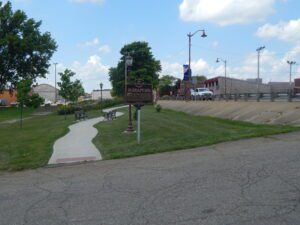
, OH
Christian Deardorff (1781-1851) with his brother-in-law Jesse Slingluff (1775-1836) platted and founded Dover and built the area’s first gristmill on Sugar Creek. With the coming of the Ohio and Erie Canal to Dover, Deardorff lobbied successfully to make Dover a toll stop for the canal and the be afforded a source of water power for his mill. A dam built on Sugar Creek obstructed for the mill there. Deardorff received access to the canal near Tuscarawas Avenue, and there erected a mill, later named the Cascade Mill by the Hardesty brothers when they purchased it in 1872. The Hardestys, from Carroll County, came to Dover in the 1860s and began operating a large mill on the Calico Ditch, near the foot of 2nd Street. The Dover Milling Company bought the last Hardesty-owned mill in 1951.
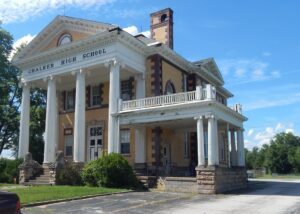
, OH
Southington native Newton Chalker built, furnished, and donated Chalker High School to his community in 1907. Chalker was born in 1842 in Southington Township and lived there until adulthood. He later built a prosperous law and real estate practice in Akron. Chalker’s dedication to improve educational opportunities in the township likely originated with his personal struggle to complete high school, which was repeatedly interrupted by financial concerns and family obligations. The Chalker High School building was designed in the Neo-Classical Revival architectural style which was favored for public buildings, churches and schools early in the twentieth century. The building exhibits Classical influences through the use of fluted columns that support a pedimented gable, resembling a Greek temple. Chalker High School and the Civil War Monument were listed in the National Register of Historic Places in 2010. (Continued on other side)
, OH
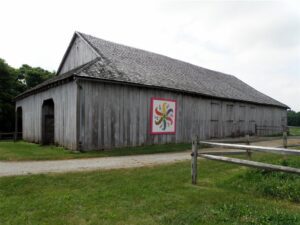
With the intention of becoming a “gentleman farmer,” John Johnston began development of his Upper Piqua farm in 1808 with a two-story log cabin and this double pen log barn. The surrounding outer sheds were built to protect the log pens from the weather. One of the oldest structures of its kind in Ohio, the barn is built around two hand-hewn log pens, each sixty-foot square. The barn served the family’s farming activities and was a storage facility for trade goods Johnston needed when the farm was the Piqua Indian Agency, 1811-1829.
, OH
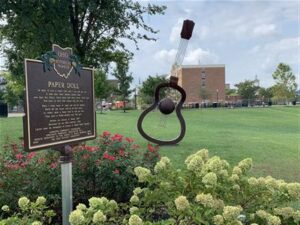
John Stewart Black (1891-1936) was a Vaudeville performer and songwriter who penned the classic “Paper Doll.” He is also remembered for “Dardanella,” which he called his “gift to the musical world.” “Dardanella”, recorded by the Ben Selvin Novelty Orchestra, debuted in 1919 and is believed to have sold more than five million copies. In 1942, the Piqua-born Mills Brothers recorded Black’s tune “Paper Doll.” It sold over 6 million records, was number one on the Billboard charts for twelve weeks in 1943 and became one of the most memorable records of the World War II era. Many artists, including Frank Sinatra and Bing Crosby, recorded “Paper Doll” and the song was inducted into the Grammy Hall of Fame in 1998.
, OH
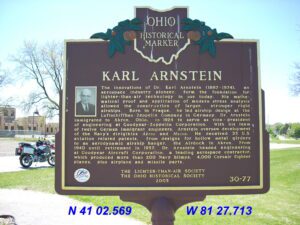
The innovations of Dr. Karl Arnstein (1887-1974), an aerospace industry pioneer, form the foundation for lighter-than-air technology in use today. His mathematical proof and application of modern stress analysis allowed the construction of larger, stronger rigid airships. Born in Prague, he led airship design at the Luftschiffbau-Zeppelin Company in Germany. Dr. Arnstein immigrated to Akron, Ohio, in 1924 to serve as vice-president of engineering at Goodyear-Zeppelin Corporation. With his team of twelve German immigrant engineers, Arnstein oversaw development of the Navy’s dirigibles Akron and Macon. He received 35 U.S. aviation related patents, from designs for hollow metal girders to an aerodynamic airship hanger, the Airdock in Akron. From 1940 until retirement in 1957, Dr. Arnstein headed engineering at Goodyear Aircraft Corporation, a leading aerospace contractor, which produced more than 200 Navy blimps, 4,000 Corsair fighter planes, plus airplane and missile parts.
, OH
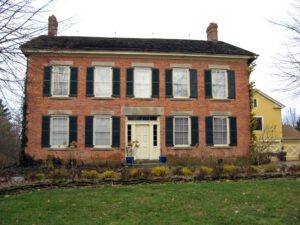
Born in Jefferson, Ohio, Theodore E. Burton graduated from Oberlin College and became a prominent Cleveland attorney. He was elected to Congress in 1888 and served from 1889-91, 1895-1909, and 1921-28. He was elected U.S. Senator in 1908 and 1928 and was a leading contender for the U.S. Presidency in 1916. Due to his work in saving Niagara Falls from development and his opposition to wasteful waterways projects, President Theodore Roosevelt appointed Burton chairman of the Inland Waterways Commission in 1907 and the National Waterways Commission in 1909. Burton is credited with pushing legislation through Congress that authorized the construction of the Panama Canal and negotiating agreements to ensure its neutrality. He lobbied to fight wasteful spending and influence of big business and sponsored the Sherman Anti-Trust Act of 1890. As president of the American Peace Society, Burton hosted the First World Conference on International Justice in Cleveland in 1928, attended by 13,000, including world leaders.