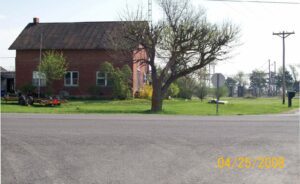
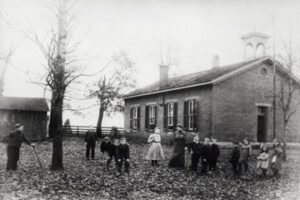
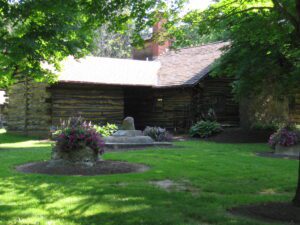
Built in 1886 by direct descendants of slaves, the Black and White schoolhouse provided education for local youth until 1928. Denied admission to white schools in the area, local African-American families first built a log schoolhouse across the road in 1883 in which to educated their children. Three years later, this brick building was constructed. The black families allowed white children to attend and, as a result, the school became known as the Black and White school. It is an early integrated school in Ohio.
In 1854, Samuel and Rebecca McClellan Collins deeded 1.28 acres to Beavercreek Township, Greene County, for the purpose of building a schoolhouse. The first two schoolhouses were constructed of stone with fireplaces for heat. Collins neighborhood children in first through eighth grade were educated in the present red brick building until 1944, when decreased enrollment forced Xenia Township to close the school. Virgil and Helen Bryson Brantley, great-granddaughter of Samuel and Rebecca Collins, purchased the school property in 1982 and began the restoration of the vandalized and deteriorated schoolhouse. The pony/coal shed and privies were rebuilt on their foundations. (Continued on other side)
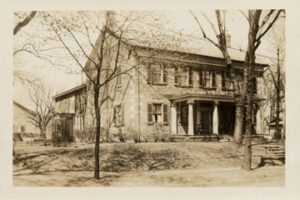
Constructed of sandstone quarried from nearby Putnam Hill, the Stone Academy dates to 1809. The Springfield School House Company erected the building, it is believed, to lure the statehouse from Chillicothe. However, when Zanesville was chosen as the capital the following year, the building was used for public functions and for its “intended” purpose as a school. The Ohio Anti-slavery Society held its state conventions here in 1835 and 1839, with prominent abolitionist leader Theodore Weld, among others, in attendance. The Stone Academy became a private residence after 1839. In the 1870s, it was the childhood home of Elizabeth Robins, the famed late-nineteenth and early-twentieth century actress, playwright, author, and activist. The Stone Academy was donated to the Pioneer and Historical Society of Muskingum County in 1981.
Following the establishment of the public land system in 1785, the Continental Congress appointed a committee, chaired by James Monroe, to establish government in the new territory north and west of the Ohio River. Drafted prior to the Constitution of the United States, the Ordinance of 1787 provided the mechanism by which prospective states would enter the Union on an equal basis with existing states. It also prohibited slavery in the new territory and pledged good faith in dealing with Native American tribes. According to this plan, the Northwest Territory became the states of Ohio, Indiana, Illinois, Michigan, Wisconsin, and part of Minnesota in due course.
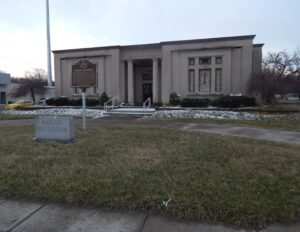
The Marion Mausoleum represents a time in early 20th-century America in which burial practices changed because of advances in engineering and construction materials, concerns about hygiene, and a new rise in wealth among the middle class. Exhibiting elements of the Neo-Classical Revival and Prairie architectural styles, construction of the sandstone building began in 1906. The mausoleum opened to the public in 1916. The interior is comprised of marble and concrete. Furnishings include chandeliers, wool carpeting, and wrought iron furniture. Stained-glass windows admit natural light. Two windows feature an upside-down torch with a still-burning flame, which symbolizes a belief in eternal spiritual life after death and burial. The mausoleum has space for 383 internments. As of 2016, it is supported and maintained by a perpetual care fund.
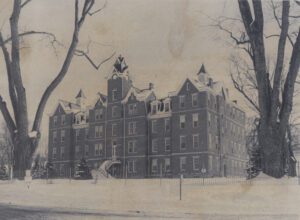
The surrounding 132 acres of land served as the Knox County Poor Farm (aka Knox County Infirmary and County Home) from 1842 to 1955. The farm was nearly self-sustaining. Able residents grew their own food, raised livestock, and did various chores as partial compensation for their care. In 1874, a fire in the original wood farmhouse resulted in one death. Public outrage and concerns for residents’ safety compelled the county commissioners to build a new “fireproof” poorhouse. The four-story brick building was constructed from 1875-1877. It is believed to be the last building designed by architect William Tinsley, utilizing a version of the Kirkbride Plan. This plan, conceived by Dr. Thomas Story Kirkbride, improved the layout of institutions and infirmaries for the well-being of their charges. (Continued on other side)
In recognition of its noteworthy representation of the history, culture, and architecture of the Western Reserve, Burton Village’s Historic District was placed on the National Register of Historic Places in 1974. The Historic District, an area of approximately 20 acres surrounding the Village Green and along streets at the north end of the Green, includes 15 buildings of historical significance built between 1815 and 1891. Preserved within the District are commercial and public buildings and private dwellings that reflect the cultural and architectural development of a village of the Western Reserve of Ohio during the 19th century. Buildings in the predominant architectural styles of the 19th century are all represented in the Historic District, including Western Reserve, Greek Revival, Second Empire, Italianate, and Queen Anne. [Continued on other side]
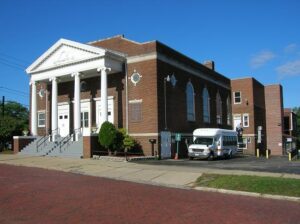
This church, founded in 1866, is the oldest Black congregation in Akron. After worshiping in several locations, the congregation held a fund-raiser to help finance the construction of a permanent home. The person collecting the most money had the privilege of renaming the church. That honor went to Mrs. Belle (Smith) Wesley. Completed in 1928, the current structure is a Neo-Classical Revival style building, featuring a classical pedimented portico, or porch, and four distinctive ionic columns. An education wing was added in 1963 by the late Rev. Dr. E. E. Morgan, Jr. Akron Black architects Herbert L. Wardner and John O. Somerville designed the church, and then a Black contractor, Samuel Plato, completed the structure. The church has long been a vital religious and social focal point for Akron’s Black community. The local chapter of the National Association for the Advancement of Colored People (NAACP) was organized at Wesley Temple. Placed on the National Register of Historic Places 3/19/94.