

, OH
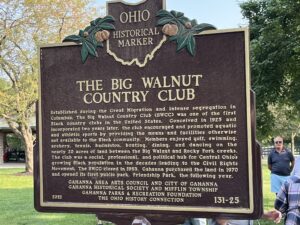
Established during the Great Migration and intense segregation in Columbus, The Big Walnut Country Club (BWCC) was one of the first Black country clubs in the United States. Conceived in 1925 and incorporated two years later, the club encouraged and promoted aquatic and athletic sports by providing the means and facilities otherwise not available to the Black community. Members enjoyed golf, swimming, archery, tennis, badminton, boating, dining, and dancing on the nearly 20 acres of land between the Big Walnut and Rocky Fork creeks. The club was a social, professional, and political hub for Central Ohio’s growing Black population in the decades leading to the Civil Rights Movement. The BWCC closed in 1963. Gahanna purchased the land in 1970 and opened its first public park, Friendship Park, the following year.
, OH
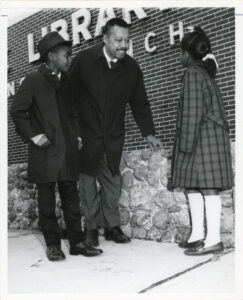
On November 19, 1968, the Columbus Metropolitan Library dedicated the first public library in the nation named after Dr. Martin Luther King Jr. After King’s assassination on April 4, 1968, the East Side Community Council requested that the new library being planned for the King-Lincoln Bronzeville community bear his name. The King family had both family and civic ties to Columbus and were honored by the tribute. More than 1,000 people gathered outside 1600 E. Long Street to hear Martin Luther King Sr. deliver the November dedication speech. Continuing the King family tradition, Martin Luther King III cut the ribbon to open a new branch building at 1487 E. Long Street on October 18, 2018. The Martin Luther King Branch was the first Columbus public library to bear an individual’s name.
, OH
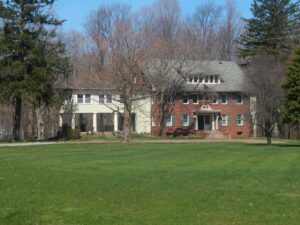
Greenwood Farm straddles the East Branch of Euclid Creek where a waterfall and gorge expose outcroppings of Euclid bluestone. George and Maude Maynard Phypers acquired the property in 1908. Four generations of the Phypers family lived here until the City of Richmond Heights purchased it in 2004. Called Cleveland’s “Insurance Dean” for his leadership in the field, George (1873-1972) was a businessman and civic leader. He served on the Richmond Heights Village Council from 1921 to 1953. Maude (1872-1965) was the first woman to serve on the local school board (1931). The 17-acre farm includes a 19th century post-and-beam English barn and a 1917 Colonial Revival brick house. A powerhouse supplied electricity to the farm and a nearby school prior to rural electrification in the 1930s. Greenwood Farm was listed on the National Register of Historic Places in 2016.
, OH
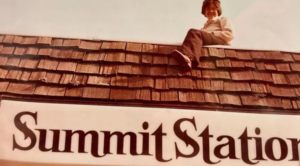
2210 Summit Street once housed one of Ohio’s longest-running lesbian bars. In 1970, a lesbian bartender at Jack’s A Go Go recognized that while Columbus had bars for gay men, it needed one geared toward lesbian clientele. Patrons knew the bar as “Jack’s,” Logan’s Off Broadway, and Summit Station. Staff welcomed women from small towns, women working in trades, women of color, butch/femme lesbians, and transgender people. Regulars recall that stepping through the door felt like finally entering a place of true belonging. Women could dance, “get together,” break up, sing karaoke, party with friends, and celebrate birthdays and holidays. Summit Station remained a safe public space, despite ongoing police harassment of its gender non-conforming regulars. A sign posted outside declared: “Ladies Night, Every Night. Men $5.” (Continued on other side)
, OH
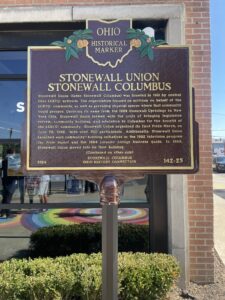
Stonewall Union (later Stonewall Columbus) was founded in 1981 by central Ohio LGBTQ+ activists. The organization focused on activism on behalf of the LGBTQ+ community, as well as providing physical spaces where that community could prosper. Deriving its name from the 1969 Stonewall Uprisings in New York City, Stonewall Union formed with the goals of bringing legislative reform, community building, and education to Columbus for the benefit of the LGBTQ+ community. Stonewall Union organized its first Pride March, on June 26, 1982, with over 500 participants. Additionally, Stonewall Union launched such community-building initiatives as the 1982 television program Gay Pride Report and the 1984 Lavender Listings business guide. In 1985, Stonewall Union moved into its first building. (Continued on other side)
, OH
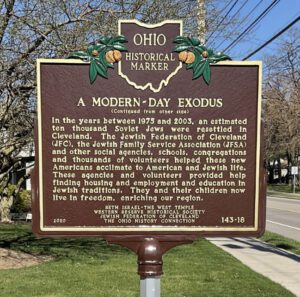
Here in 1963 congregants of Beth Israel-The West Temple, led by Louis Rosenblum, Herb Caron, and Rabbi Daniel Litt, founded the Cleveland Committee (later Council) on Soviet Anti-Semitism, the first American organization created to advocate for freedom for Soviet Jews. In 1970 this work led to the formation of the Union of Councils for Soviet Jews (UCSJ) under the leadership of Louis Rosenblum. The UCSJ, whose national office was located here 1970-1973, became the largest independent Soviet Jewry organization in the world. By the turn of the 21st century, the efforts begun here helped 1.6 million Jews leave the former Soviet Union. (Continued on other side)
, OH
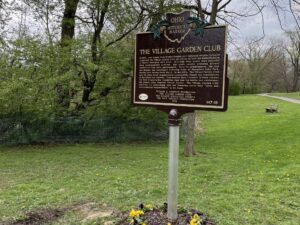
In 1930, nine women from Shaker Heights and Cleveland Heights formally organized The Village Garden Club and set as its goal the beautification of Shaker Parklands with trees. At a time when women were excluded from environmental activism, the club’s careful planning allowed members to lead civic improvements. Since its establishment, the club has planted and maintained flowering trees at Horseshoe Lake Park, pausing only during World War II. In the 1960s, The Village Garden Club and 34 other local organizations successfully fought the construction of the Clark-Lee Freeway. Club member Mary Elizabeth Croxton chaired the Park Conservation Committee that won the battle and established the Shaker Lakes Regional Nature Center. The Village Garden Club continues its stewardship over the flowering grove with “civic and environmental responsibility” as its focus.
, OH
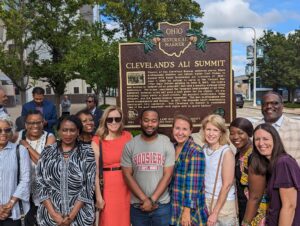
Players of the Cleveland Browns gathered eleven Black professional athletes and future mayor Carl Stokes to discuss with boxer Muhammad Ali (January 17, 1942-June 3, 2016) his refusal to serve in the Vietnam War. After their private meeting on June 4, 1967, the twelve men decided to “support Ali on principle” and held a lengthy national press conference. The boxer, considered the “greatest heavyweight of all time,” garnered national scorn and paid a high price for his stance. Ali was arrested, found guilty of draft evasion, his passport confiscated, titles stripped, and U.S. boxing licenses suspended. The men in attendance also faced condemnation and threats. In 1971, the Supreme Court unanimously overturned Ali’s conviction. The Cleveland Ali Summit is considered “one of the most important civil rights acts in sports history.”