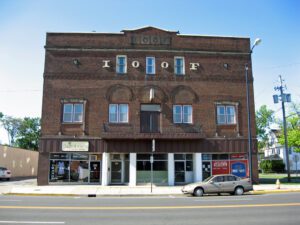
The Independent Order of Odd Fellows (IOOF), a world-wide fraternal organization, was introduced to the United States from England in 1819 and was established in Ohio in 1830. Mahoning Lodge #29 in Warren, Ohio, received its jurisdictional charter on May 21, 1844, and is currently the oldest active lodge in northeast Ohio. The lodge was originally located at the southwest corner of Park Avenue and Market Street, but was subsequently moved several times within the city. The present Odd Fellows Temple was dedicated in 1925. Friendship, Love, and Truth. Erected May 21, 1994, in commemoration of the 150th anniversary of Mahoning Lodge #29 in Warren, Ohio
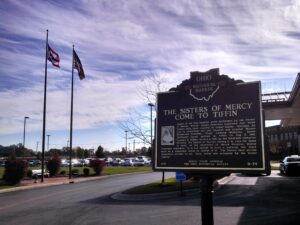
Pastor of St. Mary’s Church, Rev. Thomas F. Conlon met with the newly appointed bishop of the Toledo Diocese, Rt. Rev. Joseph Schrembs, to discuss building a charity hospital for the community. Community leaders and physicians promoted the necessity of a hospital that cared for all people regardless of race, creed, or color. Seven acres of land were purchased from Miss Emma J. Bowe on West Market Street for the construction of a four-story, fireproof brick building. Designed by local businessman George W. Netcher, the new hospital cost approximately $75,000. At the hospital’s dedication on October 26, 1913, Bishop Schrembs praised the people of Tiffin saying, “I appealed to the public-spirited citizens and my appeal did not fall upon deaf ears, as this building testifies.”
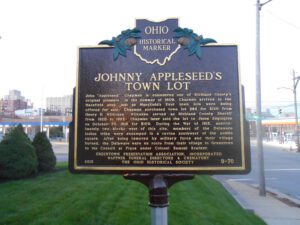
John “Appleseed” Chapman is considered one of Richland County’s original pioneers. In the summer of 1809, Chapman arrived in the Mansfield area just as Mansfield’s first town lots were being offered for sale. Chapman purchased town lot 265 for $120 from Henry H. Wilcoxen. Wilcoxen served as Richland County Sheriff from 1820 to 1825. Chapman later sold the lot to Jesse Edgington on October 30, 1818 for $100. During the War of 1812, approximately two blocks west of this site, members of the Delaware Indian tribe were encamped in a ravine southwest of the public square. After being removed by military force and their village burned, the Delaware were en route from their village in Greentown to the Council at Piqua under Colonel Samuel Kratzer.
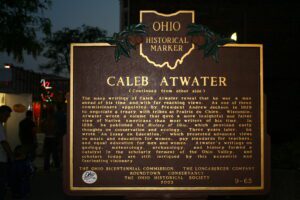
Born in North Adams, Massachusetts on December 23, 1778, Caleb Atwater graduated from Williams College in 1804. He moved to Circleville in about 1814 where he organized the city’s first school board and served as postmaster and prosecuting attorney. His life and work as a teacher, minister, lawyer, legislator, and scholar greatly influenced early 19th-century Ohio. Upon arriving in Circleville, he became interested in local history and the nearby earthworks and in 1820 published his book Descriptions of the Antiquities Discovered in the State of Ohio and Other Western States, the first compilation of prehistoric remains in the Ohio and Mississippi valleys. Elected to the Ohio State Legislature in 1821, Atwater fervently supported canal construction. He also chaired Ohio’s first board of school commissioners and was instrumental in passage of Ohio’s Public School Law. For this, he has been called the “Father of Ohio’s Common Schools.” (continued on other side)
Intersection of State Route 554 and Depot Road, Springfield Township
Bidwell
, OH
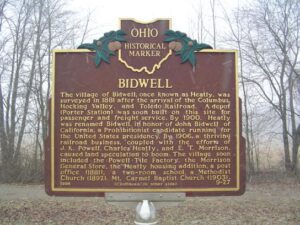
The village of Bidwell, once known as Heatly, was surveyed in 1881 after the arrival of the Columbus, Hocking Valley, and Toledo Railroad. A depot (Porter Station) was soon built on this site for passenger and freight service. By 1900, Heatly was renamed Bidwell, in honor of John Bidwell of California, a Prohibitionist candidate running for the United States presidency. By 1906, a thriving railroad business, coupled with the efforts of J.K. Powell, Charles Heatly, and E.T. Morrison, caused land speculation to boom. The village soon included the Powell Tile Factory, the Morrison General Store, the Heatly housing addition, a post office (1881), a two-room school, a Methodist Church (1892), Mt. Carmel Baptist Church (1903), (Continued)
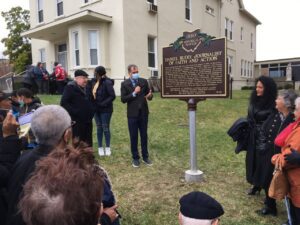
Daniel Arthur Rudd was born into slavery on August 7, 1854, in Bardstown, Kentucky. He became a newspaperman, lecturer, publicist, and tireless advocate for the Roman Catholic Church. After the Civil War Rudd moved to Springfield. Baptized and raised in Catholicism, he joined St. Raphael Parish, where the philosophy of racial equality offered by the church solidified his vision of justice. By 1885 he had established his own weekly newspaper, The Ohio State Tribune. He rebranded it The American Catholic Tribune (ACT) after moving to Cincinnati. Rudd claimed ACT was the only Catholic newspaper owned by an African American. At the height of its popularity in 1892, the publication had a circulation of 10,000. In 1893 Rudd was asked to chair the Afro-American Press Association, representing more than 200 black-owned newspapers.
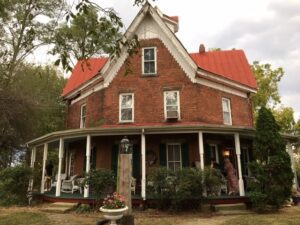
Zimmerman-Bury Octagon House. The Zimmerman-Bury Octagon House was built by Ezekiel B. Zimmerman (1843-1935) and Francis B. Hess Zimmerman (1848-1920) in 1883. Ezekiel graduated from Smithville Academy and was an avid reader. One of Ezekiel’s sons, Ernest Zimmerman (1888-1973), remembered that his father had encountered Orson Fowler’s manifesto A Home for All, or the Gravel Wall and Octagon Mode of Building (1853) and surmised that his father patterned the house after Section V of the book. The approximate 99,000 bricks comprising the house were made on the property, creating exterior walls and a center stairway which are three bricks or about 12 inches thick. Ernest noted the house’s “Russian Tin” roof, referring to its metal standing seam construction. The roof and architectural ornament make the house stand out compared to other octagon structures in Ohio. (Continued on other side)
corner of South Michigan Avenue and East Indiana Street
Edgerton
, OH
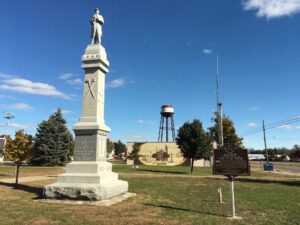
Edgerton was settled beside the St. Joseph River when the Lake Shore & Michigan Southern railroad was completed in 1854. The village was incorporated on December 4, 1865, and named for Alfred P. Edgerton, who donated the land for the park. He was an agent for Hicks & Company, a land speculation business. The firm of Von Behren & Shaffer built the town hall and opera house in 1884 for $7,998. The building and park became a hub of local activity. The park’s bandstand showcased the Edgerton Village Band and citizens gathered for picnics and festivities. (Continued on other side)