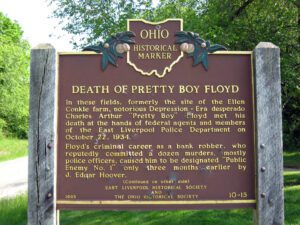
In these fields, formerly the site of the Ellen Conkle farm, notorious Depression-Era desperado Charles Arthur “Pretty Boy” Floyd met his death at the hands of federal agents and members of the East Liverpool Police Department on October 22, 1934. Floyd’s criminal career as a bank robber, who reputedly committed a dozen murders, mostly police officers, caused him to be designated “Public Enemy #1” only three months earlier by J. Edgar Hoover. (Continued on other side)
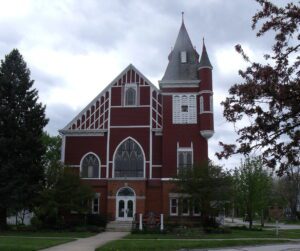
The Burton Congregational Church was organized in 1808 and met in several nearby locations before this present building was erected in 1836 at a cost of $4,000. It was originally located within the park directly opposite where it stands today, but was moved to its present location in 1850. The steeple, rising 104 feet from the ground, crowned the roof in 1875. The church building was frequently used as a public hall and for many years was also used as the main hall for the Agricultural Fair, the forerunner of the Great Geauga County Fair. A former architect referred to the church as “Steamboat Gothic” because of its unusual appearance, but to its membership and friends it is just a beautiful place to worship God.
In 1873, Tiffin’s Cronise sisters became the first women admitted to the Ohio Bar. At that time, Ohio laws did not provide for the admission of women attorneys. On April 4th 1873, Nettie Cronise applied to the district court. Despite vigorous opposition, leading local attorneys, including William Harvey Gibson and George Seney, supported Nettie’s applications. Ironically, at the same time as Nettie’s admission, the U.S. Supreme Court affirmed Illinois’ denial of admission to the bar to another woman based upon gender. Regardless, Nettie opened the door for the admission of women to the bar of Ohio. Six months later, Florence, Nettie’s younger sister, was admitted. Florence was also the first female notary public in the state. Together the sisters opened the first female-owned law practice in Ohio, N. & F. Cronise. (Continued on other side)
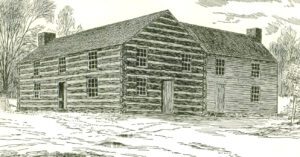
With the Division Act of 1800, the U.S. Congress divided the Northwest Territory at a line essentially the present boundary of Indiana and Ohio. The Indiana Territory stood west of the line. The name Northwest Territory was retained for the land east of the line and Chillicothe became its capital. The legislature for the territory convened in Chillicothe in November 1800. Since there were no public buildings in which the legislature could meet, its session was held in a two-story log house that stood on this site called “Abrams’ Big House.” It was so called for its owner, Basil Abrams. During the War of 1812, the building served as the barracks for the 19th U.S. Regiment of Infantry. Thereafter, it was known as the “old barracks” until it was razed circa 1840.
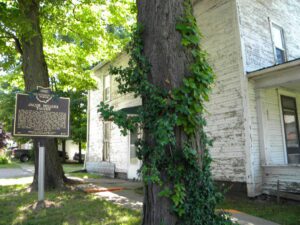
In 1805, for $1.50 an acre, Jacob Miller purchased this property in the Congressional Land Office in Chillicothe, capital of the new state of Ohio. He and Somerset co-founder John Finck then each built a tavern on either side of town along the Zane’s Trace, laid out along existing Indian trails in 1796-1797 and Ohio’s first major thoroughfare. Finck built his home and tavern in 1807 and Miller his shortly after. From 1800 to 1815, Zane’s Trace saw significant traffic between the established eastern states and the newly opened Northwest Territory. A perpetual stream of emigrants rolled westward, giving constant occupation to hundreds of tavern-keepers. Besides operating his tavern and farming, Jacob Miller was a public servant. In 1809, he was appointed Overseer of the Poor as there was a need to “bind out” poor children to families who could take care of them. [continued on other side]
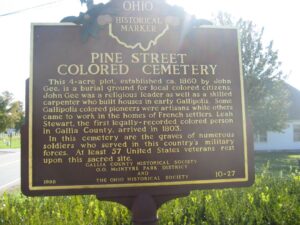
This 4-acre plot, established ca. 1860 by John Gee, is a burial ground for local colored citizens. John Gee was a religious leader as well as a skilled carpenter who built houses in early Gallipolis. Some Gallipolis colored pioneers were artisans while others came to work in the homes of French settlers. Leah Stewart, the first legally-recorded colored person in Gallia County, arrived in 1803. In this cemetery are the graves of numerous soldiers who served in this country’s military forces. At least 57 United States veterans rest upon this sacred site.
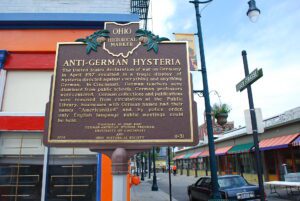
The United States’ declaration of war on Germany in April 1917 resulted in a tragic display of hysteria directed against everything and anything German. In Cincinnati, German teachers were dismissed from public schools, German professors were censored, German collections and publications were removed from circulation at the Public Library, businesses with German names had their names “Americanized” and, by police order, only English language public meetings could be held. (Continued on other side)
Now ranked among the country’s finest, the zoo began in 1900 with one large woodchuck in a box at Walbridge Park. After the organization of the Toledo Zoological Society, 1905-10, the zoo began its steady growth, particularly after 1923 under the leadership of Percy C. Jones. An ambitious federal construction program during the Great Depression of the 1930s provided several major structures.(See other side)