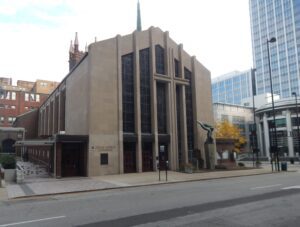
In 1817 twenty-two men, including future President William Henry Harrison, chartered Cincinnati’s first Episcopal parish, Christ Church. In 1835 members erected a Gothic Revival-style church on this site. The neighborhood evolved as the city grew with the influx of immigrants. Parish women raised funds to teach, feed, clothe, and shelter tenement families, and alleviate suffering during floods and disease outbreaks. In 1883 the women helped establish what became Cincinnati Children’s Hospital. In 1909 members opened the Late Gothic-style Parish House, a community center with kitchen, classrooms, library, auditorium, clinic, gymnasium, and bowling alley. By the parish’s centennial in 1917, music had expanded beyond worship to public concerts. In 1940 the annual Boar’s Head Festival of music and pageantry began. Since the 1960s, members have collaborated with local agencies to advocate for social and economic justice, a mission continuing into the 21st century. (Continued on other side)
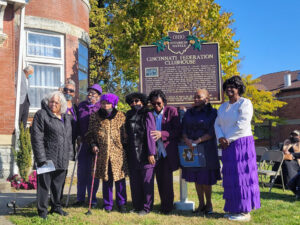
“Lifting As We Climb”: The Cincinnati Federation of Colored Women’s Clubs (CFCWC) was organized May 6, 1904, during a meeting called by Mary Fletcher Ross at the Allen Temple A.M.E. Church. Gathering together eight existing African-American women’s clubs, the CFCWC sought to unite in their work promoting “the betterment of the community.” At a time when both government and private philanthropies overlooked the needs of Black Americans, CFCWC members helped to organize the city’s first kindergartens for Black children, taught in Cincinnati African-American public schools –including the Walnut Hills Douglass and Stowe schools—and raised money for the Home of Aged Colored Women. Since 1904, the Cincinnati Federation of Colored Women’s Clubs has ensured the civic and constitutional rights of all African Americans while meeting the needs of their city.
The Breathing Association was founded in 1906 as the Tuberculosis Society under the leadership of public health advocate Carrie Nelson Black. The society provided nutrition, medical care, and sanitorium services to people who could not afford proper medical care. A tuberculosis dispensary was operated at 40 South Third Street in Columbus for Ohioans needing consultation and treatment. Tuberculosis, known as the White Plague, killed one out of nine persons in Columbus during the early 1900s. An Open Air School was established on Neil Avenue in 1913 for children in homes where there were one or more cases of tuberculosis. In 1931, the Nightingale Cottage was opened on Brice Road as a tuberculosis preventorium for children. As tuberculosis became controllable, the agency became focused on emerging lung health issues. Today, The Breathing Association continues as a leading resource on lung health issues and preventing lung disease.
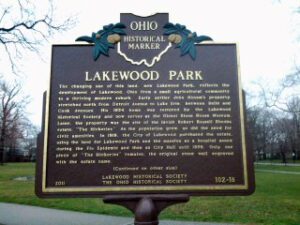
The changing use of this land, now Lakewood Park, reflects the development of Lakewood, Ohio from a small agricultural community to a thriving modern suburb. Early settler John Honam’s property stretched north from Detroit Avenue to Lake Erie, between Belle and Cook Avenues. His 1834 home was restored by the Lakewood Historical Society and now serves as the Oldest Stone House Museum. Later, the property was the site of the lavish Robert Russell Rhodes estate, “The Hickories.” As the population grew, so did the need for civic amenities. In 1919, the City of Lakewood purchased the estate, using the land for Lakewood Park and the mansion as a hospital annex during the Flu Epidemic and then as City Hall until 1959. Only one piece of “The Hickories” remains; the original stone wall engraved with the estate name.
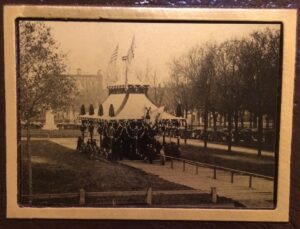
Abraham Lincoln visted Cleveland twice; once in life and the other in death. The first visit was on February 15-16, 1861, while in route to his presidential inauguration. The second, more solem visit was on April 28, 1865. Cleveland was one of twelve citiels to host a scheduled public viewing of the assassinated president’s remains. In addition to local officials, Lincoln’s cortege included a military escort of then current and former Union officers who were veterans of the Civil War. These officers would form the early membership of the organization known as the Military Order of the Loyal Legion of the United States. (continued on other side)
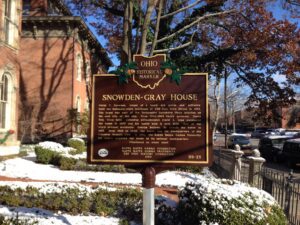
Philip T. Snowden, owner of a fancy dry goods and millinery, built the Italianate-style residence at 530 East Town Street in 1852. The house was part of the fashionable University Place addition on the east side of the city. From 1862-1864 Ohio’s governor, David Tod, lived here. Columbus philanthropist David S. Gray purchased the house in 1870 and his family held it until 1922. One of the city’s premier architects, George Bellows, Sr. rebuilt the house in 1872. From 1923 to 1940, the house was the headquarters of the Columbus Women’s Club. In 1951, the Kappa Kappa Gamma fraternity for women acquired the house as its national headquarters. (Continued on other side)
Near the Intersection of W Rich Street and W. Main Street
Columbus
, OH
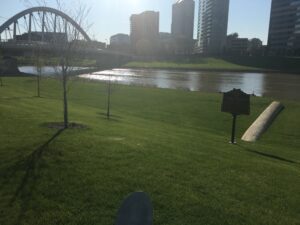
The historic district extends from the former Main Street Bridge to Long Street and encompasses the public buildings on either side of the Scioto River. The 580 foot long low-head concrete arch Main Street Dam was constructed in 1918 in response to the catastrophic 1913 flood. The dam helped reshape the Downtown Columbus Scioto River basin into a reflecting pool for the monumental riverfront buildings of teh Civic Center, which were influenced by the City Beautiful movement of the 1890s and early 1900s. Nearly a century after its construction, however, the dam had contributed to an unhealthy environment for aquatic life and was removed in late 2013 as part of teh Scioto Greenways river restoration project.
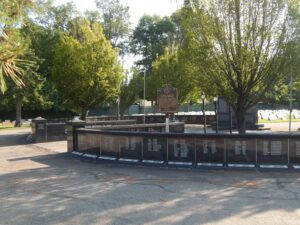
On May 28, 1961, the Kol Israel Foundation, a Cleveland organization of Holocaust survivors, dedicated this monument in remembrance of the attempted genocide against the Jewish people by Nazi Germany during World War II. The monument is believed to be one of the first of its kind in the United States. Human remains, ashes and artifacts reclaimed from three concentration camps are buried beneath the monument. (Continued on other side)