

, OH
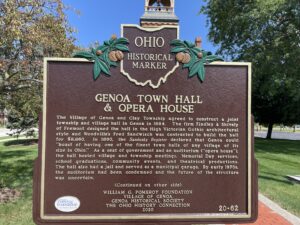
The Village of Genoa and Clay Township agreed to construct a joint township and village hall in Genoa in 1884. The firm Findley & Shively of Fremont designed the hall in the High Victorian Gothic architectural style and Woodville’s Fred Sandwisch was contracted to build the hall for $8,860. In 1890, the Sandusky Register declared that Genoa could “boast of having one of the finest town halls of any village of its size in Ohio.” As a seat of government and an auditorium (“opera house”), the hall hosted village and township meetings, Memorial Day services, school graduations, community events, and theatrical productions. The hall also had a jail and served as a municipal garage. By early 1970s, the auditorium had been condemned and the future of the structure was uncertain. (Continued on other side)
, OH
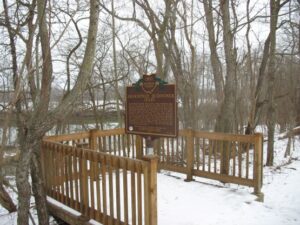
The schooner Idaho was built in Milan during prosperous times, which started with the opening of the Milan Canal in 1839. The canal connected the village with Lake Erie by way of the Huron River and facilitated the development of the area’s shipbuilding industry and port, as Milan became one of the busiest grain ports during the 1840s. Completed at the A. J. Mowry shipyard in 1863, the Idaho sailed the Great Lakes until the economic panic of 1873. The Idaho was headed to the Milan dry dock for repair, but due to depressed economic conditions, the crew abandoned her here at the lower lock of the Milan Canal. Eventually, only “bones”, or iron pins, from the Idaho’s hull could be seen protruding through the mud of the abandoned lock. The last remnants of the schooner have since disappeared from the lock and now reside in Milan museums and in personal collections.
, OH
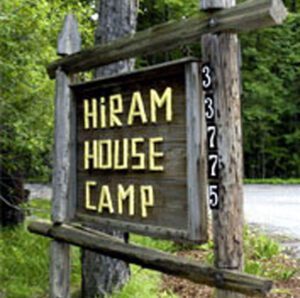
Hiram House was Ohio’s first settlement house and among the earliest in the nation, opening in October 1896 in Cleveland’s Whiskey Island neighborhood. Representing the ideals of a late-1800s urban progressive movement, settlement houses provided–through “service, not charity” –health, recreational, and self-development opportunities that were not widely available in this era. Founded by Hiram College divinity graduate George A. Bellamy (1872-1960), Hiram House administered a wide range of social services for people of different ethnic and economic backgrounds. Bellamy established the “Fresh Air Camp” circa 1900; Cleveland industrialist Samuel Mather donated this tract of land in 1903. In continuous operation since its founding, Hiram House has provided outdoor experiences and educational programs for thousands of Ohio children.
, OH
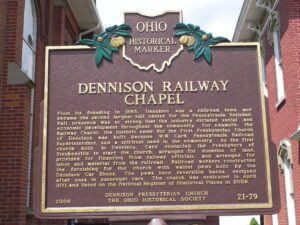
From its founding in 1865, Dennison was a railroad town and became the second largest rail center for the Pennsylvania Railroad. Rail presence was so strong that the industry dictated social and economic development throughout the community. For example, the Railway Chapel, the historic name for the First Presbyterian Church of Dennison was built because W.W. Card, Pennsylvania Railroad Superintendent, saw a spiritual need in the community. As the first church built in Dennison, Card contacted the Presbytery of Steubenville to start the church, arranged for donation of land, provided for financing from railway officials, and arranged for labor and material from the railroad. Railroad workers constructed the furnishing for the church with walnut pews built by the Dennison Car Shops. The pews have reversible backs, designed after ones in passenger cars. The church was dedicated in April 1871 and listed on the National Register of Historical Places in 2009.
, OH
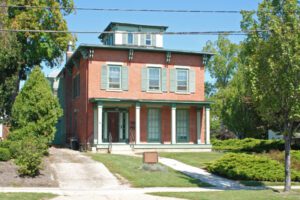
Aluminum pioneer Charles Martin Hall was born in 1863 in Thompson, Ohio (Geauga County), and moved with his family to Oberlin in 1873. Hall graduated from Oberlin College in 1885, studying chemistry under Professor Frank Fanning Jewett (1844-1926). Jewett, who lived in this house from 1884 to 1923, encouraged Hall’s interest in chemistry and aluminum, then a semi-precious metal. Hall discovered an electrochemical reduction process for producing metallic aluminum from aluminum oxide dissolved in molten cryolite in his woodshed laboratory at his family’s home at 64 East College Street on February 23, 1886. This process, the culmination of research with Jewett, became the basis for the aluminum industry in America. In 1888 Hall co-founded the Pittsburgh Reduction Company, later the Aluminum Company of America (ALCOA). Upon his death in 1914, Hall left one-third of his estate to Oberlin College.
, OH
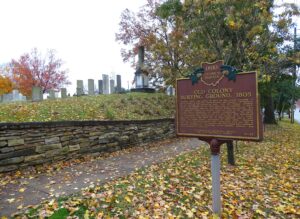
Granville, Ohio, was settled in 1805 by the Licking Company, a group formed in Granville, Massachusetts, and Granby, Connecticut, for the purpose of emigrating west. The Old Colony Burying Ground was defined on the first town plat of Granville in 1805. Many of Granville’s pioneers are interred within this ground, and the cemetery retains its original form and most of its westward facing rows of sandstone and marble gravestones. The early settlers buried here helped to lay out this town and determined the appearance and development of the village as it is today. The first burial, the infant son of Ethan Bancroft, was in April 1806. The oldest extant gravestone is dated 1808. Eighteen veterans of the Revolutionary War, thirty-nine from the War of 1812, and sixteen Civil War veterans rest here along with ministers, farmers, industrialists, physicians, young mothers, children, and other citizens of Granville.
, OH
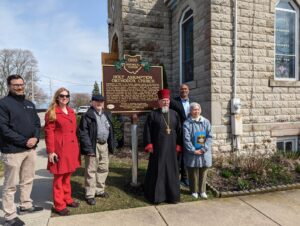
Established in 1898 as the Russian Orthodox Church of the Dormition, Holy Assumption was founded by Carpatho-Russian immigrants from the Austro-Hungarian Empire. Constructed in 1905-1906, it is considered to be the oldest Orthodox church building in Ohio. Archbishop Tikhon, head of the Russian Orthodox Church in North America, consecrated the church and celebrated the first Liturgy. Tsar Nicholas II of Russian personally donated the four icons on the iconostas, or icon screen, as well as liturgical items. Both the Tsar and, by then Patriarch, Tikhon were murdered by the Bolsheviks during the 1917 Russian Revolution and were glorified as Saints of the Orthodox Church. Holy Assumption Orthodox Church continues to be a beacon of the Orthodox Faith on the Marblehead peninsula.
, OH
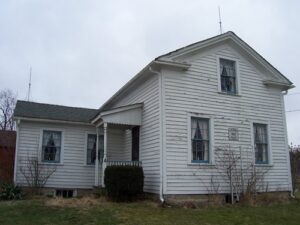
This 48-acre farm is the last remnant of an agricultural way of life that characterized Parma Township well into the 20th century. The farmhouse, built circa 1855 by Western Reserve settler Lyman Stearns, is representative of the Greek Revival style of architecture popular in this region prior to the Civil War. The “Yankee” style barn predates the house. Suburban development following World War II engulfed virtually all of this area by the 1950s. The Stearns Homestead was added to the National Register of Historic Places in 1981. (continued on other side)