SW Corner of Sunbury Square near S. Columbus St & E. Granville St.
Sunbury
, OH
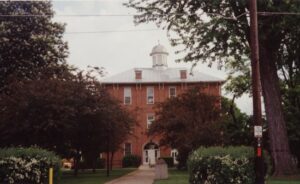
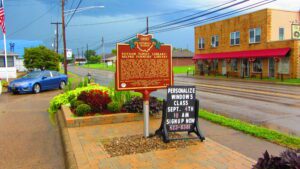
When Sunbury was platted in 1816, a town square was set aside for public use with the intention of constructing a town hall on the site. The first two stories of the Town Hall were built, as a school, in 1868 for $5,000. The Masons added the third story for $1,500 and occupied it for 91 years, until a lodge was constructed. Since 1868, the Town Hall has served Sunbury as a village office building, jail, fire station, and community library. Church services as well as Farmer’s Institutes were held in the building, and at one time it housed a bank. In 2002, the Town Hall was renovated for use as a community room and village offices.
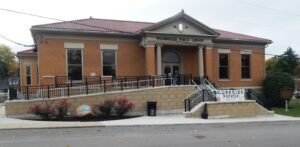
The Wilmington Public Library of Clinton County, one of 111 Carnegie libraries in Ohio, opened its doors to readers on June 30, 1904. A $12,500 gift from steel magnate and philanthropist Andrew Carnegie financed construction of the original 3,360-square-foot building. The community provided the building site, formerly known as Martin Field, and pledged tax funds for the library’s ongoing operation and maintenance. Expansions and modernizations have incorporated the original building and preserved its historic architectural style. “A Library outranks any other thing a community can do to benefit its people.” – Andrew Carnegie
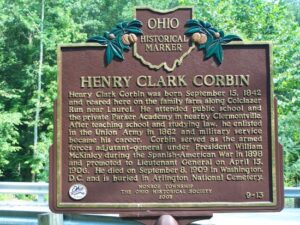
Henry Clark Corbin was born September 15, 1842 and reared here on the family farm along Colclazer Run near Laurel. He attended public school and the private Parker Academy in nearby Clermontville. After teaching school and studying law, he enlisted in the Union Army in 1862 and military service became his career. Corbin served as the armed forces adjutant-general under President William McKinley during the Spanish-American War in 1898 and promoted to Lieutenant General on April 15, 1906. He died on September 8, 1909 in Washington, D.C. and is buried in Arlington National Cemetery.
Born in Chillicothe in 1872, Burton Stevenson’s life was devoted to the written word as a prolific author and anthologist, and as a librarian. Following stints as a journalist while a student at Princeton University and then at newspapers in Chillicothe, Stevenson became the librarian of the city’s public library in 1899. He held the post for 58 years. Stevenson helped secure a Carnegie Library for Chillicothe, completed in 1906, and became prominent for his service during World War I. He founded a library at Camp Sherman (an army training camp north of the city), which became a model for others nationally.
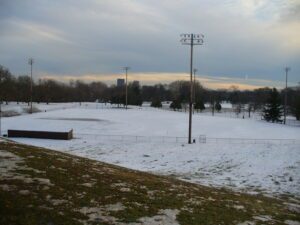
On October 3, 1920 the first game matching two professional teams of the American Professional Football Association, a league that would become the National Football League (NFL), was held on this field within Triangle Park. In that game, the Dayton Triangles defeated the Columbus Panhandles 14-0. The Triangle’s Lou Partlow scored the first touchdown and George “Hobby” Kinderdine kicked the first extra point. Three factories founded by Dayton businessmen Edward Deeds and Charles Kettering sponsored the Dayton Triangles team. The factories were the Dayton Engineering Laboratories Company (DELCO), Dayton Metal Products Company (D.M.P.Co.), and Domestic Engineering Company (DECO), later call Delco-Light. They formed an industrial triangle of plants in downtown Dayton.
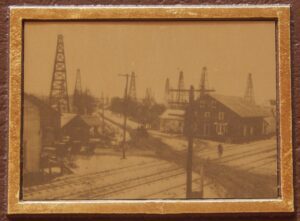
The Bremen Oil Boom commenced in 1907-’08 and the town became a center in the region’s petroleum industry. The area was a forest of oil derricks. From this point south, it was said that one could go down Broad Street from derrick to derrick and not touch the ground. A reconstructed derrick, erected to commemorate Bremen’s sesquicentennial in 1984, may be seen in Howell Park directly east of this marker.
Agricultural development and cultivation on steep lands led to severe soil erosion in the nation in the 1920s and 1930s. In response, the United States Department of Agriculture established the Soil Conservation Service (SCS) in 1935. The SCS established the North Appalachian Experimental Watershed (NAEW) in the hills of Coshocton County to study and develop methods of conserving soil and water resources. The Federal government and Coshocton County purchased 1,047 acres of land for the program and, in 1936, field research equipment was installed and buildings constructed. The Works Progress Administration (WPA) and Civilian Conservation Corps (CCC) provided labor near the program’s inception, as did the Civilian Public Service Agency during World War II. (Continued on other side)
As a shareholder of the United Library Association in Pomfret, Connecticut, General Israel Putnam amassed a large collection of books, which was called the Putnam Family Library. The collection was divided among his heirs after his death in 1790. His son, Colonel Israel Putnam brought part of that collection with him to Washington County, Ohio, in 1795. Education was a foremost concern to settlers in the Ohio Country and was reinforced in article three of the Northwest Ordinance of 1787. Accordingly, the Putnam family’s collection circulated among neighbors and provided the means of education for the people of Belpre and surrounding communities. By 1796, a group of subscribers, paying ten dollars a share, fully organized a public library. Later known as the Belpre Farmers’ Library, it was the first library established in the Northwest Territory. The library operated under the management of the shareholders until 1815.