

, OH
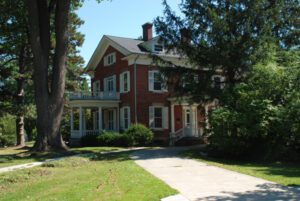
Jabez Lyman Burrell (1806-1900), originally from Massachusetts, built this house in 1852. Burrell made his living as a cattleman and farmer, but devoted much of his time serving the cause of abolitionism, helping slaves, who had escaped the South, get to Sheffield and from there to Lorain and across Lake Erie to Canada. He was also devoted to equal education for all, providing funding to a freedmen’s school in Selma, Alabama, and serving as a trustee of the Oberlin Collegiate Institute, well known for educating African Americans and women. From 1884 to 1934, this was the home of Henry Churchill King (1858-1934), who was the president of Oberlin College from 1902-1927. The Kings added the porches and rear wing and made their home a social center for the college and community. The house is listed on the National Register of Historic Places and is a City of Oberlin Historic Landmark.
, OH
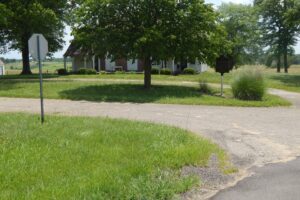
Agricultural development and cultivation on steep lands led to severe soil erosion in the nation in the 1920s and 1930s. In response, the United States Department of Agriculture established the Soil Conservation Service (SCS) in 1935. The SCS established the North Appalachian Experimental Watershed (NAEW) in the hills of Coshocton County to study and develop methods of conserving soil and water resources. The Federal government and Coshocton County purchased 1,047 acres of land for the program and, in 1936, field research equipment was installed and buildings constructed. The Works Progress Administration (WPA) and Civilian Conservation Corps (CCC) provided labor near the program’s inception, as did the Civilian Public Service Agency during World War II. (Continued on other side)
, OH
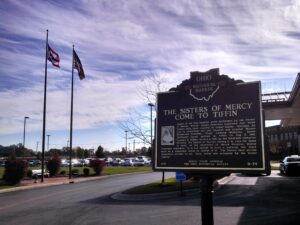
Pastor of St. Mary’s Church, Rev. Thomas F. Conlon met with the newly appointed bishop of the Toledo Diocese, Rt. Rev. Joseph Schrembs, to discuss building a charity hospital for the community. Community leaders and physicians promoted the necessity of a hospital that cared for all people regardless of race, creed, or color. Seven acres of land were purchased from Miss Emma J. Bowe on West Market Street for the construction of a four-story, fireproof brick building. Designed by local businessman George W. Netcher, the new hospital cost approximately $75,000. At the hospital’s dedication on October 26, 1913, Bishop Schrembs praised the people of Tiffin saying, “I appealed to the public-spirited citizens and my appeal did not fall upon deaf ears, as this building testifies.”
, OH
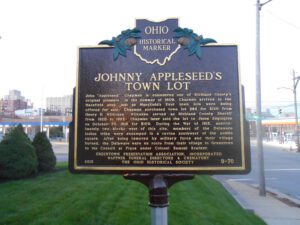
John “Appleseed” Chapman is considered one of Richland County’s original pioneers. In the summer of 1809, Chapman arrived in the Mansfield area just as Mansfield’s first town lots were being offered for sale. Chapman purchased town lot 265 for $120 from Henry H. Wilcoxen. Wilcoxen served as Richland County Sheriff from 1820 to 1825. Chapman later sold the lot to Jesse Edgington on October 30, 1818 for $100. During the War of 1812, approximately two blocks west of this site, members of the Delaware Indian tribe were encamped in a ravine southwest of the public square. After being removed by military force and their village burned, the Delaware were en route from their village in Greentown to the Council at Piqua under Colonel Samuel Kratzer.
, OH
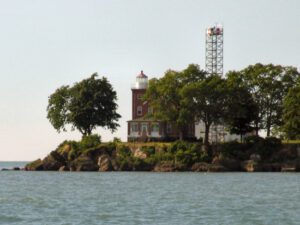
Constructed and first lit in 1897, the South Bass Island Light was in continuous operation until 1962 when the U. S. Coast Guard built an automated light tower to replace it. Significant for its contribution to transportation and commerce on Lake Erie, the South Bass Island Light was built to safely guide vessels through the crowded South Passage. Although many light stations were constructed with a dwelling as a separate structure, the keeper’s dwelling of the South Bass Light was attached to the 60-foot tower. The dwelling was designed in the Queen Anne style with red brick laid in Flemish bond. Outbuildings, a barn and oil house, were built in 1899. In 1967, The Ohio State University acquired the property for support of the F. T. Stone Laboratory programs for research, education, and outreach. South Bass Island Light was placed on the National Register of Historic Places in 1990.
, OH
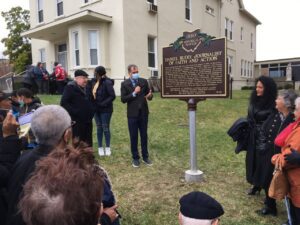
Daniel Arthur Rudd was born into slavery on August 7, 1854, in Bardstown, Kentucky. He became a newspaperman, lecturer, publicist, and tireless advocate for the Roman Catholic Church. After the Civil War Rudd moved to Springfield. Baptized and raised in Catholicism, he joined St. Raphael Parish, where the philosophy of racial equality offered by the church solidified his vision of justice. By 1885 he had established his own weekly newspaper, The Ohio State Tribune. He rebranded it The American Catholic Tribune (ACT) after moving to Cincinnati. Rudd claimed ACT was the only Catholic newspaper owned by an African American. At the height of its popularity in 1892, the publication had a circulation of 10,000. In 1893 Rudd was asked to chair the Afro-American Press Association, representing more than 200 black-owned newspapers.
, OH
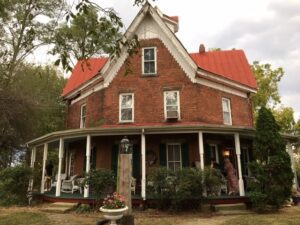
Zimmerman-Bury Octagon House. The Zimmerman-Bury Octagon House was built by Ezekiel B. Zimmerman (1843-1935) and Francis B. Hess Zimmerman (1848-1920) in 1883. Ezekiel graduated from Smithville Academy and was an avid reader. One of Ezekiel’s sons, Ernest Zimmerman (1888-1973), remembered that his father had encountered Orson Fowler’s manifesto A Home for All, or the Gravel Wall and Octagon Mode of Building (1853) and surmised that his father patterned the house after Section V of the book. The approximate 99,000 bricks comprising the house were made on the property, creating exterior walls and a center stairway which are three bricks or about 12 inches thick. Ernest noted the house’s “Russian Tin” roof, referring to its metal standing seam construction. The roof and architectural ornament make the house stand out compared to other octagon structures in Ohio. (Continued on other side)
, OH
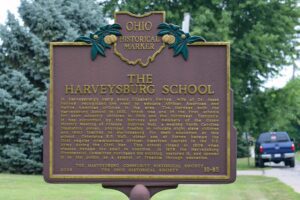
The Quaker village of Harveysburg was founded in 1829 on land originally a part of Colonel Abraham Buford’s Revolutionary War Land Grant. Levi Lukens, a Virginia Quaker, purchased the 1000 – acre survey in 1812 and sold a portion to Rhoden Ham in 1815. Ham then sold a portion of his holdings to William Harvey, a Quaker originally from North Carolina, who developed 47 lots for a village which thrived from its beginnings. Early businesses included grist mills, a tin shop, hardware store, blacksmith shop, a large pork packing plant, a bank, and a dry goods store owned by William Harvey. Its first post office opened in 1839. Harveysburg was incorporated in 1844. The village received its name from a merchant in Cincinnati who told William Harvey that he should add burg to his name and call the place Harveysburg.