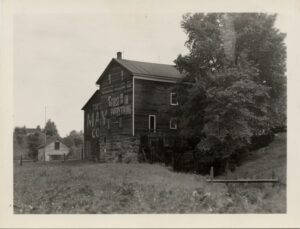
Fowlers Mill (originally Fowler’s Mills) developed around a group of mills built in the 1830s on the Chagrin River. Opportunities from these mills led to Fowlers Mill becoming the commercial center of Munson Township. From the 1830s into the twentieth century, the community expanded with construction of churches, a post office, township hall, stores, hotel, blacksmith shop, schools, and houses built in such styles as Federal, Greek Revival, Italianate, and Queen Anne. This type of community center was common in rural, nineteenth century America, but rarely survives with so much original fabric intact. On Mayfield Road, the Disciple Church was built in 1842. East of the church, the brick central school built in 1913 replaced earlier one-room schoolhouses. The gristmill is the only mill standing in Geauga County. The cemetery contains burials dating from the 1830s. The Fowler’s Mills Historic District was placed on the National Register of Historic Places in 2002.
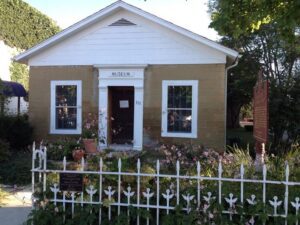
Built by William Stedman in 1816 of local stone, this building served as the Bank of the Alexandrian Society, which printed its own currency. The bank failed in 1817 and 1837. This building has also been used as a store, post office, and interurban railway depot. It was enlarged and opened as a museum during Granville’s Sesquicentennial Celebration in 1955, and was listed on the National Register of Historic Places as part of the Granville Historic District in 1980.
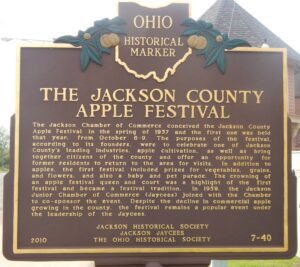
The Jackson Chamber of Commerce conceived the Jackson County Apple Festival in the spring of 1937 and the first one was held that year, from October 6-9. The purposes of the festival, according to its founders, were to celebrate one of Jackson County’s leading industries, apple cultivation, as well as bring together citizens of the county and offer an opportunity for former residents to return to the area for visits. In addition to apples, the first festival included prizes for vegetables, grains, and flowers, and also a baby and pet parade. The crowning of an apple festival queen and court was a highlight of the first festival and became a festival tradition. In 1959, the Jackson Junior Chamber of Commerce (Jaycees) joined with the Chamber to co-sponsor the event. Despite the decline in commercial apple growing in the county, the festival remains a popular event under the leadership of the Jaycees.
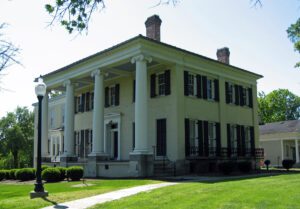
1832 Greek Revival Style. The Kinsman House once served as classrooms for the Dana School of Music, Hiram College Branch. The house is listed on the National Register of Historic Places.
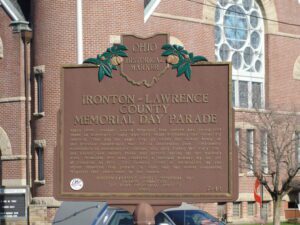
Since 1868, Ironton’s annual Memorial Day parade has recognized those in Lawrence County who died while defending our country’s freedom. This was the same year in which the Grand Army of the Republic established May 30 as Decoration Day. Originally established to commemorate soldiers who died during the Civil War, the parade now honors those who served during all the nation’s wars. Memorial Day was declared a national holiday by an act of Congress in 1971. The Ironton event is recognized as the oldest Memorial Day parade in Ohio and the oldest continuing Memorial Day observance in the nation.
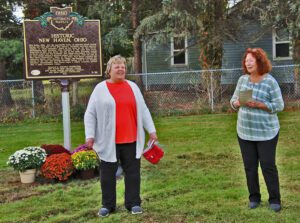
New Haven, Ohio, was the mercantile center of southwest Huron County during the first half of the 19th century. Residents described immense wagons, or “land schooners,” lined up for miles on the New Haven-Worthington Road traveling from Columbus to the Lake Erie ports. Organized in 1815, New Haven was one of the early townships formed in Huron County and the Firelands. The village was platted, with streets at right angles around a diamond-shaped town green, after the plan of New Haven, Connecticut. When, in the 1840s, New Haven rejected the railroad’s direct route through the village, the Sandusky & Newark was routed to the west and through Plymouth taking with it the shipping business. Subsequently, New Haven began a steady economic decline into a small crossroads village.
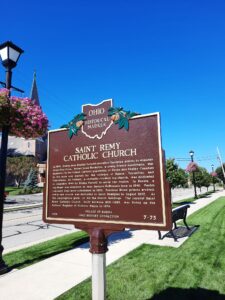
In 1839, Bishop John Baptist Purcell recruited European priests to minister to his Ohio flock. Father Louis Navarron, a young French missionary, was appointed to the French Catholic population of Darke and Shelby Counties in the area now marked by the villages of Russia, Versailles, and Frenchtown. St. Valbert, a centrally-located log church, was dedicated in December 1840 by Bishop Purcell to serve the region. In Russia, a log chapel was dedicated on Jean Jacques DeBrosse’s farm in 1846. Parish boundary lines were established in 1850, Precious Blood priests arrived, and a new church was dedicated to Saint Remigius in August 1852. As the congregation grew, so did the church buildings. The current Saint Remy Catholic Church, built between 1891-1892, was listed on the National Register of Historic Places in 1979.
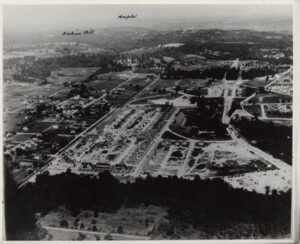
Ground was broken for Mariemont by Mary M. Emery, the village’s founder, on April 23, 1923. This planned community was designed by eminent town planner John Nolen and twenty-five of America’s leading architects. As part of the “garden city movement,” Mariemont was influenced by English models. Mariemont was incorporated July 12, 1941, and was listed on the National Register of Historic Places on July 24, 1979.