

, OH
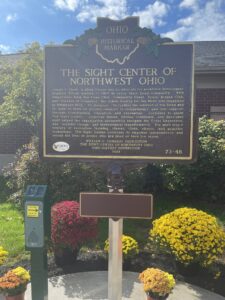
Joseph F. Clunk, a blind Ohioan and an advocate for workforce development, inspired Toledo leaders in 1923 to serve their blind community. With cooperation from the Lions Club, Community Chest, Toledo Rotary Club, and Chamber of Commerce, the Toledo Society for the Blind was organized in November 1923. Its purpose, “to further the interest of the blind and to open to them all possible avenues to independence and self-support, through investigation, education, and recreation,” continues to guide The Sight Center. Generous donors, tireless volunteers, and dedicated staff helped the organization successfully navigate the Great Depression, war, societal change, and technological transformation. For more than a century of innovative training, classes, clubs, clinics, and assistive technology, The Sight Center continues to empower independence and enrich the lives of people who are blind or have low vision.
, OH
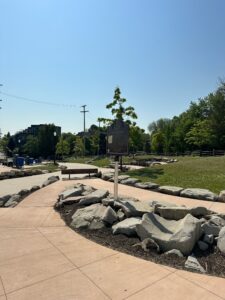
Opened in July 1862, the 35 1/2-acre site here in Brooklyn Township’s University Heights served as the largest Civil War army camp of rendezvous, organization, and training in northeast Ohio. It was bordered by Hershel (now West 5th) and University (now West 7th) streets and Railway and Marquard avenues. A wartime high of 4,151 volunteers occupied the barracks here on December 5, 1862. Lieutenant William Dustin of the 19th Ohio Volunteer Artillery wrote, “It was a table land above the city and admirably suited to the use of a camp of instruction. It was as level as a floor and carpeted with grass. The capacious pine barracks held about 25 each of the battery’s men.” A total of 15,230 men trained here during the war–4.9 percent of the 310,646 enlistments in Ohio. More than 11,000 soldiers were discharged here at war’s end. It closed in August 1865. (continued on other side)
, OH
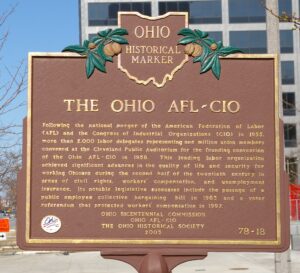
Following the national merger of the American Federation of Labor (AFL) and the Congress of Industrial Organizations (CIO) in 1955, more than 2,000 labor delegates representing one million union members convened at the Cleveland Public Auditorium for the founding convention of the Ohio AFL-CIO in 1958. This leading labor organization achieved significant advances in the quality of life and security for working Ohioans during the second half of the twentieth century in areas of civil rights, workers’ compensation, and unemployment insurance. Its notable legislative successes include the passage of a public employee collective bargaining bill in 1983 and a voter referendum that protected worker’s compensation in 1997.
, OH
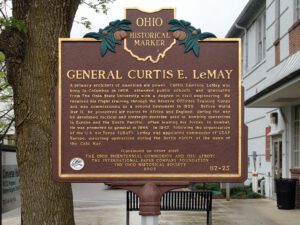
A primary architect of American air power, Curtis Emerson LeMay was born in Columbus in 1906, attended public schools, and graduated from The Ohio State University with a degree in civil engineering. He received his flight training through the Reserve Officers Training Corps and was commissioned as a second lieutenant in 1929. Before World War II, he pioneered air routes to Africa and England; during the war he developed tactical and strategic doctrine used in bombing operations in Europe and the South Pacific, often leading his forces in combat. He was promoted to general in 1944. In 1947, following the organization of the U.S.Air Force (USAF), LeMay was appointed commander of USAF Europe, directing operations during the Berlin Airlift at the dawn of the Cold War. (continued on other side)
, OH
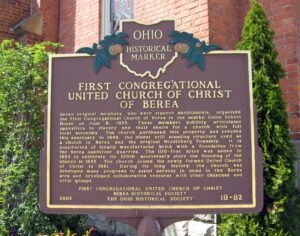
Seven original members, who were staunch abolitionists, organized the First Congregational Church of Berea in the nearby Union School House on June 9, 1855. These members publicly articulated opposition to slavery and their desire for a church with full local autonomy. The church purchased this property and erected this sanctuary in 1869, the oldest still standing structure used as a church in Berea and the original Middleburg Township. It is constructed of locally manufactured brick with a foundation from the Berea sandstone quarries. The 100-foot spire was added in 1954 to celebrate its 100th anniversary since the founding of the church in 1855. The church joined the newly formed United Church of Christ in 1961. During its long history, the church has developed many programs to assist persons in need in the Berea area and developed collaborative ventures with other churches and civic groups.
, OH
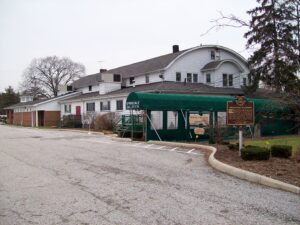
Springvale Ballroom is located on part of the one hundred and forty acre tract that English immigrant John Biddulph bought in 1840. Fred Biddulph, John Biddulph’s grandson, was born near this site in 1887. Fred and his wife, Clara, built the five thousand square foot Springvale Ballroom. On May 19, 1923, they paid fifteen dollars for the right to open the dancing pavilion. The first dance at Springvale Ballroom was held on May 23rd. A five hole golf course was added to the property in 1928. Later changes to Springvale included renovation of the ballroom, the addition of a golf office, and an upgrade to a full eighteen hole course.
, OH
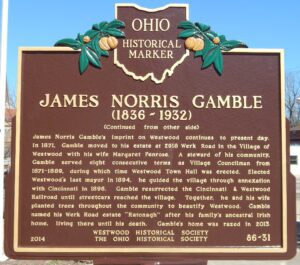
James Norris Gamble, entrepreneur, industrialist, philanthropist and civic leader, is best known for inventing Procter & Gamble’s Ivory Soap, the “soap that floats,” in 1878. Applying a scientific approach, Gamble transformed P&G into a nationally recognized corporate leader and creator of consumer products for a rapidly growing America. Beyond P&G, Gamble financed early efforts to educate freed southern slaves as an original sponsor of the Freedmen’s Aid Society. Later, he underwrote civil rights leader Mary McLeod Bethune’s work to educate poor African American women. In Cincinnati, Gamble’s philanthropy included endowment of Christ Hospital and the founding of its Institute of Medical Research. Gamble funded completion of University of Cincinnati’s Nippert Stadium in 1924 as a tribute to his late grandson.
, OH
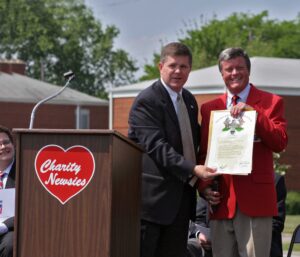
The founding of the philanthropic organization Charity Newsies stems from a cold, blustery day in December 1907, when a small newspaper boy stood on the corner of Broad and High streets. Inside the nearby Billy’s Chophouse, entertainers George Baker and Harry Shunk talked to C.C. Philbrick, publisher of the new Ohio Sun Newspaper about the area’s poor children needing clothing. They noticed the newspaper boy and brought him to the Chophouse to get warm. On a spur of the moment they took his newspapers outside, shouting “It’s all for charity”, and sold all the papers. The money was given to the boy. Realizing potential, the men decided to raise additional funds for the poor by selling the Ohio Sun Newspaper and recruited others to help. On December 20, 1907, the Sunday before Christmas, 50 men sold a special edition of the paper and raised $702.42, 100% for charity.