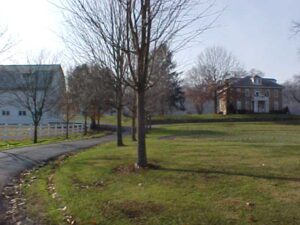
Rufus P. Stone, grandson of General Rufus Putnam, settled on this 1,000 acre farm and built a wooden farmhouse here in 1818. In 1855, John E. Thomas purchased the original farmhouse and 600 acres from the heirs of Rufus P. Stone. Thomas enlarged the farmhouse into the present manor house with a large sandstone addition in 1857. The farm was known for its extensive orchards and fine livestock, including cattle, sheep, and high quality saddle horses. Thomas, dressed in silk hat, frock coat, and all the finery of the day, rode one of his fine saddle horses around the estate supervising farm laborers. He developed an enclosed nature preserve on the farm for breeding and raising deer that were nearly extinct in Ohio in the 1850s. Thomas later acquired 200 more acres of the original acres for a total of 800 acres.
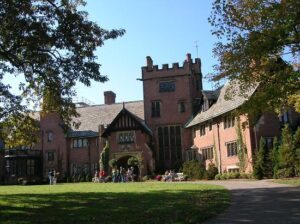
The former “country estate” of the Frank A. Seiberling family, Stan Hywet Hall is one of the finest examples of Tudor Revival architecture in the United States. “F.A.” Seiberling (1859-1955) co-founded the Goodyear Tire & Rubber Company in 1898 and later the Seiberling Rubber Company, thus greatly contributing to Akron’s distinction as “The Rubber Capital of the World.” Built between 1912 and 1915, The 65-room Manor House and service buildings are situated on more than 70 acres of restored historic gardens and wooded landscapes, all reflecting the Seiberlings’ tastes in the decorative and cultural arts. Stan Hywet Hall and Gardens was listed on the National Register of Historic Places in 1975 and designated a National Historic Landmark in 1982.
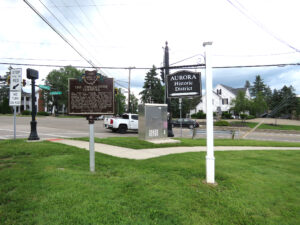
The Chillicothe Turnpike stimulated the growth of Aurora Center, Aurora’s first commercial area. Established in 1802 by Benjamin Tappan, the road also precipitated the development of Kirtland, Chester, Russell and Bainbridge, provided access to landlocked properties, and linked distant towns from Lake Erie to Ohio’s first capital in Chillicothe. In Aurora, the Chillicothe Turnpike turned southwest towards Hudson and continued southward over the boundary of the Western Reserve.
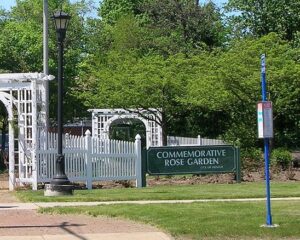
From the 1920s through the 1970s, Mentor was recognized as the Rose Capital of the Nation. Lake effect climate, a variety of soils, and abundant water made Mentor ideal for growing roses. Over a dozen growers produced about five million plants a year from their fields in Mentor. The Civic Center Complex was once a massive field of roses, and streets such as Tea Rose, Wyant, and Rosebud were named in honor of the blossoms that grew so abundantly here. Notable growers include Gerard K. Klyn, the largest rose grower in the Midwest; Joseph Kallay, who in 1932 received U.S. patent No. 10 for “Blaze;” Melvin E. Wyant, accredited rose grower, judge, and lecturer; Joseph J. Kern, nationally recognized expert on old fashioned roses; and Paul R. Bosley, who specialized in hybrid tea roses. By the 1970s, increased land values and development led to depletion of much of Mentor’s nursery lands.
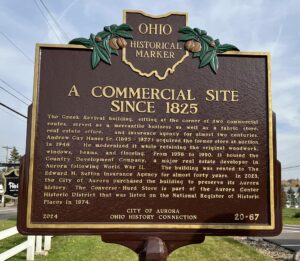
James Willard Converse (1806-1892) opened his store in 1825 at 10 South Chillicothe Road. Serving residents, merchants, and travelers, the store proved central to Aurora’s early commercial development. Converse’s Daybook survives as a glimpse into the habits of early citizens, who, along with household items, regularly purchased whiskey. Surprisingly, such sales surged on George Washington’s February 22 birthday. Converse deeded the business to employee Seth A. Gillett in 1834. Hopson Hurd Sr. (1793-1869) purchased it from Gillett in 1845. Hurd’s store was popular with local farmers who used their home made cheese as legal tender and enjoyed the barrel of whiskey kept in Hurd’s basement for customers who paid their bills. Hurd added a cheese warehouse to his store and, as a major exporter of cheese to Cleveland, Warren, and Pittsburgh, amassed a sizeable fortune.
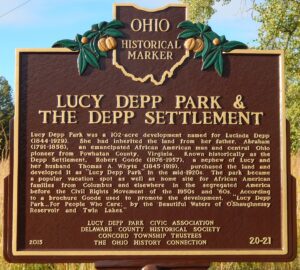
Lucy Depp Park was a 102-acre development named for Lucinda Depp (1844-1929). She had inherited the land from her father, Abraham (1791-1858), an emancipated African American man and central Ohio pioneer from Powhattan County, Virginia. Known historically as the Depp Settlement, Robert Goode (1876-1957), a nephew of Lucy and her husband Thomas A. Whyte (1845-1919), purchased the land and developed it as “Lucy Depp Park” in the mid-1920s. The park became a popular vacation spot as well as home site for African American families from Columbus and elsewhere in the segregated America before the Civil Rights movement of the 1950s and 60s. According to a brochure Goode used to promote the development, “Lucy Depp Park…For People Who Care; by the Beautiful Waters of O’Shaughnessy Resevoir and Twin Lakes.”
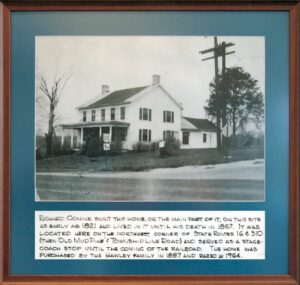
Born in New Jersey, Richard and Sarah Conine, the founders of the village of Pataskala, moved to Lima Township and lived on this site as early as 1821 when Richard established a grist mill nearby. Their homestead also served as a stagecoach stop on the mud pike between Columbus and Newark prior to the coming of the railroad. Richard platted “Conine Town” south and west of here in 1851, and the town was renamed Pataskala soon after. The public-spirited Conines contributed to the building of several area schools and churches and donated land for the Pataskala Cemetery. After their deaths, Sarah’s nephew Jacob Van Dorn inherited the property. John Hawley purchased the home in 1887 and for many years it was known as “The Hawley House.” It was demolished in 1964 to make way for commercial development.
The Triangle, one of the most historic places in Berea, has been the center of the city’s civic life since the mid-19th century. Just beneath lie the solid layers of the famous Berea Sandstone that brought prosperity to Berea during its early years. Quarry owner and Berea Seminary founder John Baldwin obtained much of what is now Berea from Gideon Granger, Postmaster General under President Thomas Jefferson and original owner of Township 6, Range 14 (later Middleburg Township) of the Western Reserve. When the seminary trustees transferred the Triangle tract to the people of Berea in 1847, they designated it by deed as a public promenade. This farsighted stipulation preserved it from commercial development during the 20th century. (continued on other side)