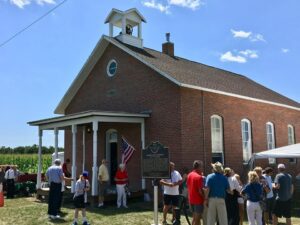
Bridenbaugh District No. 3 School. One-room schools were commonly named for people who furnished land for the building. Michael Bridenbaugh (1820-1895), who settled in Riley Township in 1835, and wife Jemima (1834-1903) sold a half-acre of land to the Riley Township school board in 1873. The first school on the site was a wooden structure, built in 1878. It was replaced by a brick building in 1889. The school operated until 1927, after which the district was consolidated. Students attended classes in nearby Pandora. (Continued on the other side)
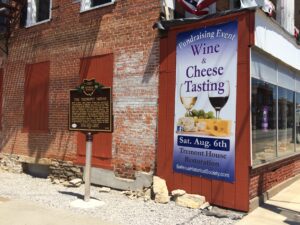
Built in 1846, the Tremont House was opened by Loel and Samuel B. Chandler to serve stagecoach traffic on the Maumee Pike (U.S. Route 20). Briefly a hotel, this Bellevue landmark has housed grocery and hardware stores, a pharmacy, and even a cigar factory. The third floor ballroom hosted community events and fraternal organizations such as the Independent Order of Odd Fellows (IOOF). The building’s west side is on the western boundary of the Firelands region of the Connecticut Western Reserve. An example of Greek Revival architecture, the Tremont House was listed on the National Register of Historic Places in 2006.
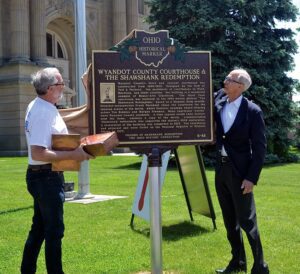
Wyandot County’s third and current courthouse was constructed from 1899-1900. Designed by the firm of Yost & Packard, the architects of courthouses in Wood, Harrison, and other counties, the building is a wonderful example of Beaux-Arts Classicism. The third floor courtroom was featured in the 1994 motion picture “The Shawshank Redemption,” based on a Stephen King novella. Director-screenwriter Frank Darabont chose the courtroom for the opening scenes of the movie, which features Academy Award-winning actors Tim Robbins and Morgan Freeman. Many courtroom “extras” were Wyandot County residents. A time capsule inside Lady Justice, atop the dome, contains a copy of the movie, commemorating ‘Shawshank’ enthusiasts who supported the statue’s 2009 restoration. A restoration of the building was completed in 2015. The courthouse and adjacent jail were listed on the National Register of Historic Places in 1973.
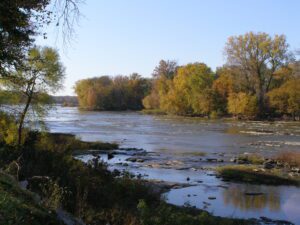
This site, at the head of the Great Rapids of the Maumee, has been a major river crossing for centuries. The village was platted in 1833 as Gilead but was overshadowed by rival Providence during the canal era. In 1868 the name Grand Rapids was adopted, and the town prospered with the arrival of the railroad in 1877. Fires ravished the village in the late 1890s and spring floods have remained a threat. Restoration of the Victorian architecture began in 1975 and has helped revitalize this village along the historic Maumee.
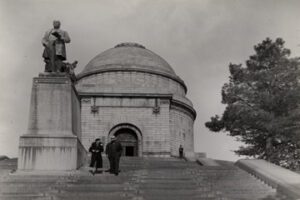
William McKinley served the nation as president, the people of Ohio as governor, and the citizens of his congressional district as a representative. McKinley was shot by an assassin in Buffalo, New York, in September 1901 and died several days later. The McKinley National Memorial, funded by children’s donations, was dedicated in 1907. It is the burial site of the 25th President, First Lady Ida Saxton McKinley, and two daughters. Designed by architect Harold Van Buren Magonigle, the pink Milford granite structure was designated a National Historic Landmark in 1975.
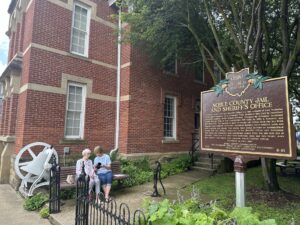
The Noble County Jail and Sheriff’s Office is a fine example of Late Victorian architecture designed by a prominent Ohio architect and built by important nineteenth century Noble County builders. Designed by Columbus architect Joseph Warren Yost, it was constructed 1881-1882 by Mills & Summers and cost $9,477.55. The building is made of orange-red bricks from the Ava Brick Company and features horizontal sandstone banding and a detailed gable end with brackets and finials. The Queen Anne design includes an asymmetrical façade with two distinct entrances to the Sheriff’s Office and Residence. The office and residence face courthouse square while the jail cells are at the rear. There are four first-floor individual cells and two larger men’s and women’s cells above with concrete barrel-vaulted ceilings. (Continued on other side)
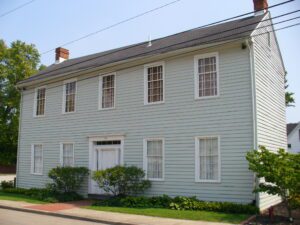
First Lady Lucy Ware Webb Hayes was born in this four-room Federal Vernacular house in 1831. Well educated for her time, she attended local schools, took classes in the preparatory department of Ohio Wesleyan University in Delaware, and graduated from Wesleyan Female College in Cincinnati in 1850. She married lawyer and future U.S. President Rutherford B. Hayes in 1852. They raised five children to adulthood. As a colonel’s wife during the Civil War, “Mother Lucy” boosted morale for the soldiers of the 23rd Ohio Volunteer Infantry regiment. In 1870, during Hayes’ first term as governor of Ohio, Lucy helped establish the Ohio Soldiers’ and Sailors’ Orphans’ Home as a state institution. (continued on other side)
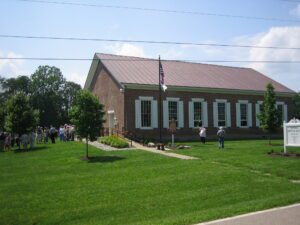
The Hopewell Associate Reformed Church and Cemetery, now known as Historic Hopewell, was founded in 1808 in a log building that was replaced in 1826 with the present building. It was built by the area’s first settlers, mainly Scotch-Irish who left Kentucky and South Carolina because of their opposition to slavery. The church encouraged worship by African Americans and played an important role in the Underground Railroad. It became the parent church for four “Daughter” Presbyterian congregations: Fairhaven in 1835, Oxford in 1837, College Corner in 1849, and Morning Sun in 1876. Reverend Alexander Porter, the first pastor, was committed to education and constructed a school near the Hopewell Spring that still produces clear water. “Old Hopewell” was completely refurbished in 1880, but by 1915 the membership declined and regular services discontinued. Today Hopewell holds Sunday services in the summer and is maintained by a generous and devoted group of volunteers.